Skip to main content
NS&I raises British Savings Bond rates again – but are they good enough?

Just one day after the Bank of England's Monetary Policy Committee (MPC) voted to keep the base rate on hold at 3.75% on 30th July 2026, National Savings & Investments (NS&I) announced another increase to the rates on its Guaranteed Growth and Guaranteed Income Bonds, also known as British Savings Bonds.
This is the third increase to these bonds this year and, given that the base rate was left unchanged, it may seem a little surprising. However, when you look at what has been happening in the wider savings market, the move makes perfect sense.
What are the new rates?
| Product | Previous interest rate (from 23rd June 2026) | New interest rate (from 31st July 2026) |
|---|---|---|
| Guaranteed Growth Bonds 1-year (Issue 91) | 4.69% gross/AER | 4.72% gross/AER |
| Guaranteed Income Bonds 1-year (issue 91) | 4.60% gross/ 4.69% AER | 4.63% gross/ 4.72% AER |
| Guaranteed Growth Bonds 2-year (issue 79) | 4.67% gross | 4.70% gross/ AER |
| Guaranteed Income Bonds 2-year (issue 79) | 4.58% gross/ 4.67%AER | 4.61% gross/ 4.70% AER |
| Guaranteed Growth Bonds 3-year (issue 81) | 4.65% gross/ AER | 4.68% gross/ AER |
| Guaranteed Income Bonds 3-year (issue 81) | 4.56% gross/ 4.65% AER | 4.59% gross/ 4.68% AER |
| Guaranteed Growth Bonds 5-year (issue 73) | 4.55% gross/ AER | 4.75% gross AER |
| Guaranteed Growth Bonds 5-year (issue 73) | 4.46% gross/ 4.55% AER | 4.65% gross/ 4.75% AER |
Why is NS&I increasing rates again?
Unlike commercial banks, NS&I has a very different objective.
Its role is to raise money for the Government in a cost-effective way, so rather than trying to get to the top of the best buy tables, it adjusts its interest rates to attract just enough money to meet its Net Financing Target; the amount NS&I needs to raise as a Government department, after allowing for withdrawals.
If too much money is flowing in, it can reduce rates. If it needs to attract more deposits, it can increase them.
Whilst the Net Financing raised for 2025/26 was £12.1 billion, so was within the leeway target for the year of plus or minus £4 billion, it was just under £1 billion less than the actual Net Financing Target of £13 billion. So perhaps NS&I realises that it needs to be more competitive to raise the funds needed, to meet the current tax years target especially given that the target is higher at £15 billion (+/- £4 billion).
Competition for savers' money has been strong this year. Fixed term bond rates have been climbing higher as banks and building societies compete for deposits, and NS&I will need to stay competitive if it wants to raise the funds it needs.
Competitive, but not market leading
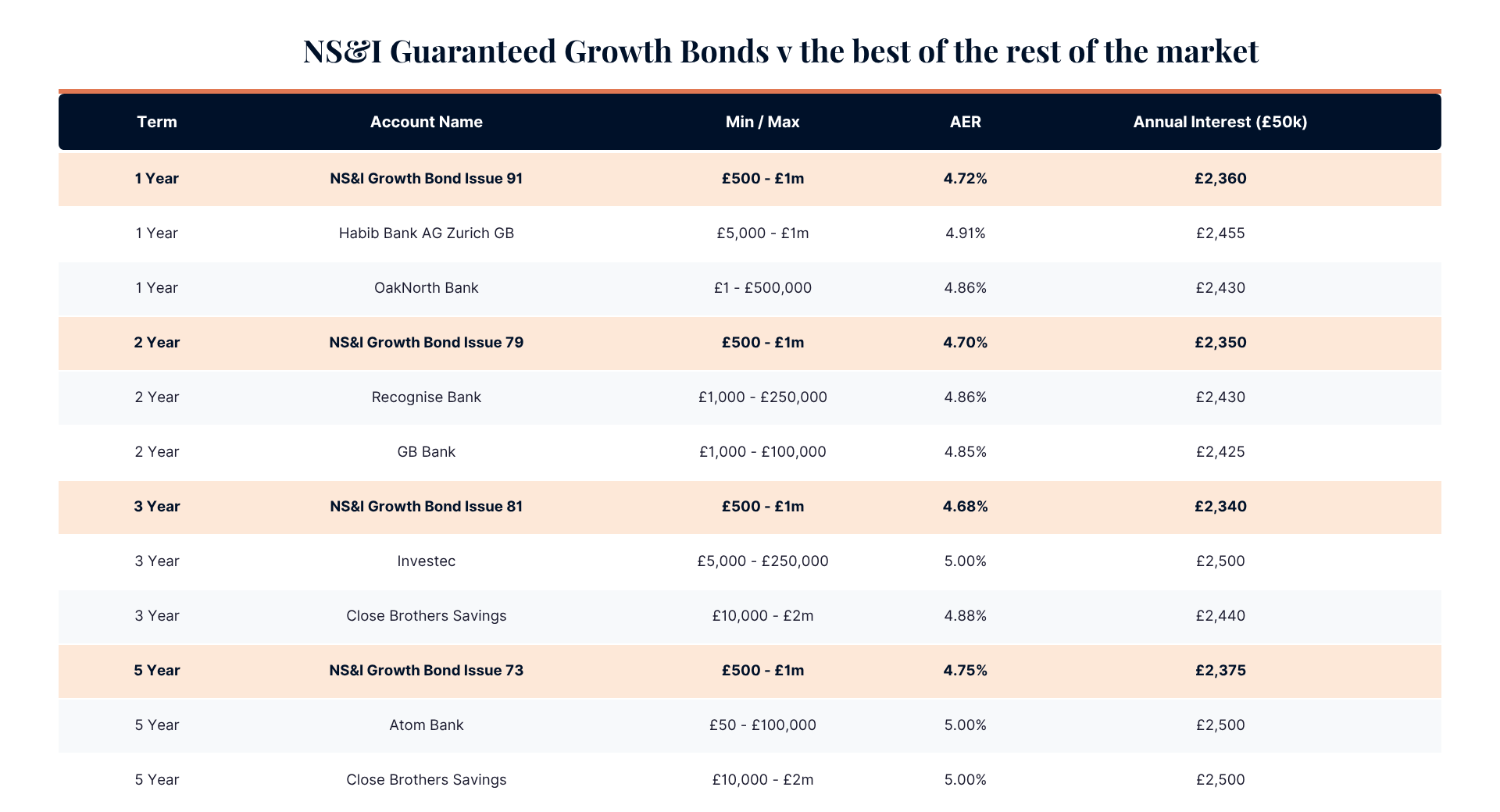
NS&I has become more competitive, but it still is not offering the highest rates available.
Of course, if it did consistently top the best buy tables, it would almost certainly attract more money than it needs, making it more expensive for the Government to borrow through NS&I than necessary.
Instead, it aims to offer rates that are attractive enough to meet its funding target without distorting the wider savings market.
The latest increases narrow the gap and make the British Savings Bonds look much more appealing, particularly when compared with many of the accounts offered by the well-known High Street banks.
However, if savers are prepared to shop around and use a provider that they are perhaps less familiar with, they can still earn higher rates elsewhere. As long as that bank or building society is part of the Financial Services Compensation Scheme (FSCS), there is no reason not to take a well-informed leap of faith in order to earn more.
Why do many savers still choose NS&I
Of course, the interest rates are only part of the story. Security is another.
Money held with banks and building societies is protected by the Financial Services Compensation Scheme (FSCS), up to £120,000 per banking licence. Whilst that level of protection is more than enough for most people, those with larger cash balances often have to spread their money across several providers to remain fully protected.
One of the biggest attractions of NS&I is the security it offers. Every penny deposited is backed by HM Treasury, giving savers an unlimited Government guarantee.
For those who don’t have the time or inclination to open multiple savings accounts, this is one of the key reasons NS&I remains so popular, even when it is not paying the very highest rates.
Should you choose NS&I?
British Savings Bonds now compare more favourably when compared to many of the products offered by the High Street banks. And they remain one of the simplest ways for those with larger cash balances to benefit from the unique HMRC protection.
But that does not necessarily mean they are the best option.
If your main objective is to maximise the interest on your savings, then the bottom line is that you can earn far more by shopping around.
For the latest rates, visit our Best Buy tables.
Arrange your free initial consultation
Rates correct 04/08/2026
This article is intended for general information only, it does not constitute individual advice and should not be used to inform financial decisions.