Skip to main content
Hunt’s politically charged budget
Hunt’s politically charged budget gives the voting public a second National Insurance cut in six months, but will it be enough to save the Tory party in the upcoming General Election?
Chancellor Jeremy Hunt delivered what could be his last Spring Budget (on 6 March 2024), with a further 2% National Insurance cut making the headlines, but there were other measures introduced which could have an impact on your finances. So, what was announced?
Arrange your free initial consultation
National Insurance
Following the 2% National Insurance reduction announced in the Autumn Statement last November, a further 2% National Insurance reduction was announced. This will again affect earnings between £12,570 and £50,270 p.a. and will take effect in April 2024 in the pre-election giveaway that was widely anticipated following speculation in the press. This will save workers up to a further £753 p.a., on top of the up to £753 p.a. saving as a result of the reduction announced in the Autumn Statement.
Child Benefit
It was announced that the High Income Child Benefit Charge (HICBC) will be replaced by a household income based system in April 2026 following a consultation. In the meantime, from April 2024 the threshold above which the HICBC starts to apply on a tapered basis will increase from £50,000 to £60,000 and the top of the taper will increase from £60,000 to £80,000 in a move that Mr Hunt will hope will please working families.
Savings/Investments
Following speculation prior to the Autumn Statement, a British ISA was announced. This will be a further £5,000 tax free ISA allowance for investments into British companies, which will be available in addition to the standard £20,000 ISA allowance.
A new British Savings Bond will also be made available through National Savings and Investments (NS&I), which will offer a fixed rate over three years, though the rate payable has not been announced.
Pensions
Regarding the lifetime allowance, currently 0% and due to be scrapped in April 2024, there were no further changes announced. However, Mr Hunt did not miss the opportunity to reference Labour’s plans to reintroduce the allowance, stating “Ask any Doctor what they think about Labour’s plans to bring it back, and they will say “don’t go back to square one'.”
There were also new rules announced requiring Defined Contribution and Local Government pension funds to disclose how much UK equity exposure they have relative to their international equity exposure. This could prove controversial given the funds’ mandates will be to produce the best risk adjusted return they can for investors, irrespective of their asset allocation.
Property
It was announced that higher rate Capital Gains Tax (CGT) rates on property sales will be reduced from 28% to 24% in April 2024, in a move that the government claims will be revenue generating. The Furnished Holiday Lettings (FHLs) regime will also be abolished.
‘Non-doms’
The current ‘non-dom’ rules, a tax advantageous regime for those who are non-UK domiciled (their ‘permanent home’ is outside the UK), will be replaced by a residency based system from 2025.
Inheritance Tax
After strong rumours that Inheritance Tax would be scrapped before last year’s Autumn Statement, it was not mentioned in the Chancellor’s budget statement.
Conclusion
In what was always going to be a politically charged speech given the proximity to the general election, Chancellor Jeremy Hunt will hope he has done enough to convince voters to give the Conservative Party another term in office in his Spring Budget. In what the Labour Party leader Keir Starmer described as a ‘Last Desperate Act’; the speech was filled with warnings about the potential implications of a future Labour government (the budget speech transcript on the gov.uk website has ‘political content removed’ 27 times!).
However, workers, families, those selling second homes and those already benefitting from last year’s Lifetime Allowance changes may see themselves as in a better position than they were previously, and they could see a future Labour Government as a risk to the longevity of the recently announced changes.
If this is to be the case, there could be a limited opportunity to plan over the next few months. So now is the time to seek advice, to make sure you are doing all you can to protect you and your family’s wealth. If you'd like to learn more about how you can minimise the amount of tax you pay on your wealth, why not get in touch and speak to one of our experts for a free initial consultation or please speak to your adviser if you would like to discuss any of the changes detailed above.
This article is intended for general information only, it does not constitute individual advice and should not be used to inform financial decisions.
The opinions shared in this article are solely those of the individual and they do not necessarily reflect those of The Private Office.
The Financial Conduct Authority (FCA) does not regulate tax advice.
Arrange your free initial consultation

Don’t let redundancy derail your retirement
Following the first Labour Budget in 14 years, and repeated warnings from the Prime Minister Sir Keir Starmer that it would be ‘painful’, many companies have been reviewing financial decisions in an attempt to mitigate the fallout.
Higher employment costs have become part of the backdrop for many UK employers, adding further pressure at a time when businesses are already reviewing hiring, investment and workforce plans.
At the same time, widespread disruption from AI adoption has led to restructuring across sectors, with many firms announcing redundancies as they adapt to new technologies and changing workforce needs. This was seen in the likes of Oracle whose workforce fell by around 21,000 employees in its 2026 financial year, a reduction Reuters said was partly linked to AI adoption. Meta has also been reshaping its workforce around AI, with reported plans to cut around 10% of employees, close to 8,000 people, while moving 7,000 employees into AI related roles.
The combined uncertainty of fiscal policy and technological transformation has contributed to a cautious corporate environment.
Arrange your free initial consultation
The recent and ongoing events in the political and economic worlds should all serve as a reminder of the fragility of employment and the importance of having a financial plan in place, as this can provide peace of mind and some breathing room if you were to become unemployed.
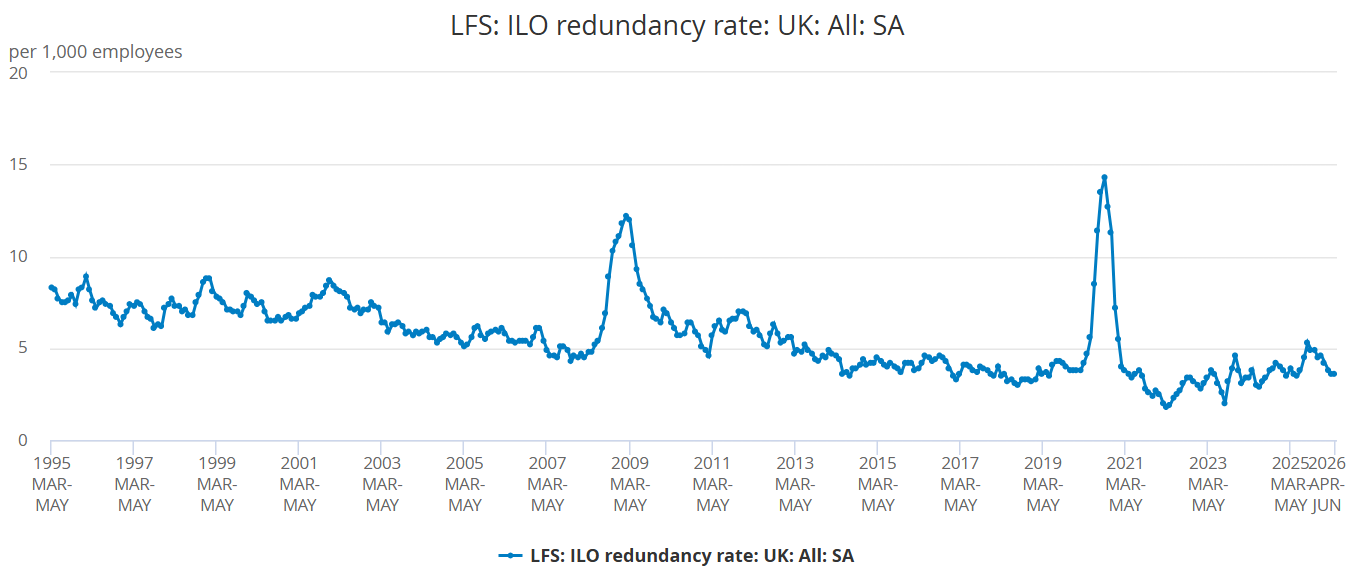
Figure 1 - UK Redundancy Rate, Source: LFS: ILO redundancy rate: UK, 2026
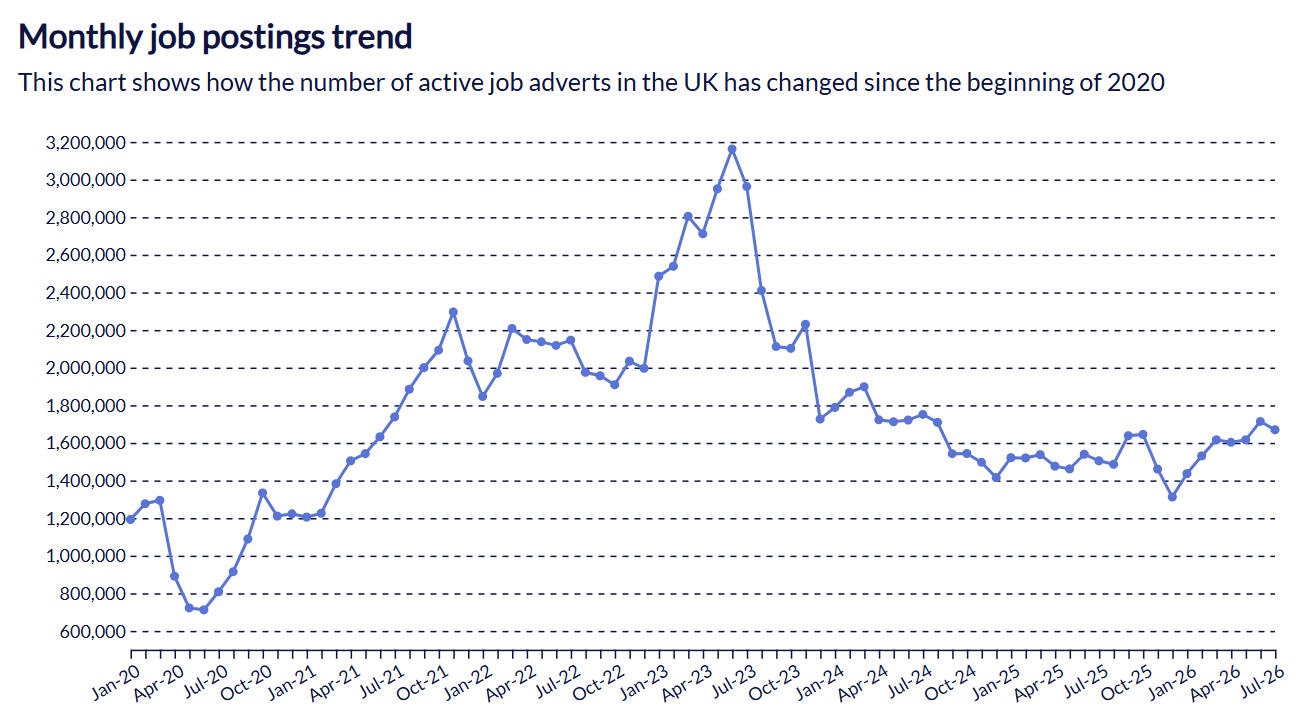
Figure 2 - Monthly job posting trends, Source: Labour Market Tracker: The REC, June 2026
How to help avoid your financial plan being derailed by redundancy
Cash emergency fund
A part of any financial plan needs to include a substantial emergency cash reserve, to ensure you are not immediately impacted by any shocks such as redundancy. As a general guide, an emergency cash fund would typically be between three and twelve months of essential expenditure. We spend significant time with clients, using cash flow modelling, to provide answers around the size of your cash fund and how to build this buffer.
In turn using cash flow modelling and sticking to a financial plan, built with your adviser, you should have the comfort and reassurance that if a shock such as redundancy were to occur, you have built savings and investments to sustain you during such a period.
When you are made redundant
Although redundancy is a shock to your financial plans and typically seen as a negative, it can also present an opportunity for those approaching retirement.
One of the opportunities which may present itself is to make use of your redundancy payment as a contribution into your pension up to your annual allowance or carry forward allowance, where available. The standard annual allowance remains £60,000 for the 2026/27 tax year, although it may be lower for some higher earners or those who have already accessed defined contribution pension savings flexibly. If you are close to retirement, it is an effective way of increasing the value of your pension pot with tax relief, before you potentially look to draw on it, in a tax efficient manner.
In some cases, redundancy can actually open the door to an earlier retirement than previously planned. If you have already built up a solid financial base, including pensions, ISAs, general investments, or property, a significant redundancy payout, may mean that a phased or full retirement becomes feasible. With the right planning and advice, it’s possible to assess whether your financial assets, along with your redundancy payment, could fund your lifestyle without the need to return to work.
For those who are younger when they experience redundancy, during the critical ‘accumulation’ stage of the financial plan, redundancy can point to the importance of having a financial plan and initiating these conversations with an adviser. Furthermore, typically those who are made redundant and are able to find new employment fairly quickly, there is an opportunity to implement a new refreshed financial plan to protect against any future shocks, which once again can be modelled within cash flow.
Remember, a drop or complete stop in both your and your employer’s pension contributions could seriously affect your financial plans, not least if this also includes a stop on any other benefits you may have received from your employer, such as a company car, phone or health benefits that may need to be replaced.
So, it’s really important you take the opportunity to step back and re-evaluate the financial plans you have for the future, especially if you don’t get back into employment fairly quickly.
Redundancy payment
A redundancy payment is treated as taxable income over the £30,000 tax free allowance. This payment can therefore provide an amount to protect the employee from any initial cash flow problems. In terms of options for this payment there are many. As mentioned above you could contribute to your pension, which is especially tax efficient for those approaching retirement at the point of redundancy. However, there are other options as well. For instance:
- Make an overpayment or pay off a mortgage. This is a potential option to make your wider situation more secure and provide some additional comfort in a time of uncertainty.
- Hold the payment in cash accounts and draw on the money where appropriate to ensure you remain stable. This means ensuring your cash is earning the best interest is critical, particularly with top easy access savings accounts still offering rates of up to 5% AER as of September 2026. Please see our Best Buy Tables.
It is important to note that the first £30,000 tax free limit usually applies to genuine redundancy or severance payments. Other elements of a termination package, such as unpaid salary, holiday pay, bonuses or payment in lieu of notice, are normally taxed as earnings. Statutory redundancy pay is also capped, with the maximum statutory redundancy payment in Great Britain currently £22,530 from 6 April 2026.
The benefit of receiving advice
Conducted by one of our experienced financial planners, cash flow modelling provides you with clarity on your current financial position and what it might mean for the future.
It simply lays out all of your income and expenditure to map out your financial future. The earlier you seek advice and begin implementing a plan the more robust your situation may be when trying to ride out any financial shocks such as redundancy. Having a clear plan with your finances is proven to be beneficial in the long run, and with our clients at TPO we utilise cash flow modelling to give them the comfort in case of redundancy or any other similar financial shock.
If you’d like to speak to an independent financial adviser about your own personal financial plans, whether you’re concerned about redundancies or not, then why not get in touch. We can map out your financial future so you have the confidence that your wealth will last you for as long as you need it.
Arrange your free initial consultation
The financial conduct authority (FCA) does not regulate cash flow planning.
Investment returns are not guaranteed and you may get back less than you originally invested.
Past performance is not a guide to future returns.

New pension opportunities, but you may need to act fast!
In the 2023 Spring Budget, Chancellor of the Exchequer Jeremy Hunt took many by surprise with his chosen policy changes, particularly in regard to pension allowances. Not only was the Annual Allowance increased from £40,000 to £60,000 and the more restrictive Tapered Annual Allowance increased from £4,000 to £10,000, but it was also announced that the Lifetime Allowance would be abolished.
Consequently, and taking into account a looming election and possible change of government, now could be an opportune time to consider whether you are aiming to maximise your pension contributions prior to the end of the current tax year to take advantage of these tax benefits.
Arrange your free initial consultation
What is the Annual Allowance?
The annual allowance is the maximum amount of pension savings an individual can make each tax year without an annual allowance allowance charge applying.
As noted above, from the start of the current tax year, the annual allowance was increased to £60,000, and you can receive tax relief on your personal contributions up to 100% of your relevant UK earnings (including salary, bonuses, commission).
However, high earners could be subjected to a tapered annual allowance, which gradually reduces their annual allowance to a minimum of £10,000 for those with taxable income over £260,000.
Personal pension contributions are eligible for tax relief at an individual’s marginal rate of income tax. This means that a basic rate taxpayer will receive a 20% uplift on the money they contribute to their pension. A higher or additional rate taxpayer can then also claim an additional 20% or 25% via their self-assessment tax form, resulting in an overall potential tax saving of 40% or 45%!
Employer or Company contributions are also paid gross and can receive corporation tax relief as a business expense.
What is ‘Carry Forward’ and does it apply to me?
Unlike with an ISA, whereby if you do not contribute the full ISA allowance of £20,000 by the 5th of April in a given tax year then this unused allowance is lost forever, this rule does not apply to pensions. The Government introduced the carry forward rules in April 2011, allowing individuals to utilise any unused pension annual allowance from the previous three tax years.
Those with a tapered annual allowance can also still use carry forward if they have any unused annual allowances remaining in previous three tax years.
In order to carry forward any unused annual allowance from these tax years, you must:
- Be a member of a UK-registered pension scheme and had a qualifying pension (this does not include the state pension) since the 2020/21 tax year.
- Have used up your entire annual allowance in the current tax year.
- Have remaining unused annual allowance in previous tax years.
- Have sufficient relevant UK earnings in the current tax year for a personal contribution.
Lifetime Allowance & Transitional Protections
Due to the tax advantages of making pension contributions, the Government previously placed a limit on the amount of pension benefits an individual could accumulate over their lifetime, without incurring a tax charge. This tax charge is known as the Lifetime Allowance (LTA) charge and applied to individuals with pensions valued over £1,073,100.
However, with the UK Government announcing that the LTA charge would be removed from 6 April 2023 and then the LTA abolished from 6 April 2024, this means there is an opportunity for those who are near to or who have exceeded the £1,073,100 threshold to consider recommencing pension contributions.
Historically, the Government has provided individuals with the opportunity to apply to protect their LTA before any changes in legislation. Certain types of transitional protection were introduced with the stipulation that you could no longer make any further pension contributions, but this restriction was then also lifted for those with existing protection before 15 March 2023.
Therefore, this has presented another potential opportunity, as those previously unable to make any contributions due to the risk of losing their protection, may have a significant level of unused annual allowance from previous tax years.
Use it or lose it
With wage growth reaching 7.3% for the period between August to October 2023 (according to the ONS), the tax band freeze means people are technically paying more income tax than ever before. Therefore, it would be prudent to look for ways to maximise the tax-efficient legalisation currently on offer.
Aside from the fact that any unused annual allowance from the 2020/21 tax year will be lost after 5th April 2024, there is no predicting if or when changes will be made again to this legislation. It seems as if the UK population collectively hold their breath at the sign of any Budgets which have seen a vast array of changes to pension rules over the years.
Whilst the most recent changes were positive for pension savers, it is important to consider the implications of the impending election in the next 6-12 months; if there is a change in government then this policy change could be reversed. With that and all the above in mind, it is worth exploring your options and taking appropriate action concerning your carry forward allowance; use it before you lose it!
Pensions can be a complicated and daunting matter to navigate, from obtaining the relevant information from your pension providers to a thorough understanding of ever-changing UK legislation. Therefore, please do reach out to a financial adviser if you would like help making the best use of your savings and pension allowances.
Arrange your free initial consultation
This article is intended for general information only, it does not constitute individual advice and should not be used to inform financial decisions.
A pension is a long-term investment. The value of an investment and the income from it could go down as well as up. The return at the end of the investment period is not guaranteed and you may get back less than you originally invested.
The Financial Conduct Authority (FCA) does not regulate tax advice.

The importance of Cash
There’s no getting away from it, costs have risen exponentially. With a growing cost of living crisis throughout the country, the need for cash retention to act as a buffer in these circumstances remains vital for everyone. This increase in costs will likely mean most people will need to try and save money where they can. Nevertheless, while cash is a crucial component of a well-rounded financial strategy, it's essential to strike a balance. Allocating too much cash for an extended period could expose your wealth to inflation risk, where the purchasing power of your money will decrease over time. It is therefore imperative to assess your overall financial goals, time horizon and risk appetite when deciding how much to keep in cash versus how much to invest in other assets.
There are many reasons to hold money in cash, so we look to explore the importance of cash and its inherent benefits within personal finance, whilst also considering the common risks associated with cash investments. Of course, managing your savings is a highly personalised process, and how much you save should reflect your individual circumstances.
Arrange your free initial consultation
Emergency Fund
The term ‘emergency fund’ or ‘buffer’ refers to money set aside for the sole purpose of being used in times of financial distress. The fund provides a financial safety net to cover any unexpected, and typically costly, expenses that may arise such as those following a loss of job or unexpected tax bill. The amount you should target for an emergency fund depends on a number of factors, including your financial situation, expenses, lifestyle, and debts. Typically, consideration may be given between three to six months of normal expenditure in cash, to be drawn from in the event of an emergency. This is considered a prudent financial practice because it helps avoid unnecessary debt and financial stress.
Top Tip: Starting off small is better than not starting at all!
The Stock Market
While investing in the stock market offers great potential opportunities for accumulating wealth and financial growth, it is important to be aware of the fundamental downsides and risks, and striking the right balance between investments and cash has proven particularly relevant over the past few years with investment markets going through a turbulent time.
Although investors are attracted to the idea of growing their wealth through stock market investments, this should always be looked at as a long-term strategy given the risks associated.
Up until November 2021, there were very few options for your lower risk portion of your wealth, as interest rates were extremely low. However, since the recent interest rate hikes many investors are turning their attention towards setting aside some cash into savings account and are benefiting from some of the highest returns in almost two decades. Unsurprisingly, the last few years have witnessed huge inflows of cash into savings, particularly fixed time deposits, with investors looking elsewhere from the stock market in providing safer and guaranteed returns.
Nonetheless, whilst saving rates have risen, cash has been a depreciating asset, after inflation, with ‘real returns’, remaining negative over the long term. So, for many, it is fundamental to have a comprehensive financial plan in place, to ensure your investment and cash allocations are aligned to meet your objectives and goals.
When it comes to investing, however, one particular benefit of holding some money in cash is managing sequencing risk with your investments. This refers to the impact of the timing of investment returns on a portfolio, particularly when withdrawals are made. If an investor needs to sell assets to cover income or emergency expenses, this can significantly affect the overall portfolio value. As such, the benefit of holding some money in cash is that you help reduce the chances of becoming a forced seller during an investment market downturn. By having this safety measure in place, you can help cover some expected or unexpected expenditure without negatively impacting your long-term investment strategy.
If you are interested in exploring what savings accounts have to offer, please check out our best buy tables, which compares the best accounts on the market.
Retirement
Holding cash as you approach retirement plays a vital role in providing financial flexibility, security and peace of mind when we consider aforementioned risks with invested pension provisions.
As we have covered, sequencing risk can be a major issue for investors. This risk is more common during retirement, as you are far more dependent on your retirement income through your invested pension pots. Significant market downturns alongside taking pension income could be detrimental on your long-term retirement goals, where cash reserves are not in place, as you could be realising losses that could impact the value of your future pension provisions.
Furthermore, healthcare costs are increasingly forming a large part of unexpected costs during retirement. Health spending per person steeply increases after the age of 50, so having cash buffers in place to cover immediate healthcare needs is important.
Using cash in place of drawing from your pension can also have tax benefits, as some pensions sit outside the scope of inheritance tax. This means that the assets held within a pension fund may not be subject to inheritance tax when passed on to beneficiaries. However, given the complexity of inheritance tax laws, it is recommended to seek advice from professionals who have the expertise to guide you through your estate and pension planning.
If you’d like to learn more about how cash can best play a part in your wealth strategy, why not get in touch and speak to one of our experts.
Arrange your free initial consultation
This article is intended for general information only, it does not constitute individual advice and should not be used to inform financial decisions.
Investment returns are not guaranteed, and you may get back less than you originally invested. Past performance is not a guide to future returns.
The Financial Conduct Authority (FCA) does not regulate cash flow planning, estate planning or tax advice.
Savings Champion and their associated services are not regulated by the Financial Conduct Authority (FCA).
Are you overcontributing to your pension?
When building up your pension it is important to be conscious of what limits apply in order to maximise the full tax benefits.
Thousands of people across the UK are experiencing tax charges for overcontributing to their pensions and most don’t even realise. According to HMRC over 50,000 people reported pension contributions that exceeded their ‘Annual Allowance’ (AA) in 2021-2022. This number has been skyrocketing since 2010 and has increased by 10,000 people since 2020-2021, when only approximately 40,000 exceeded their Allowance (Please see chart below).
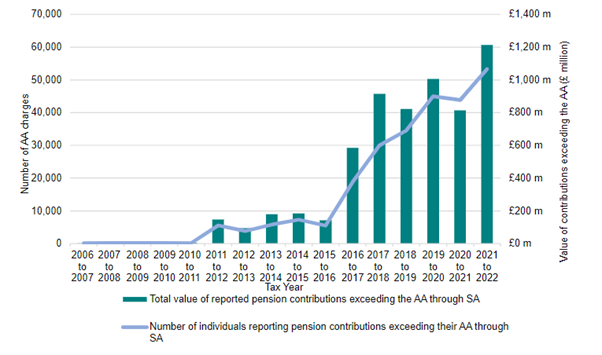
Figure 1. Number of individuals and value of pension contributions exceeding the AA reported through SA 2006 to 2007 to 2021 to 2022, Source: UK Government
Often people don’t even realise that they are overcontributing until it is too late. So, why are so many people being caught out?
Arrange your free initial consultation
What is an Annual Allowance?
Although there is not a limit on the amount that can be saved into pensions each year, there is a limit on the amount that can benefit from tax relief each tax year. An individuals ‘Annual Allowance’ is the limit that you can contribute to your pension in any tax year whilst benefiting from tax relief. The current annual allowance is £60,000, however, you can only receive tax relief up until your net relevant earnings. Net relevant earnings are the total earnings from salary, bonuses, benefits in kind and trading profits for self-employed individuals in a tax year. So, if your salary is £40,000 for example, you would only receive tax relief up to £40,000, but if it is £80,000, in most cases, you would only receive tax relief up to £60,000 in one tax year.
What if I exceed my Annual Allowance?
If you exceed this allowance in a tax year, any contributions above the limit will typically be subject to an annual allowance tax charge. This excess will be added to your taxable income and be subject to income tax at your marginal rate. In some cases, you might be able to ask your pension scheme to pay the charge from your pension. This is known as Scheme Pays and means your pension would be reduced, but this is not always possible.
Why are people overcontributing?
Although the annual allowance sounds straightforward, there are some caveats that make understanding it a lot more complex. Where your net relevant earnings are more than £60,000 a year and have been a member of a registered pension scheme for more than three years, you may have the ability to use carry forward allowances. If you have not used your full annual allowance from any of the previous three tax years, you can carry this allowance over to the current tax year. This can cause confusion and miscalculations regarding exactly how much more an individual can contribute using carry forward.
Those who have a high income are also subject to more complex rules with regards to their annual allowance. For every £2 of adjusted income (i.e. total taxable income before any Personal Allowances and less certain tax reliefs) that an individual earns over £260,000 their annual allowance is reduced by £1, to a minimum of £10,000. This means that anyone with an income of £360,000 or more has a reduced annual allowance of £10,000.
Another caveat that trips people up is that, in some cases, the annual allowance reduces to £10,000 per tax year when an individual begins drawing down or withdrawing from their pension. This is often triggered for those who are flexibly accessing a defined contribution scheme. It is worth noting this is not the case for all withdrawals, for example when taking a Pension Commencement Lump Sum (PCLS) or annuity. When this reduced allowance comes into effect, carry over cannot be utilised anymore. This can often catch people out and cause them to overcontribute because they think they have more allowance than they do.
It is also worth remembering your annual allowance takes into consideration all contributions to all of your private pension schemes. Therefore, it is not only your personal contributions that count towards the annual allowance, but your employer contributions as well. For those who are fortunate enough to have a Defined Benefit (DB) scheme, otherwise known as a final salary scheme i.e., a pension that traditionally pays out a guaranteed income every year in retirement, calculating the remaining annual allowance is more complex. Any further accrual in a Defined Benefit scheme in a tax year contributes to the annual allowance. These additional complexities make calculating the annual allowance year on year more difficult to understand. As a result, many people find themselves overcontributing and incurring a tax charge without even realising.
Taxation on pension funds has become a hot topic since the 2023 Spring Budget announcement about the intention to remove the ‘Lifetime Allowance (LTA)’. The LTA is the total contributions that one can make to a pension over their lifetime without incurring certain tax charges. Those who weren’t overcontributing prior to this, for fear of exceeding the LTA, have more incentive to re-commence contributions. However, with a general election expected in the autumn of 2024, these changes could be reversed.
If you’re concerned, we can help. With more people than ever exceeding the annual allowance, it is important to be aware of the many factors that need to be considered when calculating how much you should be contributing to a pension. If you have any questions about the annual allowance, or think you might be at risk of a tax charge due to miscalculations; then please get in touch with your Financial Adviser or consider seeking advice.
Arrange your free initial consultation
This article is intended for general information only, it does not constitute individual advice and should not be used to inform financial decisions.
The information in this article is based on current laws and regulations which are subject to change as at future legislations.
A pension is a long-term investment. The value of an investment and the income from it could go down as well as up. The return at the end of the investment period is not guaranteed and you may get back less than you originally invested.
The Financial Conduct Authority (FCA) does not regulate tax advice.

How to make your child a millionaire before 40!
Most parents would like to ensure their children have a strong financial footing when they are older, but don’t always know the best way to do this. There are many ways to support your children financially throughout their lifetime, but what if there was a way to make them a millionaire before they even reached retirement age? Here we look at the best ways to put money aside for your children and how you can maximise the benefits of compound interest to make your child a “millionaire”!
Arrange your free initial consultation
The first step to saving for your children’s future is understanding your saving options. Here are the most common options that benefit from tax-free growth:
Junior ISA(JISA)
From the day a child is born you can put money into a JISA for them. The current contribution limit is £9,000 per tax year (or £750 per month) and you have the choice of a Junior Investment ISA or a Junior Cash ISA. The most important benefit of a JISA is that any gains made, or interest earned will be tax-free!
If we assume you receive an average annual net return of 5% per year and you save the maximum of £9,000 every tax year, from the day your child is born until they turn 18, you will have contributed a total of £162,000 to their account. However, due to the magic of compound interest (where you earn interest on interest), they will have a pot of over £265,000 saved in a tax-efficient wrapper, what a great 18th birthday present!
At their 18th birthday they can transfer their JISA into an Adult ISA to continue to receive tax-free interest/ investment returns.
Junior Self-Invested Personal Pension (Junior SIPP)
Setting up a pension up for your children may seem like you are overly preparing but this can actually give your children a significant head start. The maximum you can currently save into a Junior SIPP is £2,880 per tax year, and the UK government will add tax 20% tax relief of £720 per tax year, which would bring the total contribution to £3,600. If you can contribute to your child’s Junior SIPP for 18 years and again assuming a 5% growth rate, you will have contributed £51,840 but their pension pot will be worth £106,340 due to the added tax relief. If your child doesn’t contribute to the pension again, by age 57* they could have a pension pot worth around £712,986. Similar to the JISA, any gains made within the SIPP are exempt from tax, and based on current pension rules, you can take up to 25% as a tax-free lump sum upon reaching retirement age.
Recent statistics released by the Office for National Statistics (ONS) stated how the average pension wealth for all persons in the UK is £67,800 at age 57*, highlighting how starting to save early can set your child up for their future and give them a greater opportunity in retirement or even to retire early.
How to make your child a millionaire!
And this is how to do it! If you do the following and assume a 5% growth rate per annum:
- Open a JISA before your child’s first birthday and contribute £9,000 every year until age 18. This results in a total contribution of £162,000 (18 years x £9,000).
- Open a Junior SIPP before your child’s first birthday and contribute £3,600 (including tax relief) to the Junior SIPP every year up to their 18th birthday. This totals 18 years x £2,880 (or £3,600 with tax relief) which equals £51,840 (£64,800)
This would mean you will have contributed a total of £226,800 (including tax relief) to the JISA (£162,000), and Junior SIPP (£64,800). At age 18 when you stop contributing, they could have a total net worth of £372,191 when taking into account compound interest and growth. If they leave this money invested and continue to achieve 5% per year growth, by age 39 they could have a total net worth of just over £1million (£1,036,911), although the funds in the pension would not be accessible until age 57*.
At that point the pension fund could have grown to £712,986, while the ISA, could be worth £1,782,465 if it remained untouched too - an extraordinary total of almost £2.5m. That is a gift worth giving.
The power of starting to save early
Using the same assumptions as above, with a 5% annual growth rate and maximising both Junior SIPP and JISA contributions until age 18:
| Starting from date of birth | Starting at age 5 | Starting at age 10 | |
|---|---|---|---|
| JISA Value at age 30 | £477,430 | £300,604 | £162,056 |
| Junior SIPP value at age 30 | £190,972 | £120,242 | £64,823 |
| Total Value at age 30 | £668,402 | £420,846 | £226,879 |
This shows the benefits you can provide by starting the process of saving early for your child through compounding the interest or investment returns. This is a representation of how you can save for your children and assumes maximum contributions are made at each birthday, but we understand the circumstances for each parent and child will be different and may require different forms of financial planning, such as monthly contributions instead of lump sums.
Despite the examples above, it is never too late to start. If you would like to understand how, The Private Office can structure savings and investments for you and your children to help provide the whole family with a strong financial future. So why not get in touch for a free initial consultation.
* Based on current pension regulation, where the normal minimum pension age is increasing to age 57 from April 2028.
If you would like to know more about this topic, one of our Partners Kirsty Stone appeared on BBC Radio 4 Money Box live, giving her suggestions in a programme all about saving for children.
Arrange your free initial consultation
This article is intended for general information only, it does not constitute individual advice and should not be used to inform financial decisions.
All the calculations in this article assume that lump sum contributions are made for 18 years, from birth, unless otherwise stated, to the 17th birthday and are not adjusted for inflation.
The Financial Conduct Authority (FCA) does not regulate tax or cash advice.
The growth rates provided are for illustrative purposes only. Investment returns can fall as well as rise and are not guaranteed. You may get back less than you originally invested. Investments may be subject to advice fees and product charges which will impact the overall level of return you achieve.

Autumn Statement – what the announcements mean for your finances
Chancellor Jeremy Hunt promised to ‘reduce debt, cut taxes and reward work’ in his ‘Autumn Statement for growth’, but what might the changes he announced mean for your personal finances?
In the lead up to the Autumn Statement, we discussed the changes that were rumoured to have been announced in this article.
Arrange your free initial consultation
These speculated changes included:
- Reducing Inheritance tax
- Announcing an additional ISA allowance for investment into UK companies
- Changing the state pension triple lock calculation to limit next year’s state pension increase
In the end, none of these changes were introduced, with shadow chancellor Rachel Reeves claiming Hunt wanted to reduce inheritance tax but that he “couldn’t get away with it in the middle of a cost of living crisis”. Instead, the headline grabbing change was the 2% reduction to employee national insurance contributions between £12,571 and £50,271. This will equate to an annual saving of c. £754 p.a. to those earning over £50,270 p.a. with effect from January 2024. Additionally, there were National Insurance reductions for the self-employed, with Class 2 contributions effectively abolished and Class 4 contributions reduced from 9% to 8% between £12,571 and £50,271 with effect from April 2024.
However, this will only go part of the way to make up for the impact of the continued freezing of the income tax bands, which will remain frozen until 2028. Indeed, as a result of higher inflation, higher interest rates and frozen tax bands, the Office for Budget Responsibility (OBR) states “Living standards, as measured by real household disposable income per person, are forecast to be 3.5 per cent lower in 2024-25 than their pre-pandemic level.”
Separately, the speculated ISA allowance increase for investments into UK companies did not materialise and pensioners will be pleased to hear Mr Hunt state the government will “honour our commitment in full” as the state pension rises by 8.5% next year.
Regarding pensions, workers will hope a new legal right for their new employer to pay into their previous defined contribution pension scheme will simplify pension planning going forward and will mean an end to the accumulation of multiple schemes as individuals move between companies.
This was an Autumn Statement with half an eye on an upcoming general election, with announcements that should put more money in the pockets of workers and pensioners alike. Mr Hunt repeatedly referred to the OBR’s forecasts during his announcement as he tried to rebuild credibility, a little over a year after Liz Truss and Kwasi Kwarteng’s ‘mini-budget’, prior to which the OBR was not asked to run forecasts. Overall, Mr Hunt will have been grateful that he was able to use some of the fiscal headroom provided by then Chancellor, now Prime Minister, Rishi Sunak’s decision to freeze income tax bands back in 2021 to offer a national insurance cut and significant state pension rise to the voting public.
Arrange your free initial consultation
The opinions shared in this article are solely those of the individual and they do not necessarily reflect those of The Private Office.
Do I need pension financial advice?
Navigating pension planning can be complex and often presents a variety of questions. Reaching retirement can be an exciting prospect after a long time working, but also, for many, can be a nerve-wracking time, demanding careful consideration to ensure you have financial security throughout retirement. With several options, strict regulation and variables to contemplate, it’s important to get it right.
Arrange your free initial consultation
Why do I need a financial adviser for my pension?
Your pension can be the largest investment you ever make, but they are complex, with various types of schemes, so it’s important to understand what you have, and how you can use this to meet your goals and individual objectives. Working with a financial adviser can help to work through the jargon and ensure that you can maximise your pension wealth both now and into the future. An adviser can help you manage any risk you take within your pension, as well as get a clearer understanding of tax efficiencies to give you the best opportunity of reaching your retirement goals.
When is a financial adviser for my pension required by law?
In most cases, it’s a choice whether you take pension financial advice, however, there are a few exceptions which vary depending on the type of pension you hold.
There are two types of pensions; defined benefit pensions (also known as a final salary scheme, but also include public sector schemes for example Career Average Revalued Earnings, or CARE) and defined contribution pensions. A defined benefit pension pays a secure income for life, based on a number of factors including years' service and position held at your place of work. A defined contribution scheme (which is the more common these days) can be a private or work-based pension, with the amount you receive from your pension based on the total amount contributed by retirement.
If you are considering transferring, or cashing in, a defined benefit pension, you are legally required to seek financial advice when the transfer value is over £30,000. Defined benefit pensions are hugely valuable, providing a guaranteed income for life, therefore it’s vital that you make the correct decision with these types of pensions. The regulator, the Financial Conduct Authority (FCA), requires you to take financial advice to safeguard you from making poor decisions. As this area of advice is complex, it does usually carry a high adviser charge to explore the various options available to you.
In some circumstances, defined contribution pensions may require you to take advice. If you have a pension that has a Guaranteed Annuity Rate (GAR) or guaranteed minimum pension that you’d like to transfer and these benefits are valued at over £30,000, you must legally take advice to protect you from making an irreversible decision that negatively impacts your financial future.
Defined contribution pensions, sometimes also known as money purchase pensions, can also come with a variety of weird and wonderful benefits, which include safeguarded benefits as outlined above, which may mean you legally must seek financial advice. Within defined contribution pensions, you build up an investment pot which you are then able to access from normal minimum retirement age, which is currently 55, but rising to 57 by April 2028. At this age, you can draw on your pension flexibly, with 25% tax free and the remaining 75% taxable at your marginal rate. You can draw the full 25% as one lump sum, or a smaller amount at a time until used up, draw a lump sum payment, known as UFPLS (uncrystallised fund pension lump sum) of which 25% is tax free, and 75% taxable. These rules are known as Pension Freedoms rules and were brought in back in 2015. It’s worth noting however, that just because these rules apply now, doesn’t mean your pensions allow for this, so it is worth finding out.
Understanding the Rules
Within defined contribution pensions, you build up an investment pot which you are then able to access from normal minimum pension age, which is currently 55, but rising to 57 from 6 April 2028. At this age, you can draw on your pension flexibly, with up to 25% usually available tax free, subject to the lump sum allowance, and the remaining withdrawals taxable at your marginal rate. The standard lump sum allowance is currently £268,275, although some people may have a higher protected allowance. You can draw the full 25% as one lump sum, or a smaller amount at a time until used up. You may also be able to take lump sum payments known as UFPLS, or uncrystallised funds pension lump sums. With UFPLS, 25% of each payment is usually tax free and 75% is taxable as income. These rules are known as Pension Freedoms rules and were brought in back in 2015. It’s worth noting however, that just because these rules apply now, doesn’t mean your pensions allow for this, so it is worth finding out.
Do I need a financial adviser to withdraw from my pension?
Although there is no legal requirement to take pension financial advice when withdrawing money from your pension, it is often prudent to do so. Pensions can be used extremely efficiently to fund retirement, although it does depend on what options you have available to you. As mentioned above, Pension Freedoms rules came into force in April 2015, meaning you can access your pension flexibly, as and when you want to. Not all schemes had to adopt these rules however, so making sure your pensions are structured correctly before you draw on them can really impact your retirement plans.
When you reach retirement, you move from the saving phase of life to the spending phase, accumulation to decumulation, and so it’s important to know how much you have, and how best to draw on your assets efficiently to maximise what you have. A financial adviser can help with this by building a retirement plan for you, using such tools as cash flow planning, making sure you can meet your goals throughout retirement. Understanding what you have, and how you can best use each asset comes down to the options you have for these, and a financial adviser can help you to understand this. A big worry for many is the thought of running out of money, and cash flow planning can alleviate these fears by showing what is possible now and in the future.
Can I withdraw my private pension before 55?
In most cases, you cannot withdraw money from a private pension before age 55 without facing significant tax charges. This age is known as the normal minimum pension age and it is due to rise to 57 from 6 April 2028. There are limited exceptions, such as serious ill health or a protected pension age within your scheme, but these rules can be complex. You should also be cautious of anyone suggesting you can access your pension early through a loan, loophole or special arrangement, as this can be a sign of a pension scam.
When can I withdraw my pension?
Most people can start withdrawing from a private pension from age 55, rising to 57 from 6 April 2028, as mentioned above. This does not mean you have to take your pension at that age. You can usually leave it invested until you need it, which may give your pension more time to grow. Your options will depend on the type of pension you have and the rules of your scheme, so it is important to understand what is available before you decide when to take money out.
Can I withdraw my pension fund while working?
Yes, you can usually withdraw money from your pension while continuing to work, provided you have reached the minimum pension age and your scheme allows it. This can be useful if you want to reduce your hours or phase into retirement, but taking taxable pension income while you are still earning can push you into a higher tax band. It may also trigger the Money Purchase Annual Allowance, which can reduce the amount you can contribute to defined contribution pensions while still receiving tax relief to £10,000 a year.
Can I withdraw 25% of my pension tax-free every year?
You can usually take up to 25% of your pension as a tax-free lump sum, but this does not normally mean you can take 25% of the same pension tax free every year. The tax-free amount is usually linked to the value of the pension being accessed and is subject to the standard lump sum allowance, currently £268,275. Some people take their tax-free cash in one go, while others take it gradually by accessing parts of their pension over several years.
What are the benefits of pension financial advice?
Pensions are long term investment vehicles, and a financial adviser can help you make informed decisions and recommend an appropriate investment strategy for you, taking into account how much risk you are comfortable with.
Tax rules can be complex with pensions, and working with a pension financial adviser can help you understand how much you can put into your pension now, but also how you draw on your pension efficiently when you retire, to make the most of the tax benefits.
Currently pensions are an effective tool for estate planning purposes, passed on as you wish when you die. However this is due to change from 6 April 2027, when most unused pension funds and death benefits are expected to be brought within the value of a person’s estate for inheritance tax purposes. This could affect how pensions are used within estate planning and may make it even more important to review beneficiary nominations and the wider retirement plan.
Increasingly people are turning to (Artificial Intelligence) AI for financial advice due to its quick and accessible nature. This can be useful for general information around finances, but it’s important to bear in mind that any ‘advice’ offered by AI regarding your specific situation can be unreliable (as shown by the frequent ‘hallucinations’ that AI is prone to) and not subject to any of the regulations that registered financial advisers must follow. These regulations were put in place to protect the consumer against advice that could be misleading or even malicious and the Financial Conduct Authority (FCA) is currently investigating ways to regulate AI financial advice. AI is not currently a substitute for regulated financial advice in its current form, and if you are considering making any important financial decisions based on the recommendations of these AI sources, it is strongly recommended to reach out to a financial adviser instead.
A financial adviser will keep up to date with legislation surrounding pensions, which can change. We have seen many changes with pensions over the past decade, with the introduction of auto-enrolment, Pension Freedoms rules and now with confirmed changes to the inheritance tax treatment of most unused pension funds and death benefits from 6 April 2027. These changes can really affect retirement plans. Working with an adviser will ensure that you are kept up to date with these changes, and act where required.
It’s worth noting that working with a financial adviser doesn’t come for free so there will be additional costs, but this cost should provide you with long term benefits. Having that trusted person to manage your pension on your behalf, so you don’t have to worry about it and can enjoy living your life, can provide immeasurable value.
How we can help
Working with the Private Office, either as a short term, one off or an ongoing basis, can help you achieve your goals, whether you want to retire earlier than anticipated, or start to work in a different way, phasing retirement over time. Having the knowledge that your pensions are working as hard for you as they can, can really provide peace of mind in the long run. Having a well-thought-out retirement plan that a professional is keeping track of can reduce stress and ultimately help achieve your goals.
At The Private Office, everything starts with building your financial plan, understanding what you want to achieve in life, and then finding the solution which means your money will support you. Pensions are so highly regulated but unfortunately that comes with a huge amount of industry jargon, so part of our job is making sense of this for you, making sure you understand what you have but ultimately ensuring that you don’t have to worry and instead can enjoy your life before and into retirement.
Arrange your free initial consultation
This article is intended for general information only, it does not constitute individual advice and should not be used to inform financial decisions.
The information in this article is based on current laws and regulations which are subject to change as at future legislations.
A pension is a long-term investment. The value of an investment and the income from it could go down as well as up. The return at the end of the investment period is not guaranteed and you may get back less than you originally invested.
The Financial Conduct Authority (FCA) does not regulate tax advice, estate planning or cashflow modelling.

What is a widow's pension in the UK?
A partner passing away is, of course, a distressing situation that leaves many wondering how they will cope. As well as the emotional difficulties you face in this situation, you may also be asking how you will be able to support yourself financially. You can find some comfort in the fact that you may be eligible for bereavement support, sometimes known as a widow’s pension, which could be valuable if you were financially dependent on your deceased partner.
This, of course, brings up all sorts of questions, including “who qualifies for a widow’s pension?” and “how much is a widow’s state pension?”. Here we look to answer some of these questions so you know whether you are eligible, how much you could receive, and for how long?
What is a widow's pension?
The term widow’s pension is slightly outdated, as the benefit referred to as the “widow’s pension” was phased out in April 2001 and replaced by Bereavement Support Payments (BSP). However, you might still hear people using the old term to refer to this. BSP is financial support that you receive after the passing of a partner.
It is also important not to confuse Bereavement Support Payment with Widowed Parent’s Allowance. Widowed Parent’s Allowance is a separate bereavement benefit for people whose partner died before 6 April 2017 and who were responsible for a child or young person. The amount someone receives is based on their late partner’s National Insurance contributions. Widowed Parent’s Allowance has now largely been replaced by BSP, although some people may still receive it, and new claims may only be possible in limited circumstances where a partner died before 6 April 2017.
The original widow’s pension was available until the widow turned 65, or they remarried or retired. This is a key difference with the modern BSP which is only payable up to 21 months after your partner passes away, or until you reach state pension age.
In addition to the difference in length of payment, BSP is available to all widowed partners (whether married or in civil partnerships), regardless of their gender. Crucially, following a successful debate in the House of Commons in February 2023, this payment by law can now extend to those who were living together, but were not married or civil partners. This previously restricted a large number of couples, but the modernisation of this scheme is welcome and is expected to open the payment up to around 21,000 families to claim.
How much is a widow's pension?
In order to qualify for a Widow’s Pension your partner must have paid National Insurance contributions, or their death must have been related to their job.
Bereavement support payment is paid in monthly instalments, and the amount that you receive will depend on whether you have children or not. Those without children will receive up to £100 every month, whereas this amount can increase to £350 if you have children. This lasts for 18 months.
In addition to the regular widow’s pension, you may also be eligible for a one-off Bereavement Support Payment. This is usually a tax-free lump sum of £2500 but increases to £3500 if you have children.
You do not need to worry about tax with this payment; UK regulations dictate that this support is tax free, while it’s also important to note that it’s not included in the benefit cap. This means that you don’t need to take this into account when you’re applying for any other means-tested benefits. If you get benefits, BSP will not affect your benefits for a year after your first payment. After a year, money you have left from your first payment could affect the amount you get if you renew or make a claim for another benefit.
You must tell your benefits office (for example, your local Jobcentre Plus) when you start getting BSP.
Am I eligible to claim Bereavement Support Payment?
You do not need to be over a certain age to receive Bereavement Support Payments. However, payments cease once you are over state pension age.
To qualify:
- You must be below the state pension age when your partner passed away and living in the UK or another country that pays bereavement support.
- Your partner paid National Insurance contributions for a minimum of 25 weeks within one tax year since April 1975 or died under circumstances relating to their work.
- Your partner must have passed away within the last 21 months. If you do not claim within the first 3 months after their death, then you will not be eligible to receive the full amount.
As it currently stands, Bereavement Support Payments are not means-tested, so if you’re wondering “how much is a widow’s state pension?”, then this only depends on whether you have children or not. You’ll be eligible for the higher rate if you have children that you support.
When should I apply for Bereavement Support Payment?
If your partner died after April 2017, then Bereavement Support Payment is paid for up to 18 months after your spouse or civil partner passed away, so it’s important that you claim as soon as possible to avoid missing out. You must claim within 3 months of your partner passing away to receive the full 18 payments.
How to claim Bereavement Support Payment
To apply for Bereavement Support Payment, you can do so through the UK Government website, by telephone, or via post. You may need to provide details such as your partner’s National Insurance number, proof of death, and bank account information to process the claim.
Can a widow claim pension credit?
Pension Credit is a government initiative that is designed to provide elderly people on a lower income with extra money to cover living costs. To qualify for pension credit, you will be means tested and you must be over the state pension age. In addition, you can get assistance with housing costs such as ground rent and service fees. It’s something that you should factor into your long-term care planning for older age, as it can provide important help to lower income retirees.
Widows are eligible to claim pension credit just like anyone else. Eligibility is based on your age and income, and you may also receive additional support if you are a carer, have a disability or are responsible for a young person. Widow’s pension and bereavement support have no effect on your ability to apply for pension credit. If you get benefits, Bereavement Support Payments will not affect your benefits for a year after your first payment. After a year, money you have left from your first payment could affect the amount you get if you renew or make a claim for another benefit.
So, in summary, a widow’s pension does not actually exist in the UK anymore but has been replaced by Bereavement Support Payments. However, you might find people still call these payments a ‘widow’s pension’. These payments are made in monthly instalments. Widowed Parent’s Allowance is separate from Bereavement Support Payment, and although it has also been replaced for most new claims, some existing claimants may still receive it.
Finally, receiving Bereavement Support Payments does not affect your eligibility for pension credit. In fact, the two are mutually exclusive, since only those above pension age can claim pension credit, and only those below pension age can claim Bereavement Support Payments.
If you think you might be eligible for a widow’s pension, but aren’t entirely sure, it may be a good idea to speak to a financial adviser. The Private Office can help you understand your options for retirement and provide you with pension advice that is suited to your individual needs and circumstances. Contact us today to see if we can help. Or why not see how we’ve helped clients following a bereavement.
Arrange your free initial consultation
Pensions are a long-term investment; investment returns are not guaranteed, the value of your investments can go down as well as up and you may get back less than you originally invested.
The information provided in this article is based on the current allowances and legislation and is subject to change.
The Financial Conduct Authority (FCA) does not regulate tax advice.

How certain are your retirement plans?
It is fair to say, the last seven years or so have brought multiple periods of market uncertainty. It feels relevant to reference 2018, the year of Trump vs China’s trade war which has once again reared its ugly head in 2025 with Trump’s ‘liberation day’ and the uncertainty that has brought to investment markets. Outside of these events we have had a pandemic, multiple geo-political conflicts, and a lengthy period of increased inflation whereby central banks around the world had no choice but to raise interest rates in an attempt to curb and reduce inflation over time. In some regions the rhetoric had been ‘higher interest rates for longer.
With the above in mind, it feels more important than ever for clients to have an understanding of the financial track they are on and where this is headed. Our existing clients will know that what serves as the foundation of this understanding is cash flow forecasting. This is such an essential tool in ensuring your wealth is segmented in such a way that enables you to make sure that the risk associated with investment markets can be managed as best as possible.
Arrange your free initial consultation
Have your retirement plans been derailed?
For those not fortunate enough to have a guaranteed, and usually inflation linked, retirement income provided by a generous Final Salary pension scheme, many prospective UK retirees are reliant on Defined Contribution (sometimes called Money Purchase) pension plans to provide for them when they stop working.
Unlike old-style Final Salary schemes, where all of the investment risk is borne by the former employer, Defined Contribution pensions are invested on an individual basis into global stock markets. Plan holders are then reliant on a combination of long term market returns and the wonders of compound growth to increase their retirement pot to a value that will allow them to achieve their desired level of expenditure in retirement.
Thanks to auto-enrolment rules introduced by the Government in 2012, many people’s retirement funds have accrued without them so much as opening an account. Clearly, some people have a far greater interest in managing their pension’s underlying investments than others, with the rise of online DIY platforms this has made it easier to do than ever, with many platforms offering unlimited trades and special offers on new fund launches.
For those less interested in becoming the next Warren Buffett, your pension provider may have kindly sorted this all for you! The vast majority of workplace pension schemes are invested in a “lifestyling” strategy as default. This aims to put scheme members into riskier assets, like equities earlier in their careers to benefit from the greater levels of return that they have experienced historically. As a member moves closer to their nominated retirement age, the pension provider automatically reduces the level of riskier assets in the plan in favour of more conservative alternatives. The result is that the pension should be sat in one of the safest asset classes – usually government bonds or sometimes cash at their chosen retirement date, ready for the member to access their funds without being subject to the whims of market volatility.
How does lifestyling work?
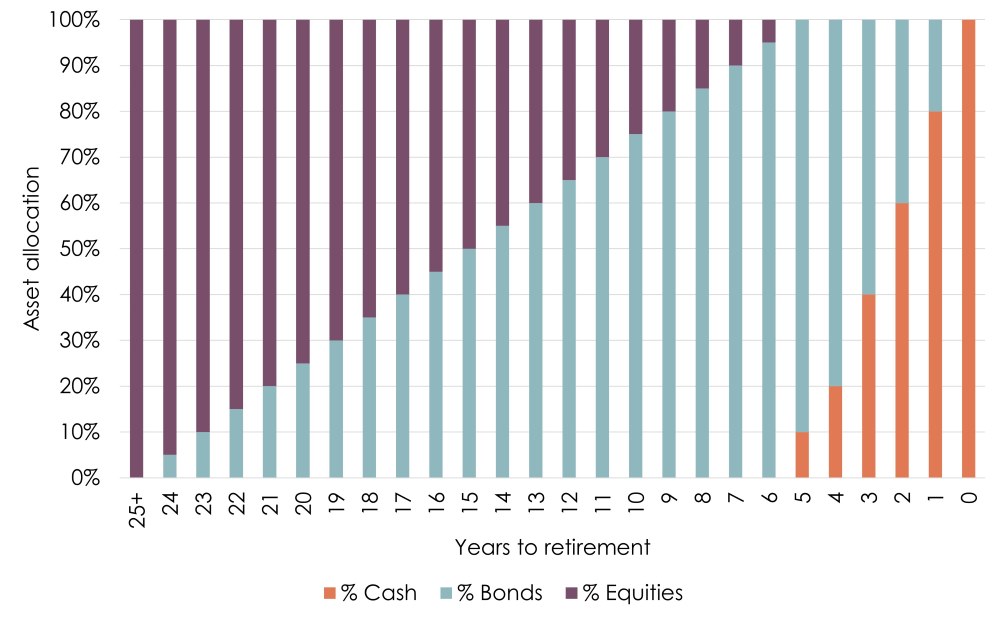
Sounds great, right? How good of your pension provider, looking after that pot from that job in your twenties for all those years. If you’re beginning to get the sense that all of this sounds a little too good to be true, then that’s because it sort of is!
“Lifestyling” funds are fundamentally flawed for a number of reasons:
The first, is that the above strategy only works if the assets assumed to be risk free, actually are. The 2022 “Mini Budget” from Liz Truss and Kwasi Kwarteng brought it sharply into focus that bonds are not a risk-free asset. Some difficult conversations had to be had for individuals whose pensions had mostly lifestyled into bonds and cash and had thought because of this their pensions were secure. It even caused some to reconsider their retirement plans and put them off for a couple of years.
Another issue with lifestyling is that your workplace pension providers are understandably following the same glide path for everyone. Retirement planning is much more nuanced than this but workplace pension providers such as Royal London, Scottish Widows, Aviva, Aegon etc do not have the capacity to speak to each of their customers and understand what they actually need their pension pots to do for them over the long-term, from an income and lifestyle perspective.
The last issue we would like to highlight with lifestyling, is that the notion of having a pension entirely de-risked ready for the day you retire only makes sense if you are planning to use the whole pot to purchase an annuity. Due to rises in bond yields, annuity rates increased steadily from 2022 to the extent that they now present an option worth considering for certain retirees, for the first time in many years.
With this being said, annuities are by no means right for everyone. For many people, drawing upon their pension pot(s) flexibly, either through regular income payments or ad hoc withdrawals, will be the way in which they access their retirement funds.
The ONS estimates that someone at the average retirement age of 65 in the UK in 2025 can expect to live to on average a further 20 years for men on average, and 23 years for women.
This means two things; firstly that there is good chance that your pension will need to last you at least 20 years, but potentially much longer; and secondly, and related to the previous point - some of your pension may not be touched for another 20 years. Therefore, this element of your pot should not take the same level of risk and have the same investment strategy as the money you will be drawing upon in the first few years of retirement, which should be sat in cash ready for you to access.
Segmenting your pension into different pots: the three pot plan
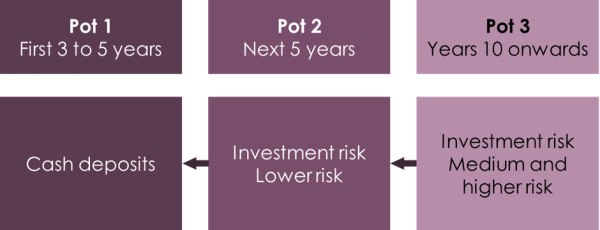
This is by no means anything ground-breaking; by segmenting your pension across different strategies, you are simply taking advantage of timescales. This means that your longest term money can work harder for you, but that the money you need to fund the next few years of living is sat in cash, taking no investment risk.
It may not always be the case that individuals hold significant levels of cash personally, in bank or building society savings or national savings and investment accounts. Nevertheless, holding cash for short-term income requirements can still be achieved. How? By holding a modern Self-Invested Personal Pension (SIPP) which can hold some of its investments in cash accounts or Money Market portfolios.
By holding a few years’ worth of expenditure in cash you give yourself time to ride out any of the shorter-term volatility in markets, meaning you are never forced to sell down upon your invested wealth at an inopportune time in market cycles in order to fund your day-to-day expenditure needs. Luckily, with interest rates still relatively high, the returns from holding cash are far better than anything we saw for many years.
As the above illustrates, planning appropriately is vital in ensuring sustainability throughout what will hopefully be a long and enjoyable retirement. Making sure that a robust retirement strategy is in place well in advance of actually retiring will allow your money to work as hard as possible for you, whilst also ensuring that you can continue to live your dream retirement without the need to worry about the ups and downs in markets.
Retirement Calculator
A useful tool to get a basic understanding of how much you may need is our retirement calculator. From your own inputs, you will be able to forecast an estimate of the pension income you will get when you retire and receive a target retirement income to aim for based on your choices.
How can we help?
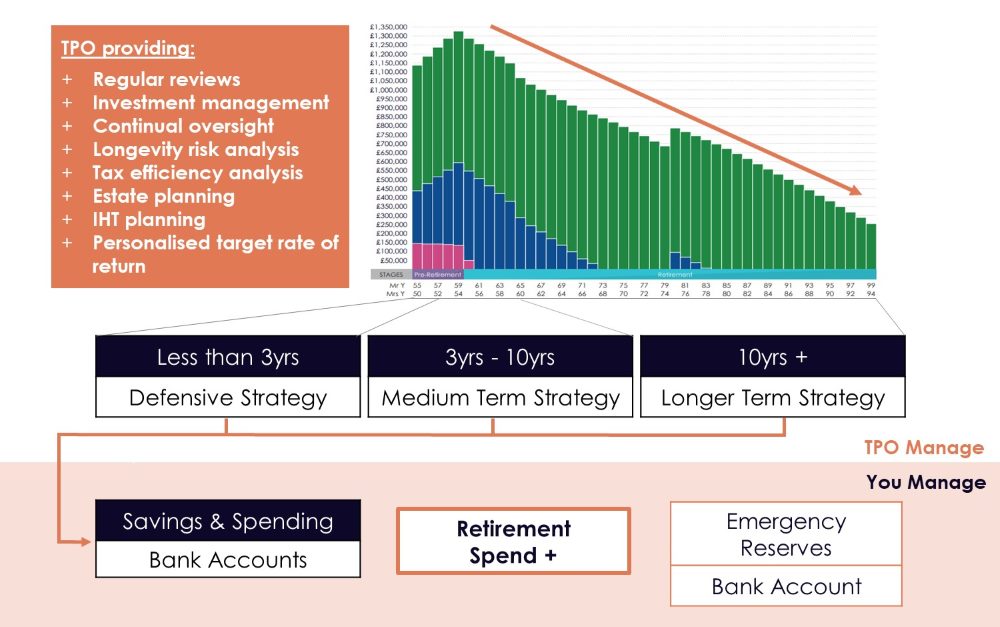
The above is purely an example of a tool we always use with our clients, cash flow modelling. This is especially useful to both us and our clients at determining what they need their assets to do for them over the long-term and identify the different time horizons ahead of them before accessing certain proportions of their wealth.
If you’d like to learn more about how you can plan your own comfortable retirement, why not get in touch and speak to one of our advisers. We’re currently offering anyone with £100,000 in pensions, savings or investments a free initial consultation worth £500.
Arrange your free initial consultation
The information in this article is based on current laws and regulations which are subject to change as at future legislations.
A pension is a long term investment. The fund value may fluctuate and can go down. Your eventual income may depend on the size of the fund at retirement, future interest rates and tax legislation.
The Financial Conduct Authority (FCA) do not regulate estate or cash flow planning, or tax advice.