Skip to main content
Inheritance tax receipts headed for record high
The latest figures from HM Revenue & Customs showed that inheritance tax (IHT) receipts have reached £5.7bn, £400m higher than during the same period last year.
At the current rate, the previous year’s record high £7bn in inheritance tax receipts is on track to be beaten come tax year end, continuing a concerning upwards trajectory. According to the Office of Budget Responsibility, total IHT intake could reach or exceed £8.4bn in the 2027/28 tax year.
Additionally, in a bid to boost IHT receipts further, HMRC has launched an investigation into more than 2,000 households between April and November 2023 that they believe may not be paying enough IHT. Often, a sizable portion of IHT recovered comes from HMRC investigations that were opened months or even years previously.
With rumours around the Government reducing or even scrapping IHT, despite the record highs, and with Labour saying that they would reverse any abolition should they win the next general election, the hot topic of IHT is leaving many with more questions than answers.
Arrange your free initial consultation
What is IHT?
Inheritance Tax (IHT) is a tax levied by the Government on the estate of a deceased person in the UK. This includes all of their assets including property, personal belongings, and investments.
However, this levy only applies to the total value of the estate that exceeds the IHT threshold or ‘nil-rate band’. As of the 2023/24 tax year, the threshold is set at £325,000. Anything above £325,000 could be subject to up to 40% inheritance tax and anything below this threshold is tax-free.
Following the introduction of the residence nil-rate band (RNRB) in April 2017, you can also add an extra £175,000 to the total tax-free threshold, provided you are passing down your assets and property to direct descendants.
Why are IHT receipts continuously on the rise?
The number of estates across the UK that are being pulled into the IHT net are increasing each year.
Total IHT receipts collected by the Government have been steadily on the rise with the situation accelerating since the IHT tax free threshold was frozen at current levels. This was initially announced by the then Chancellor, Rishi Sunak, in his 2021 Budget. The Budget outlined that the IHT threshold, along with many thresholds and allowances, would be frozen for five years until 2026. However, this was further extended for two more years until April 2028.
However, due to the rising rate of inflation coupled with ever increasing property values across the UK, the freeze essentially means that a greater number of people will cross the inheritance tax threshold each year. Many have been calling this move an example of ‘shadow tax’, as the simple act of freezing allowances rather than upping tax rates means the Government will have collected billions in extra tax.
The inheritance tax allowance of £325,000 was increased from £312,000 on 6 April 2009. This means the IHT nil rate band has been frozen for over 14 years now and will keep allowances frozen until at least 5 April 2028. That’s a staggering 19 years of higher taxes on death.
With the Government cracking down on thousands of households that owe money who might not even realise they have breached the allowance, it’s more important than ever to seek professional advice to help navigate the threshold and avoid any possible penalties. Inheritance tax is often referred to as a voluntary tax as there are many ways you can mitigate it, with the right amount of time and planning. If you’re interested in learning more about how to manage IHT on your estate, to ensure the best possible wealth protection for you or your family, we can help. Give us a call on 0333 323 9065 or book a free non-committal initial consultation with a member of our team to find out more.
Arrange your free initial consultation
This article is intended for general information only, it does not constitute individual advice and should not be used to inform financial decisions.
The Financial Conduct Authority (FCA) does not regulate tax advice.
Inheritance Tax, not just a concern for the wealthy
Often referred to as the ‘death tax’, Inheritance Tax (IHT) is a financial levy imposed on a deceased person’s estate that determines the distribution of wealth to their beneficiaries. Despite popular belief, IHT is not exclusive to the wealthy; its impact resonates across a wide spectrum of society.
IHT is calculated on the total value of the deceased’s estate, with a headline rate of 40% applied to estates that exceed the £325,000 nil-rate band (NRB). The misconception that only the wealthy need concern themselves with IHT is ousted, as longer life expectancies and changes in demographics bring the impact of this tax closer to home.
Arrange your free initial consultation
The current landscape
The Office for Budgeting Responsibility (OBR) are predicting that IHT receipts in the UK will rise sharply from the record-breaking £7.1 billion collected in 2022-2023 to £8.4 billion by 2027-2028. According to HMRC data, one in every 25 estates are subject to IHT, meaning that this tax is no longer exclusive to the wealthy. Recent data from HMRC reveals a staggering £2.6 billion in IHT receipts were collected in just 13 weeks between April and July of 2023, which is more than the total IHT bill for 2009. Based on projections, the average IHT bill is expected to rise to £304,567 in 2025-2026 and £345,084 in 2027-2028.
With its tax-free allowance, known as the NRB, remaining unchanging at £325,000 since April 2009, IHT may be considered as one of the longest-standing stealth taxes. Over the past decade there has also been no increase to the £3,000 gifting allowance. Rising house prices and frozen allowances are drawing more households into the IHT net, debunking the common misconception that IHT is solely for the wealthy.
The Office of National Statistics has released figures showing a 73% increase in house prices in the ten years from 2013 to 2023. This consistent rise in house prices over the last decade has contributed significantly to the rise in IHT receipts. Although an individual’s property value is not the sole contributor to the value of their entire estate, it accounts for a substantial proportion of it, therefore expanding the number of households within the scope of IHT. To help somewhat offset IHT, there is an additional threshold, the residence nil-rate band (RNRB), which was introduced in 2017. If an individual leaves their main residence to a direct descendant, they are able to pass on an additional £175,000 IHT free.
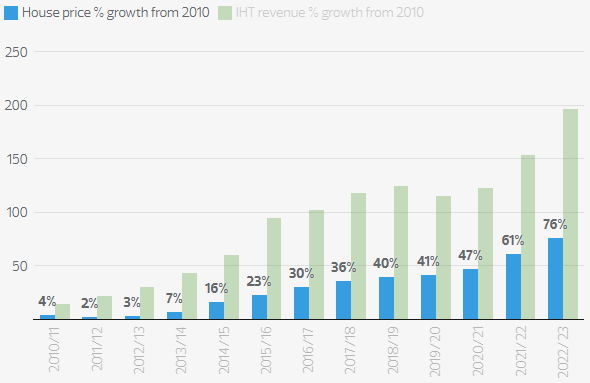
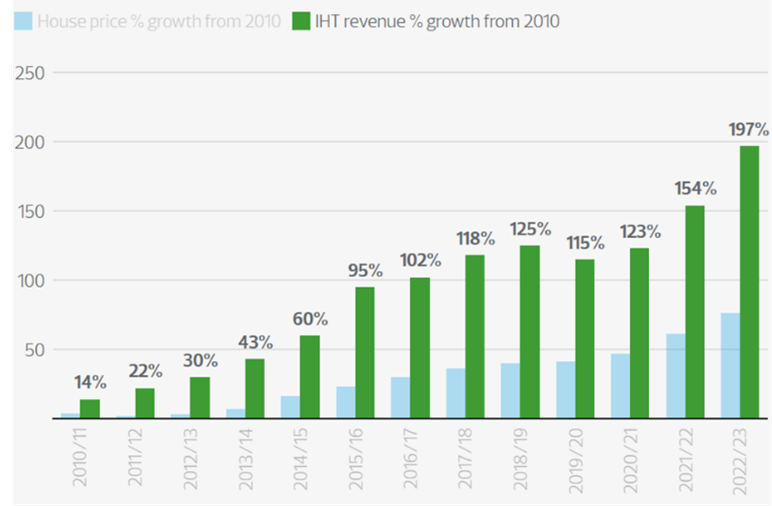
Figure 1: House price growth vs IHT revenue % growth from April 2010, Source: RSMUK, 2023.
The political elephant in the room
Rumours around Government changes to IHT?
Navigating potential changes to IHT and political uncertainties is essential, as rumours concerning the possible elimination of IHT, or introduction of a wealth tax continue to circulate ahead of the next Budget on 6th March. In an effort to win over votes, reports indicate that the Conservative Party may abolish IHT, while a wealth tax on the wealthiest individuals is also being considered, however, with the potential of a changing government with an impending General Election, how long any changes stay in place is impossible to call. To effectively plan and reduce IHT, individuals should instead concentrate on the rules and regulations currently in place, rather than basing their decisions on rumours and speculation.
How can you ensure as much as possible of your estate goes to your loved ones?
In order to mitigate IHT, a thorough strategy combining strategic financial planning and maximising available allowances is needed.
Some key strategies include:
Increase your spending - Spending additional cash to lower the value of your estate is a straightforward yet effective tactic. While this may seem straightforward, individuals should aim to strike a balance between reducing their estate, whilst ensuring they don’t compromise their long-term financial security. For this, putting in place a robust financial plan is key.
Responsible financial planning – IHT encourages individuals to engage in financial planning. It is key for this to be updated each year to ensure individuals can enjoy their desired lifestyle whilst also maximising various allowances. Working with a qualified financial adviser can help you comprehend the potential effects of IHT and encourage you to look into mitigation techniques.
Annual gifting – Making use of the £3,000 annual gifting allowance per person offers an opportunity to reduce the taxable estate. If you have not used your annual exemption in the previous tax year, then you are eligible to combine this to your current tax year to make an allowance of £6,000. Utilising additional exemptions above the £3,000 yearly allowance can also be achieved by making use of small gifting of up to £250 to different individuals, although not to anyone who has already received a gift of your whole £3,000 annual exemption.
Regular gifting - A less known allowance is gifting out of surplus income. If individuals can demonstrate that their regular income can comfortably meet their lifestyle expenditure with surplus income remaining, this can be gifted to one beneficiary or split across several. It is important that this gifting has a regular pattern as it is supposed to come out of surplus income. Given that these requirements are met, these gifts out of surplus income would not be subject to IHT.
It is very important to ensure that these gifts would not be classified as a gift out of capital.
As a reminder, any capital gifts over the annual allowance of £3,000, will be classified as Potentially Exempt Transfer (PET). This means that 7 years need to pass following the capital gift, so it is IHT exempt. Careful financial planning can help to determine, if regular gifting out of surplus income is affordable.
Gifts to charities – Gifting to charities can lower the net value of your estate whilst simultaneously giving to a charity you wish to help. Furthermore, charitable donations are free from IHT, offering a strategic way to reduce the total IHT obligation. If you leave 10% of your estate to a charity, then IHT payable above the £325,000 threshold will reduce from 40% to 36%.
Contribute to a defined contribution pension – Since the introduction of pension freedoms in 2015, pensions have emerged as one of the most tax-efficient means of wealth transfer as they do not form part of your estate for IHT purposes. Most pensions are written under a form of trust, meaning the entire pot, including tax relief, can be passed down to loved ones without incurring IHT. Older defined contribution pensions might not be written into trust, which can mean that they might still be paid into the individual’s estate, therefore this should be checked. Since most defined contribution pensions do not form part of your estate on death, pension savings aren’t usually covered in a Will. It is essential to ensure expression of wish forms are set up and kept up to date with pension providers, so they know who to pay out the benefits.
What can you do as the Budget and Tax Year end draw near?
Making the most appropriate use of the above exemptions and annual allowances can help to reduce the taxable value of your estate. These need to be tailored to your individual needs and it is key that a bespoke gifting strategy is put in place without compromising your own lifestyle. Early engagement with a financial adviser plays a key role in ensuring you are making an informed decision in the ever-changing financial landscape. With careful financial planning, individuals can make sure their hard-earned assets are protected for their chosen beneficiaries.
Key dates to have in mind: The Budget on 6th March and the end of the current tax year on 5th April.
If you’d like to learn more about how you can minimise the tax bill on your estate, why not get in touch for a free initial consultation with one of our experts.
Arrange your free initial consultation
This article is intended for general information only, it does not constitute individual advice and should not be used to inform financial decisions.
This article is also based upon our understanding of current law, HM Revenue and Custom's practice, tax rates and exemptions which are subject to change.
The Financial Conduct Authority (FCA) does not regulate cash flow planning, estate planning or tax advice.

Top up your pension with National Insurance cut
Announced by Chancellor Jeremy Hunt in the November 2023 Autumn Statement, the National Insurance (NI) cuts are now in effect as of 6 January 2024, with further cuts for self-employed taxpayers scheduled to arrive 6 April 2024.
For those who can afford it, these cuts to National Insurance rates could present a perfect opportunity to increase your pension over time. A basic-rate taxpayer will in theory see their income rise by up to £62.83 a month, as a result of the NI reduction. If they pay this straight into their pension, it will be worth £78.53 a month because of the 20% tax relief from the Government on contributions. Over time, these contributions could quickly compound into something significant for your future financial security.
Arrange your free initial consultation
What are National Insurance Contributions?
National Insurance (NI) is an umbrella term for universal health care, unemployment benefits and the public pension program.
National Insurance Contributions (NICs) are a form of tax that employees and employers pay to the Government through payroll deductions. NICs are paid automatically through the PAYE (Pay As You Earn) system, which deducts an amount based on a percentage of your income, and this generally continues until you reach retirement age. Employees are able to make additional voluntary payments to increase the pension amount that they will be entitled to receive.
NICs are collected in order to fund various state benefits, such as the NHS and state pensions.
The changes to National Insurance rates
There are three changes to NICs which were announced in the 2023 Autumn Statement. These changes are:
- A cut in the main rate of NICs paid by employees (‘primary Class 1 NICs’) from 12% to 10%. This rate cut applied from 6 January 2024
- A cut in the main rate of NICs paid by the self-employed (‘Class 4 NICs’) from 9% to 8%. This rate cut would apply from 6 April 2024.
- Cancelling the requirement of the self-employed to pay the flat rate NICs charge (‘Class 2 NIC's’), which applies when someone’s annual profit exceeds a set threshold (the ‘lower profits threshold’). This threshold is currently £12,570. This change would take effect from 6 April 2024.
These measures extend and apply to the whole of the UK. All workers earning over the annual national insurance threshold of £12,570 have seen a fall in their national insurance tax bill as of January 2024.
| Annual Salary | NIC's in 2021/2022 | NIC's in April 2022/23 | NIC's in July 2022/2023 | NIC's in 2023/2024 | NIC's in 2024/2025 |
|---|---|---|---|---|---|
| £20000 | £1,251 | £1,340 | £984 | £892 | £743 |
| £30000 | £2,451 | £2,665 | £2,309 | £2,092 | £1,743 |
| £40000 | £3,651 | £3,990 | £3,634 | £3,292 | £2,743 |
| £50000 | £4,851 | £5,315 | £4,959 | £4,492 | £3,743 |
| £60000 | £5,078 | £5,667 | £5,311 | £4,719 | £3,965 |
| £70000 | £5,278 | £5,992 | £5,636 | £4,919 | £4,165 |
| £80000 | £5,478 | £6,317 | £5,961 | £5,119 | £4,365 |
| £90000 | £5,678 | £6,642 | £6,268 | £5,319 | £4,565 |
| £100000 | £5,878 | £6,967 | £6,611 | £5,519 | £4,765 |
Source: Blick Rothenberg.
How the NI cut could boost your pension?
We have calculated that a 25-year-old basic-rate taxpayer who works and saves until they are 67 years old could end up with as much as £118,900 extra in their pension pot. And even if you’re later in life, for a 55-year-old the uplift could be an extra £15,405. So still worth it, no matter at what point you start to make the extra saving. Although clearly the younger you are the bigger the increase to your pension pot.
For higher-rate taxpayers, the figures are substantially higher. The original £62.83 contribution turns into £104.72 because of the 40% tax relief they get. This means that, for example, a 25-year-old higher-rate taxpayer could be as much as £158,550 better off by age 67. For a 55-year-old, there could be an extra £20,543.
There are some caveats to these calculations. The figures assumes no further changes to NI contributions and that these pots grow by 5% before any fees are deducted.
There are also other factors to consider that could increase the final figures such as employers matching or partly matching extra contributions made by employees, resulting in an even bigger pot over time.
Instead of continuing to work until they reach their planned retirement age, if you divert the extra cash into your pension, you could in theory retire from work a few years earlier as an alternative but feasible strategy, giving you more time to enjoy the best years of your retirement.
Due to the NI reduction involving “class 1” contributions made on earnings received by anyone between the age of 16 and state pension age who is getting more than £242 a week from one job, it means that employees now pay 10% on earnings between £242 and £967 a week.
If you’re thinking about your retirement plans, we’re offering anyone a free initial consultation and cash flow analysis worth up to £500 for those with £100 000 or more in pensions, investments and savings to help with retirement planning. Why not get in touch for a free non-committal initial consultation where you can discuss your savings plans with one of our accredited advisers who will be happy to guide you through the process. Alternatively, you can give us a call on 0333 323 9065 to get in touch with a member of our team to find out more.
Arrange your free initial consultation
This article is intended for general information only, it does not constitute individual advice and should not be used to inform financial decisions.
The information contained within this article is based on our understanding of legislation, whether proposed or in force, and market practice at the time of writing. Levels, bases and reliefs from taxation may be subject to change.
The Financial Conduct Authority (FCA) does not regulate tax advice.

New pension opportunities, but you may need to act fast!
In the 2023 Spring Budget, Chancellor of the Exchequer Jeremy Hunt took many by surprise with his chosen policy changes, particularly in regard to pension allowances. Not only was the Annual Allowance increased from £40,000 to £60,000 and the more restrictive Tapered Annual Allowance increased from £4,000 to £10,000, but it was also announced that the Lifetime Allowance would be abolished.
Consequently, and taking into account a looming election and possible change of government, now could be an opportune time to consider whether you are aiming to maximise your pension contributions prior to the end of the current tax year to take advantage of these tax benefits.
Arrange your free initial consultation
What is the Annual Allowance?
The annual allowance is the maximum amount of pension savings an individual can make each tax year without an annual allowance allowance charge applying.
As noted above, from the start of the current tax year, the annual allowance was increased to £60,000, and you can receive tax relief on your personal contributions up to 100% of your relevant UK earnings (including salary, bonuses, commission).
However, high earners could be subjected to a tapered annual allowance, which gradually reduces their annual allowance to a minimum of £10,000 for those with taxable income over £260,000.
Personal pension contributions are eligible for tax relief at an individual’s marginal rate of income tax. This means that a basic rate taxpayer will receive a 20% uplift on the money they contribute to their pension. A higher or additional rate taxpayer can then also claim an additional 20% or 25% via their self-assessment tax form, resulting in an overall potential tax saving of 40% or 45%!
Employer or Company contributions are also paid gross and can receive corporation tax relief as a business expense.
What is ‘Carry Forward’ and does it apply to me?
Unlike with an ISA, whereby if you do not contribute the full ISA allowance of £20,000 by the 5th of April in a given tax year then this unused allowance is lost forever, this rule does not apply to pensions. The Government introduced the carry forward rules in April 2011, allowing individuals to utilise any unused pension annual allowance from the previous three tax years.
Those with a tapered annual allowance can also still use carry forward if they have any unused annual allowances remaining in previous three tax years.
In order to carry forward any unused annual allowance from these tax years, you must:
- Be a member of a UK-registered pension scheme and had a qualifying pension (this does not include the state pension) since the 2020/21 tax year.
- Have used up your entire annual allowance in the current tax year.
- Have remaining unused annual allowance in previous tax years.
- Have sufficient relevant UK earnings in the current tax year for a personal contribution.
Lifetime Allowance & Transitional Protections
Due to the tax advantages of making pension contributions, the Government previously placed a limit on the amount of pension benefits an individual could accumulate over their lifetime, without incurring a tax charge. This tax charge is known as the Lifetime Allowance (LTA) charge and applied to individuals with pensions valued over £1,073,100.
However, with the UK Government announcing that the LTA charge would be removed from 6 April 2023 and then the LTA abolished from 6 April 2024, this means there is an opportunity for those who are near to or who have exceeded the £1,073,100 threshold to consider recommencing pension contributions.
Historically, the Government has provided individuals with the opportunity to apply to protect their LTA before any changes in legislation. Certain types of transitional protection were introduced with the stipulation that you could no longer make any further pension contributions, but this restriction was then also lifted for those with existing protection before 15 March 2023.
Therefore, this has presented another potential opportunity, as those previously unable to make any contributions due to the risk of losing their protection, may have a significant level of unused annual allowance from previous tax years.
Use it or lose it
With wage growth reaching 7.3% for the period between August to October 2023 (according to the ONS), the tax band freeze means people are technically paying more income tax than ever before. Therefore, it would be prudent to look for ways to maximise the tax-efficient legalisation currently on offer.
Aside from the fact that any unused annual allowance from the 2020/21 tax year will be lost after 5th April 2024, there is no predicting if or when changes will be made again to this legislation. It seems as if the UK population collectively hold their breath at the sign of any Budgets which have seen a vast array of changes to pension rules over the years.
Whilst the most recent changes were positive for pension savers, it is important to consider the implications of the impending election in the next 6-12 months; if there is a change in government then this policy change could be reversed. With that and all the above in mind, it is worth exploring your options and taking appropriate action concerning your carry forward allowance; use it before you lose it!
Pensions can be a complicated and daunting matter to navigate, from obtaining the relevant information from your pension providers to a thorough understanding of ever-changing UK legislation. Therefore, please do reach out to a financial adviser if you would like help making the best use of your savings and pension allowances.
Arrange your free initial consultation
This article is intended for general information only, it does not constitute individual advice and should not be used to inform financial decisions.
A pension is a long-term investment. The value of an investment and the income from it could go down as well as up. The return at the end of the investment period is not guaranteed and you may get back less than you originally invested.
The Financial Conduct Authority (FCA) does not regulate tax advice.
The importance of Cash
There’s no getting away from it, costs have risen exponentially. With a growing cost of living crisis throughout the country, the need for cash retention to act as a buffer in these circumstances remains vital for everyone. This increase in costs will likely mean most people will need to try and save money where they can. Nevertheless, while cash is a crucial component of a well-rounded financial strategy, it's essential to strike a balance. Allocating too much cash for an extended period could expose your wealth to inflation risk, where the purchasing power of your money will decrease over time. It is therefore imperative to assess your overall financial goals, time horizon and risk appetite when deciding how much to keep in cash versus how much to invest in other assets.
There are many reasons to hold money in cash, so we look to explore the importance of cash and its inherent benefits within personal finance, whilst also considering the common risks associated with cash investments. Of course, managing your savings is a highly personalised process, and how much you save should reflect your individual circumstances.
Arrange your free initial consultation
Emergency Fund
The term ‘emergency fund’ or ‘buffer’ refers to money set aside for the sole purpose of being used in times of financial distress. The fund provides a financial safety net to cover any unexpected, and typically costly, expenses that may arise such as those following a loss of job or unexpected tax bill. The amount you should target for an emergency fund depends on a number of factors, including your financial situation, expenses, lifestyle, and debts. Typically, consideration may be given between three to six months of normal expenditure in cash, to be drawn from in the event of an emergency. This is considered a prudent financial practice because it helps avoid unnecessary debt and financial stress.
Top Tip: Starting off small is better than not starting at all!
The Stock Market
While investing in the stock market offers great potential opportunities for accumulating wealth and financial growth, it is important to be aware of the fundamental downsides and risks, and striking the right balance between investments and cash has proven particularly relevant over the past few years with investment markets going through a turbulent time.
Although investors are attracted to the idea of growing their wealth through stock market investments, this should always be looked at as a long-term strategy given the risks associated.
Up until November 2021, there were very few options for your lower risk portion of your wealth, as interest rates were extremely low. However, since the recent interest rate hikes many investors are turning their attention towards setting aside some cash into savings account and are benefiting from some of the highest returns in almost two decades. Unsurprisingly, the last few years have witnessed huge inflows of cash into savings, particularly fixed time deposits, with investors looking elsewhere from the stock market in providing safer and guaranteed returns.
Nonetheless, whilst saving rates have risen, cash has been a depreciating asset, after inflation, with ‘real returns’, remaining negative over the long term. So, for many, it is fundamental to have a comprehensive financial plan in place, to ensure your investment and cash allocations are aligned to meet your objectives and goals.
When it comes to investing, however, one particular benefit of holding some money in cash is managing sequencing risk with your investments. This refers to the impact of the timing of investment returns on a portfolio, particularly when withdrawals are made. If an investor needs to sell assets to cover income or emergency expenses, this can significantly affect the overall portfolio value. As such, the benefit of holding some money in cash is that you help reduce the chances of becoming a forced seller during an investment market downturn. By having this safety measure in place, you can help cover some expected or unexpected expenditure without negatively impacting your long-term investment strategy.
If you are interested in exploring what savings accounts have to offer, please check out our best buy tables, which compares the best accounts on the market.
Retirement
Holding cash as you approach retirement plays a vital role in providing financial flexibility, security and peace of mind when we consider aforementioned risks with invested pension provisions.
As we have covered, sequencing risk can be a major issue for investors. This risk is more common during retirement, as you are far more dependent on your retirement income through your invested pension pots. Significant market downturns alongside taking pension income could be detrimental on your long-term retirement goals, where cash reserves are not in place, as you could be realising losses that could impact the value of your future pension provisions.
Furthermore, healthcare costs are increasingly forming a large part of unexpected costs during retirement. Health spending per person steeply increases after the age of 50, so having cash buffers in place to cover immediate healthcare needs is important.
Using cash in place of drawing from your pension can also have tax benefits, as some pensions sit outside the scope of inheritance tax. This means that the assets held within a pension fund may not be subject to inheritance tax when passed on to beneficiaries. However, given the complexity of inheritance tax laws, it is recommended to seek advice from professionals who have the expertise to guide you through your estate and pension planning.
If you’d like to learn more about how cash can best play a part in your wealth strategy, why not get in touch and speak to one of our experts.
Arrange your free initial consultation
This article is intended for general information only, it does not constitute individual advice and should not be used to inform financial decisions.
Investment returns are not guaranteed, and you may get back less than you originally invested. Past performance is not a guide to future returns.
The Financial Conduct Authority (FCA) does not regulate cash flow planning, estate planning or tax advice.
Savings Champion and their associated services are not regulated by the Financial Conduct Authority (FCA).
The value of professional advice isn't just financial
In an era of instant information and digital connectivity, obtaining financial advice has become more accessible than ever. However, it's important to consider the reliability of your sources, particularly on the internet and from individuals lacking the necessary qualifications and expertise to provide advice. Research by the Financial Service Compensation Scheme (FSCS) revealed that 22% of individuals seek advice from friends, family, or colleagues, 31% turn to online forums or tools, and 9% rely on advice from Social Media Influencers.
Arrange your free initial consultation
While the internet offers a plethora of sources for managing finances, the crucial question remains: is it trustworthy? The easy spread of information on social media and the internet has created a risky environment with unregulated content directing financial decisions. Without regulatory oversight, misleading or inaccurate advice can quickly circulate, posing a potential threat to unsuspecting investors.
Additionally, while seeking advice from close relationships can create a comfortable space for discussing financial matters, it's key to exercise caution. The existing trust and comfort within such relationships may foster a sense of security, but it's equally important to evaluate the individual's expertise. Just as you wouldn't turn to your electrician for medical advice, the same principle should apply to decisions impacting your financial well-being.
The FSCS study further delved into the reasons individuals hesitated to enlist the services of a regulated financial advisor, revealing intriguing insight. Specifically, 23% believed the value of their savings and investments fell short of the amount needed, and 38% expressed concerns about associated costs and value for money. These findings highlight a significant gap in understanding regarding the financial and emotional benefits derived from seeking professional financial advice, contributing to the emergence of the Advice Gap.
The Advice Gap
In the United Kingdom, the Advice Gap refers to a staggering 39 million adults who currently abstain from seeking any form of professional financial advice. Research conducted by the Financial Conduct Authority (FCA) in 2022 sheds light on this issue, revealing that a 60% of individuals with £10,000 or more of investable assets do not consider financial advice, due to the perception that they wouldn't benefit from it. Further insights from the FSCS investigation, revealed interesting thresholds for considering financial advice worthwhile. 13% of respondents believed that a minimum of £100,000 in funds was necessary, while 21% admitted they were uncertain about the financial threshold. This reveals a substantial segment of the population, hesitant to seek advice due to uncertainty about the potential benefits awaiting them.
The real value of Professional Guidance
A study conducted in 2019 by the International Longevity Centre (ILC) in the UK, illuminates the financial impact of seeking professional advice. The research uncovered that those individuals who sought financial guidance during the period from 2001 to 2006, experienced a total wealth boost of £47,706 in their assets over the following decade, compared to those who navigated the financial landscape independently. While the estimated average cost of a one-off independent financial consultation may be approximately £2,000, the benefits accrued over a 10-year period exceed this cost by an impressive 24 times, resulting in a net gain of £4,570 per year. This emphasises that investment in financial advice is essentially an investment in securing a more resilient and prosperous financial future.
The study goes beyond highlighting the importance of a single consultation; it emphasises the significant impact of continuous advice. Individuals who sought financial guidance more than once over the decade, experienced a remarkable 61% improvement in overall financial well-being compared to those who sought advice only once. Achieving financial well-being is not a destination, but a journey. It involves adapting to changing circumstances, making informed decisions, and staying proactive in financial planning. The study's findings highlight the importance of having a trusted advisor who can provide ongoing support, helping individuals navigate the complexities of the financial landscape.
The FSCS study brought to light a common scepticism regarding the minimum asset requirement for benefiting from financial advice. Contrary to the notion that financial advice primarily caters to those with high net worth, the ILC study, mentioned above, demonstrated that individuals who consider themselves in the "just getting by" category experienced a more substantial financial enhancement compared to their wealthier counterparts. For instance, while the affluent group saw an 11% increase in pension wealth, the "just getting by" group experienced an impressive 24% boost in pension income. The key takeaway is quite evident; irrespective of your income level, seeking financial advice can indeed exert a meaningful influence on your financial well-being.
Emotional value of advice
In reference to the ILC study, a whopping 88% of people who have taken advice think it’s good value for money. However, the worth of advice extends beyond financial gains. Amidst the backdrop of market volatility and continuing uncertainty in the political and economic spheres over the past year, it’s good to see that the emotional benefits of advice plays an important role.
A study conducted by Royal London delves into the emotional well-being advantages of seeking advice, revealing that it can offer more than just financial perks. The top three cited benefits include:
- Enhanced confidence in financial plans and the future.
- Heightened control over one's finances.
- Peace of mind and sense of preparedness to navigate life's unforeseen challenges.
Moreover, individuals reported being less anxious about their financial preparedness for retirement, highlighting the emotional impact that sound advice can have at various stages of life.
In conclusion, the studies provided by the FSCS, FCA, ILC and Royal London, paint a compelling picture of the misconceptions around financial advice and the hidden value both for financial and emotional well-being in seeking professional guidance. If you've found yourself questioning the relevance of financial advice in your life, this body of research strongly indicates that taking professional guidance could be a crucial step toward unlocking a more prosperous financial future. So don’t just take our word for it, the research speaks for itself.
If you’d like to learn more about how we can help you achieve the financial future you want, why not get in touch and speak to one our qualified financial advisors for a free initial consultation.
And why not have a look on independent website VouchedFor, to see what our existing clients have to say about us.
Arrange your free initial consultation
This article is intended for general information only, it does not constitute individual advice and should not be used to inform financial decisions.
Investment returns are not guaranteed, and you may get back less than you originally invested. Past performance is not a guide to future returns.
The Financial Conduct Authority (FCA) does not regulate cash flow planning or tax advice.

Who needs to complete a tax return ?
Were you among the 4,757 individuals who completed their tax return on Christmas Day? Or the 12,136 who did so on Boxing Day? Leaving your tax returns to the last minute is unfortunately a common experience for many taxpayers. In the tax year 2020/21, approximately 290,000 individuals incurred fines for late filing and accrued the automatic £100 late filing penalty.
And with more than 1 million people being drawn into self-assessment for the first time due, in the main, to rising inflation and the freeze, by the Government, in many annual allowances until 2028, a larger number of taxpayers are finding themselves at risk of getting hit by the late filing penalties.
Self Assessment Tax Returns
Self Assessment is a system HM Revenue and Customs (HMRC) uses to collect Income Tax.
Tax is usually deducted automatically from wages and pensions known as PAYE (Pay As You Earn). People and businesses with other income must report it in a tax return.
The idea of Self Assessment is that you are responsible for completing a tax return each year if you need to, and for paying any tax due. It is your responsibility to tell HMRC if you think you need to complete a tax return.
If you complete a Self Assessment tax return, you include all your taxable income, and any capital gains. You should also claim any tax allowances or reliefs that you are entitled to on the tax return.
You send the form to HMRC either on paper or online. The information on the tax return is used to calculate your tax liability. This process is called Self Assessment.
What is the deadline for completing a Self Assessment Tax Return?
31st October 2023 - The deadline for submission of tax returns in paper format for the tax year ending 5th April 2023.
30th December 2023 - The deadline to submit your online tax return for automatic payment of owed taxes from your pension and wages.
31st January 2024 - The deadline for online self-assessment tax returns for the 2022/23 tax year to be completed.
For more information about tax dates and thresholds, check out our up-to-date guide.
Who needs to complete a tax return?
According to the gov.uk website, you must send a tax return if, in the previous tax year (6 April to 5 April), any of the following applied:
- You were self-employed as a ‘sole trader’ and earned more than £1,000 (before taking off anything you can claim tax relief on)
- You were a partner in a business partnership
- You had a total taxable income of more than £100,000
- You had to pay the High Income Child Benefit Charge
- You had to pay Capital Gains Tax when you sold or ‘disposed of’ something that increased in value
You may also need to send a tax return if you have any untaxed income, such as:
- Some COVID-19 grant or support payments
- Money from renting out a property
- Tips and commission
- Income from savings, investments and dividends
- Foreign income
What do I need to complete a tax return online?
For those filing online, having a Government Gateway login and a Unique Taxpayer Reference (UTR) number is required. You can find everything you need to know about creating a login on the gov.uk website.
What happens if I don’t complete the self-assessment in time?
If you don’t file your tax return correctly by the deadline, you will be sanctioned with a penalty depending on how late you file your return. This penalty will begin at an initial £100 fixed fee and progress as follows:
- After 3 months, daily penalties of £10 will start, up to £900 in total.
- After 6 months, you will be sanctioned for 5% of the total tax due or £300, whichever is greater.
- After 12 months, you will be sanctioned for a further 5% of the total tax due or £300, whichever is greater - in some cases, you may have to pay 100% of the tax you owe
Additionally, the interest rate that HMRC charges on unpaid tax recently rose to the highest it has been in 14 years. The amount is calculated as the base rate plus 2.5% - so currently this is a rate of 7.75%. This is in contrast to the interest rate paid to those that are owed money by HMRC, they will only apply the base rate minus 1% (4.25%), known as the repayment interest rate.
Late filing isn't the only trigger for penalties. Failure to pay the owed tax on time will result in further penalties. In that 2020/21 tax year, 1.43 million people faced fines for overdue payments, up from 1.24 million the previous year. Interestingly, despite HMRC granting a one-month waiver for late filing and payment penalties that year, due to the challenges posed by the Covid-19 pandemic, the numbers continued to rise.
However, seeking assistance over the phone might prove challenging. HMRC announced in January 2024 that it would focus on addressing priority calls leading up to the months end, with reported waiting times increasing from 5 minutes in 2017 to 20 minutes in 2022. Many callers have faced prolonged persistence to connect with the right person for assistance, despite generally positive experiences once contact was established.
That said, HMRC has made it clear that for those that can demonstrate a genuine reason why they cannot make the deadline, they will be ‘lenient’ in their penalty process. The penalties mainly exist to punish deliberate tax evaders and those who persistently fail to complete their tax returns.
There are many ways you can minimise the tax you pay, with some taxes mitigated altogether. For those with higher earnings, check out our free guide on tax planning strategies. Alternatively, give us a call on 0333 323 9065 to book a free non-committal initial consultation with a member of our team to find out how we can help.
Arrange your free initial consultation
This article is intended for general information only, it does not constitute individual advice and should not be used to inform financial decisions.
The Financial Conduct Authority (FCA) does not regulate tax advice.
Tax return deadline looms - avoid a fine!
Were you one of the 4,757 people that filed their tax return on Christmas Day? Or the 12,136 that filed on Boxing Day? It may seem extreme to be doing your tax return over the festive period, but for those diligent people the chore is done for another year – and they have avoided the stress of leaving it too late and risking an automatic penalty of £100. In the 2020/21 tax year around 290,000 were fined.
And it’s not just late filing that can see you paying a penalty. You also have to pay the tax due! In that same tax year a further 1.43 million people were fined for not paying up on time, up from 1.24 million the year before. And that was despite the fact that HMRC waived the late filing and late payment penalties by one month that year, in recognition of the pressures caused by the Covid-19 pandemic.
HMRC has announced that it will only be dealing with priority calls in the lead up to the end of the month, as according to The Times, waiting times to speak to someone for assistance have soared from 5 minutes in 2017 to 20 minutes in 2022.
Who has to send in a tax return
Apparently more than 1 million people will have been drawn into self-assessment for the first time due to the increase in taxes due on everything from savings and dividends to capital gains, because of the freeze in many allowances that was introduced in 2021 and it set to continue until 2028.
And some people could be first timers if the increase to their income, including the State Pension, pushes their income over £100,000.* But there could be other situations too, so, you might be surprised to find that you do need to file a self-assessment tax return.
As there are so many more who may need to do a self-assessment tax return, it could be wise to check if you need to send a tax return if you’re not sure.
According to the gov.uk website, you must send a tax return if, in the last tax year (6 April to 5 April), any of the following applied:
- you were self-employed as a ‘sole trader’ and earned more than £1,000 (before taking off anything you can claim tax relief on)
- you were a partner in a business partnership
- you had a total taxable income of more than £100,000
- you had to pay the High Income Child Benefit Charge
You may also need to send a tax return if you have any untaxed income, such as:
- some COVID-19 grant or support payments
- money from renting out a property
- tips and commission
- income from savings, investments and dividends
- foreign income
What do you need if you have to file a tax return?
If you are filing online you’ll need to have a login to the Government Gateway and you’ll need your Unique Taxpayer Reference (UTR) number.
More information is available on gov.uk, so this is a great reference point especially if you don’t yet have a Government Gateway account. But you really need to get a move on if you want to avoid a penalty.
Remember that HMRC will charge interest on these fines and any unpaid tax and the amount is calculated as base rate plus 2.5% - so currently this is 7.75%. This is bad enough, but if HMRC owes you money because you have overpaid tax, they will only apply base rate minus 1% (4.25%), known as the repayment interest rate! Even more of a reason to make sure you pay up on time and accurately.
*Source: gov.uk
Arrange your free initial consultation
This article is intended for general information only, it does not constitute individual advice and should not be used to inform financial decisions.
The Financial Conduct Authority (FCA) does not regulate tax advice.

Managing the cost of care for you and your family
As a nation we are living longer. According to the Office for National Statistics (ONS) in 2010 there were 4.9 million people aged over 75, fast forward 10 years and this has grown by a huge 24%, to 6.1 million in 2020. The need, therefore, for some form of care in later life is a real fear among most families which is only growing. This fear comes from not only losing your independence but also losing the legacy you may have planned to pass to your loved ones.
Arrange your free initial consultation
A scary fact to add to this concern is the total beds available in care homes as a proportion of the population is decreasing. In 2012 there were 11.3 beds in care homes available per 100 people for those over age 75. Over a 10-year period this has reduced to 9.4 beds per 100 over age 75, this is a 17% decrease.
In a time where emotions are high as well as stress being overwhelming, the last thing you need to worry about is whether your finances are working in the best way for you so you can afford the care you want or need. Taking the time to appropriately plan for potential care costs in good time will remove this financial worry, allowing you to focus on the health and wellbeing of you and your family.
In terms of planning for care costs, a good place to start is to understand what these costs may look like.
Costs of care today
There is a common misconception that the state will pay for your long-term care. However, in reality only a few people will meet the eligibility criteria which prevents them paying the costs of care themselves.
In 2023 the average cost for residential care in the UK was is £1,078 per week (£56,056 per year), according to the AgeUK Charity. However, figures will vary significantly depending on your location and the individual circumstances surrounding your care requirements. The first step in your plan would be to research care homes around you and what the typical costs for these are. In most cases, the preferred care home isn’t based on cost but on the distance from family members, so costs can sometimes be unexpectedly high.
For the current tax year 2023/24, in England, you currently need to be below the savings threshold of £23,250 in savings and/or assets before part of the cost of care will be covered by the state and below £14,250 before all costs are paid (£28,500 in Scotland, £50,000 in Wales and £23,250 in Northern Ireland). This limit includes the value of your home unless you have a spouse or dependent occupying the property. This limit has not been increased to take into account the effects of inflation over the years, therefore fewer individuals are able to benefit from state support each year.
If your assets are above these limits, then you will need to fund your care costs personally, which may even include your home.
What is the social care cap?
It is not all bad news, in 2021 the UK government proposed a price cap on care costs of £86,000, known as the ‘social care cap’, meaning this will be the maximum an individual would pay towards their care costs in their lifetime. The cap was originally due to come into effect as of October 1st, 2023, but has been postponed to October 2025 following Jeremy Hunt’s Autumn statement of 2023. Of course, with the prospect of a changing government on the horizon it’s easy to see that a lot could happen before the postpone social care gap would be implemented.
Although there is the care cap this only covers the care costs, if you were to be in a residential care home you would still be liable to pay additional costs such as ‘hotel’ costs and luxury costs.
Building your plan
If you’ve identified that you will need to pay for care or you’d like to plan for the possibility and you’ve researched to understand what the costs look like in your area, you’re half way there in terms of building your plan. The next step is ensuring your current savings, investments and pensions are working hard and tax efficiently for you to ensure you have the best chances to meet this expense.
If you are retiring and planning for care costs is important to you, a common mistake most individuals make is holding too much wealth as cash in your bank account. Although cash is very safe and won’t, in theory, go down in value, interest rates on bank accounts have historically been lower than inflation. Therefore, your wealth could be deteriorating in real terms. It is important to have a conversation with a financial adviser to build an initial plan and check if the overall assets you are holding are appropriate.
If you are much closer to needing care, it is still important to plan the potential expenses out. This will help you to understand how long you would be able to sustain care costs until your wealth is below the threshold for the council to start making contributions. For a short-term solution, your plan may focus around cash accounts, which although may not provide the best return year on year, will provide certainty and peace of mind in the short term.
If you are in a position where the majority of your wealth is locked away in your home, and you are single and living alone, this will keep you above the threshold. In this situation you will likely need to use this wealth in some way to cover the costs. You will have a few options open to you, which include:
-
Renting the house out.
-
Taking out a mortgage or equity release.
-
Have the council take the costs from the house (typically on death).
-
Selling your home outright.
Each of these options presents potential benefits and drawbacks. For example, selling your home may provide you with a lump sum of cash that you can put towards care costs. However, you may lose your Residence Nil Rate Band (RNRB) on your property, which is an increase to the threshold for inheritance tax. Therefore, it’s important to assess each in turn and discuss with a financial professional.
At The Private Office we look at your overall financial picture and discuss what is important to you. Our first step is to always build your bespoke financial plan, which will include potential care costs, and how you may be able to pay for these.
To understand the features and risks of equity release, please ask for a personalised illustration.
Arrange your free initial consultation
This article is intended for general information only, it does not constitute individual advice and should not be used to inform financial decisions.
The Financial Conduct Authority (FCA) does not regulate cash flow planning, estate planning or tax advice.

How to make your child a millionaire before 40!
Most parents would like to ensure their children have a strong financial footing when they are older, but don’t always know the best way to do this. There are many ways to support your children financially throughout their lifetime, but what if there was a way to make them a millionaire before they even reached retirement age? Here we look at the best ways to put money aside for your children and how you can maximise the benefits of compound interest to make your child a “millionaire”!
Arrange your free initial consultation
The first step to saving for your children’s future is understanding your saving options. Here are the most common options that benefit from tax-free growth:
Junior ISA(JISA)
From the day a child is born you can put money into a JISA for them. The current contribution limit is £9,000 per tax year (or £750 per month) and you have the choice of a Junior Investment ISA or a Junior Cash ISA. The most important benefit of a JISA is that any gains made, or interest earned will be tax-free!
If we assume you receive an average annual net return of 5% per year and you save the maximum of £9,000 every tax year, from the day your child is born until they turn 18, you will have contributed a total of £162,000 to their account. However, due to the magic of compound interest (where you earn interest on interest), they will have a pot of over £265,000 saved in a tax-efficient wrapper, what a great 18th birthday present!
At their 18th birthday they can transfer their JISA into an Adult ISA to continue to receive tax-free interest/ investment returns.
Junior Self-Invested Personal Pension (Junior SIPP)
Setting up a pension up for your children may seem like you are overly preparing but this can actually give your children a significant head start. The maximum you can currently save into a Junior SIPP is £2,880 per tax year, and the UK government will add tax 20% tax relief of £720 per tax year, which would bring the total contribution to £3,600. If you can contribute to your child’s Junior SIPP for 18 years and again assuming a 5% growth rate, you will have contributed £51,840 but their pension pot will be worth £106,340 due to the added tax relief. If your child doesn’t contribute to the pension again, by age 57* they could have a pension pot worth around £712,986. Similar to the JISA, any gains made within the SIPP are exempt from tax, and based on current pension rules, you can take up to 25% as a tax-free lump sum upon reaching retirement age.
Recent statistics released by the Office for National Statistics (ONS) stated how the average pension wealth for all persons in the UK is £67,800 at age 57*, highlighting how starting to save early can set your child up for their future and give them a greater opportunity in retirement or even to retire early.
How to make your child a millionaire!
And this is how to do it! If you do the following and assume a 5% growth rate per annum:
- Open a JISA before your child’s first birthday and contribute £9,000 every year until age 18. This results in a total contribution of £162,000 (18 years x £9,000).
- Open a Junior SIPP before your child’s first birthday and contribute £3,600 (including tax relief) to the Junior SIPP every year up to their 18th birthday. This totals 18 years x £2,880 (or £3,600 with tax relief) which equals £51,840 (£64,800)
This would mean you will have contributed a total of £226,800 (including tax relief) to the JISA (£162,000), and Junior SIPP (£64,800). At age 18 when you stop contributing, they could have a total net worth of £372,191 when taking into account compound interest and growth. If they leave this money invested and continue to achieve 5% per year growth, by age 39 they could have a total net worth of just over £1million (£1,036,911), although the funds in the pension would not be accessible until age 57*.
At that point the pension fund could have grown to £712,986, while the ISA, could be worth £1,782,465 if it remained untouched too - an extraordinary total of almost £2.5m. That is a gift worth giving.
The power of starting to save early
Using the same assumptions as above, with a 5% annual growth rate and maximising both Junior SIPP and JISA contributions until age 18:
| Starting from date of birth | Starting at age 5 | Starting at age 10 | |
|---|---|---|---|
| JISA Value at age 30 | £477,430 | £300,604 | £162,056 |
| Junior SIPP value at age 30 | £190,972 | £120,242 | £64,823 |
| Total Value at age 30 | £668,402 | £420,846 | £226,879 |
This shows the benefits you can provide by starting the process of saving early for your child through compounding the interest or investment returns. This is a representation of how you can save for your children and assumes maximum contributions are made at each birthday, but we understand the circumstances for each parent and child will be different and may require different forms of financial planning, such as monthly contributions instead of lump sums.
Despite the examples above, it is never too late to start. If you would like to understand how, The Private Office can structure savings and investments for you and your children to help provide the whole family with a strong financial future. So why not get in touch for a free initial consultation.
* Based on current pension regulation, where the normal minimum pension age is increasing to age 57 from April 2028.
If you would like to know more about this topic, one of our Partners Kirsty Stone appeared on BBC Radio 4 Money Box live, giving her suggestions in a programme all about saving for children.
Arrange your free initial consultation
This article is intended for general information only, it does not constitute individual advice and should not be used to inform financial decisions.
All the calculations in this article assume that lump sum contributions are made for 18 years, from birth, unless otherwise stated, to the 17th birthday and are not adjusted for inflation.
The Financial Conduct Authority (FCA) does not regulate tax or cash advice.
The growth rates provided are for illustrative purposes only. Investment returns can fall as well as rise and are not guaranteed. You may get back less than you originally invested. Investments may be subject to advice fees and product charges which will impact the overall level of return you achieve.