Skip to main content
How much is the dividend tax free allowance?
The recent change of Government in the UK has naturally brought with it a number of speculations about what Labour will look to target when it lays out its fiscal policy for the term ahead. You will have heard about potential changes to Capital Gains Tax (CGT), or modifying Inheritance Tax (IHT), however there have been significant changes in recent years to many other areas, and one in particular is the dividend allowance. It has shrunk dramatically in recent years, from £5,000 per annum in 2017/18 to £500 per annum in 2024/25. It is important, then, that if you are getting income from dividends, you need to understand your tax implications.
Arrange your free initial consultation
What is a dividend?
Dividends are periodic payments made to shareholders by the companies they have invested in. It is a slice of the company’s post-tax profits that is ‘divided up’ among its shareholders. Clearly, the dividend amount is variable and is dependent on strong corporate performance in order for them to pay out to shareholders.
Is there a tax free Allowance for dividends in the UK?
In the UK, HMRC allows individuals to receive a certain amount of dividend income before they start paying tax, known as the dividend tax free allowance.
This allowance was first introduced on 6 April 2016 to all UK residents, replacing the dividend tax credit at that time.
Although in the UK we can utilise the dividend allowance, recently the amount at which you can earn before paying tax was reduced, meaning more people will have started paying tax on their dividend income.
What is tax free dividend allowance?
For the 2024/25 tax year, the dividend tax free allowance is £500. This means that you can receive income of up to £500 from shares and some equity-based collective investment funds without paying any tax.
Dividends that arise within ISA and pension wrappers are exempt from dividend tax due to the favourable tax-free growth nature of these investments.
Understanding tax on dividends
Once the amount of dividend income an individual receives breaches the dividend allowance, the level of tax you pay on this income depends on what level of total income you receive in any given tax year.
| Tax Band | Income Level | Income Tax Bracket | Dividend Tax Bracket |
|---|---|---|---|
| Personal Allowance | £0-£12,570 | 0% | 0% |
|
Basic Rate |
£12,571-£50,270 | 20% | 8.75% |
| Higher Rate | £50,271-125,140 | 40% | 33.75% |
| Additional Rate | Over £125,140 | 45% | 39.35% |
The above table shows the level of tax you will pay if you receive more than £500 worth of dividend income in the current tax year. If your total income for the year is less than the Personal Allowance, which sits at £12,570 in the current tax year, you will also not pay tax on your dividend income.
As per the table above, dividend tax rates are less than income tax rates, making dividends a more favourable form of income. Individuals who own their own limited company can take dividends from the profits of their company instead of a salary in order to decrease their tax liability for a given tax year.
Can I transfer tax free allowance to share dividend allowance?
Although it is not possible to transfer your dividend allowance to your spouse, like it is with part of the Personal Allowance, transferring dividends to your spouse is an effective way to mitigate dividend tax if one member of the couple falls into a lower tax bracket than the other. As assets can be passed between spouses free of inheritance tax implications, assigning shares to the lower earner means that any dividend income they receive over the dividend allowance will be taxed in accordance with their relevant, lower rate of dividend tax. For this to be effective, the transfer of the shares/investment should be a genuine and unconditional transfer of ‘beneficial’ ownership, from which the transferor should receive no benefit.
Please keep in mind this is a complex area of taxation and such work should be undertaken with help of your accountant or financial adviser.
How do I pay dividend tax?
Unlike a salary, dividends are not taxed at source. If you earn under the dividend allowance of £500, you do not need to do anything. If you earn above this, but below £10,000 in the current tax year, you must contact HMRC. HMRC will give you the option of either adjusting your tax code to pay your dividend tax liability or completing a self-assessment tax return.
If you earn over £10,000 of dividend income in the current tax year, your only option for paying your dividend tax bill is by completing a self-assessment tax return.
Self-assessment tax returns must be completed for the previous tax year by 31st October if choosing to fill in a paper form or 31st January if you opt of an online form. For example, you must complete your online tax return for the 2023/24 tax year by 31st January 2025.
How we can help
Whether you are a business owner who would like to efficiently draw an income from your business, or you are receiving income from your investments, we can build an effective, tax efficient income strategy that suits you and your family's needs. We make it a priority to stay on top of legislative changes to taxes applicable and work with a number of client accountants to ensure we have the most up to date tax information available for each client.
If you’d like to learn more about how we can help you, why not get in touch for free initial review with one of our expert advisers.
Arrange your free initial consultation
The FCA does not regulate estate or tax planning.
The information is based on our understanding of legislation, whether proposed or in force, and market practice at the time of writing. Levels, bases and reliefs from taxation may be subject to change.

Election Season – Is a shift to the left, right for markets?
In last month’s update we touched upon the French and British general elections, however at the time of writing the UK election hadn’t yet taken place and the French election had only passed its first round. Now that both elections have concluded we can take a deeper dive into market reactions.
Arrange your free initial consultation
The election results
Before we get going it’s worth summarising recent events, starting with the UK. Pollsters had been predicting a Labour landslide, and while they overestimated the realised vote share for Labour, due to our first-past-the-post voting system this still translated into one of the largest majorities our parliament has seen. This result should provide the foundation for a stable government with the ability to enact its desired agenda.
In France results were less conclusive, in part due to their more proportional voting system. Le Pen’s National Rally party won the largest vote share of any individual party, however due to the fractured nature of their parliament, with three roughly equal coalitions, it seems unlikely that a government will be formed in the very near term. This will not provide the foundation for a stable government with the ability to smoothly enact its desired agenda.
Market reactions to the UK election result
The UK had looked like a bit of a political basket case over the last few years, so the contrast of that to a new stable government is stark and has not been lost on international investors. The first port of call for market reactions to government policy, particularly the reactions of international investors, are the currency markets, where sterling has seen significant strength since the election results. Because the results were fairly certain, currency markets began to price-in a Labour victory at the start of the election week, so the chart below starts there. The blue line shows sterling against the Japanese Yen, the yellow line sterling against the Swiss Franc, the white line sterling against the US Dollar, and the orange line sterling against the Euro.
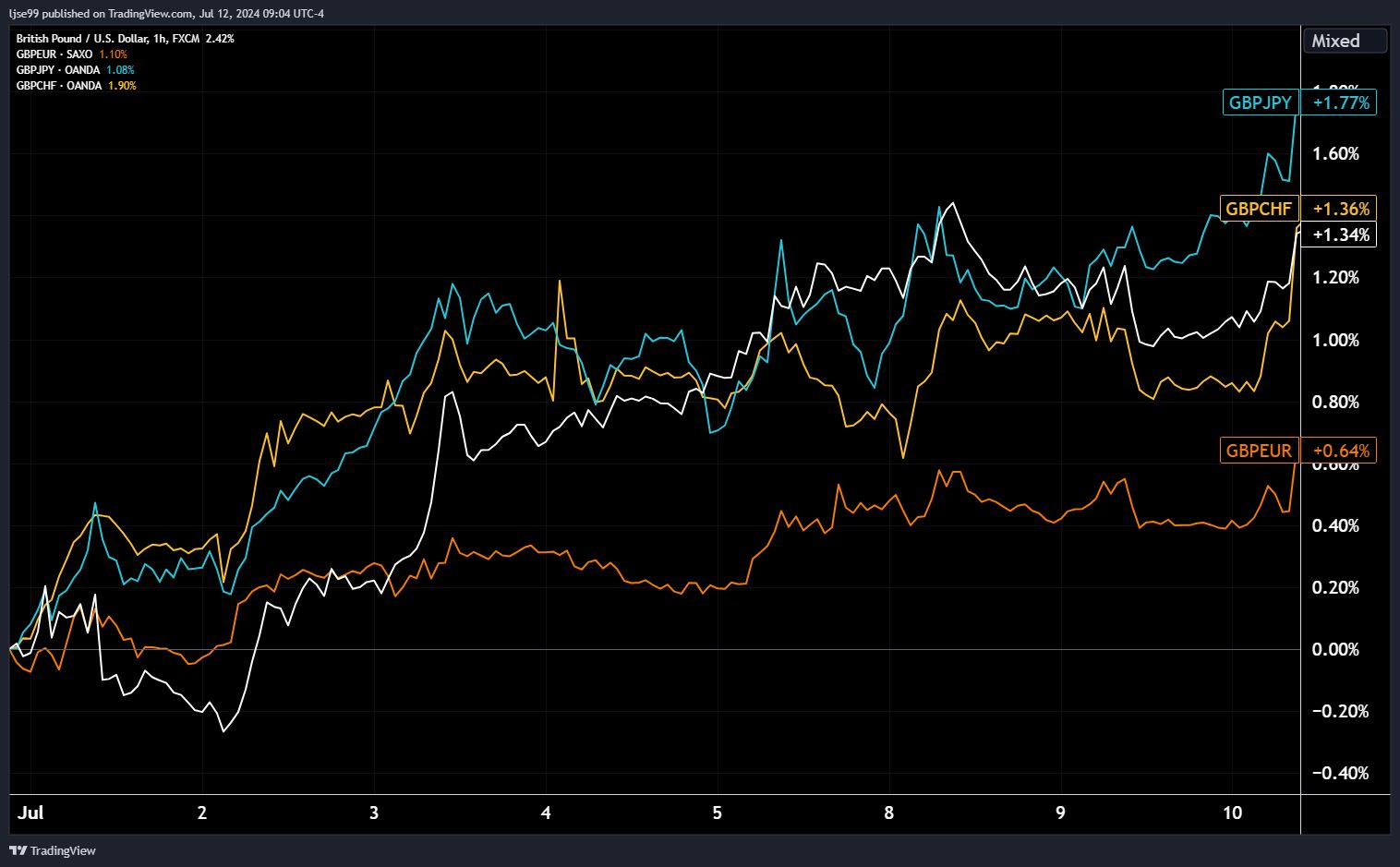 Figure 1 – Sterling versus major developed economy currencies – Source: TradingView, 2024.
As the chart shows, sterling has been strong against the major developed market currencies, with inflows to British markets pulling up the currency value.
The next port of call is the bond market. If markets perceive a new government to be more stable and fiscally trustworthy, they should demand less compensation for risk and thus a lower government bond yield. Looking at recent moves in the gilt market, this is the result we find.
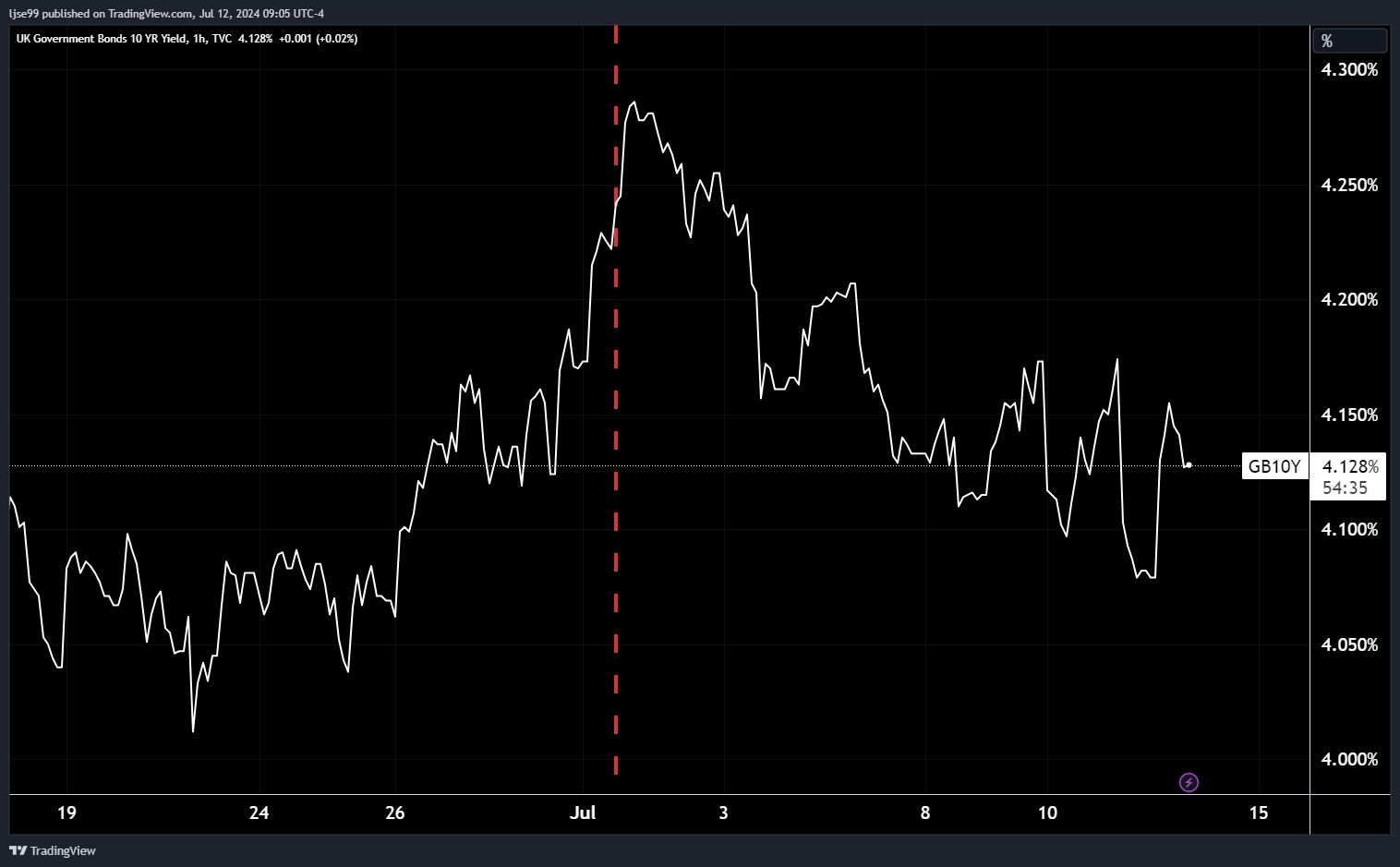 Figure 2 – 10-year UK Gilt yield – Source: TradingView, 2024.
The chart above shows the yield on a 10-year gilt over the last three weeks, with the beginning of the election week marked by the red dotted line. Clearly, since the start of the election week gilt yields have come down as would be expected.
The final market we will examine is the equity market. The two main index groupings of UK equities are the FTSE 100 and FTSE 250, where the former are the largest 100 companies, typically international businesses, and the latter are the next 250 largest companies, typically domestically focused. An election has the largest impact on the prospects of domestically focused companies, so we should expect the FTSE 250 to outperform the FTSE 100 if investors see the election as being positive for the UK economy, and within the FTSE 250 we should expect domestically focused sectors to see the strongest performance. The chart below shows the performance of the two indices, starting at the beginning of the election week. The FTSE 100 is depicted by the white line and the FTSE 250 by the orange line.
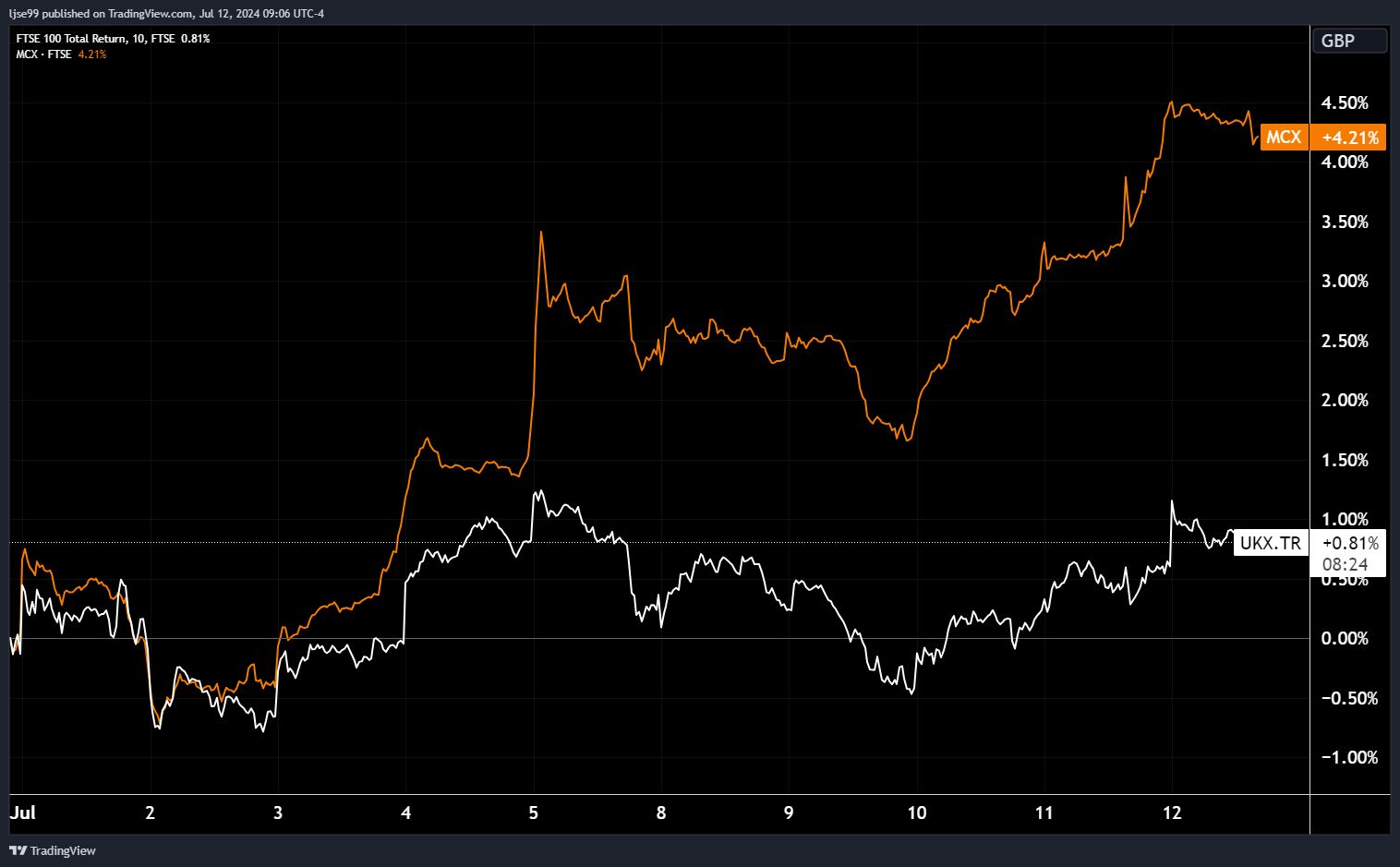 Figure 3 – FTSE 100 & 250 returns – Source: TradingView, 2024.
As predicted, the FTSE 250 has outperformed the FTSE 100 over the period, with a pronounced spike in returns on Friday the 5th, the day election results were confirmed.
When breaking this down on a sector basis, we see that of the 15 top performing FTSE 250 sectors that week, 7 are industries that are very domestically focused (highlighted in blue).
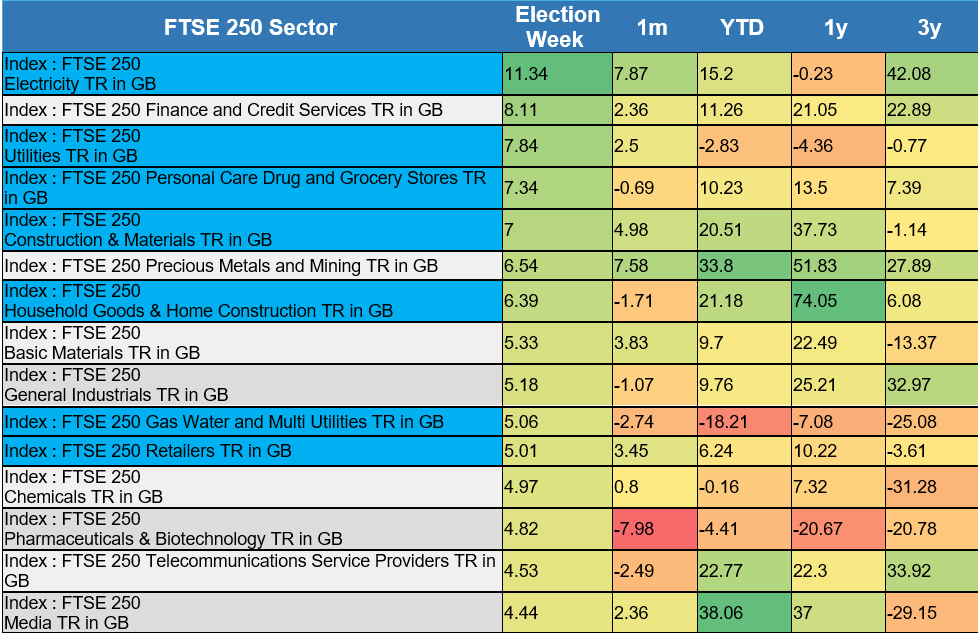 Figure 4 – FTSE 250 sector returns – Source: FE Analytics, 2024.
The strong performance of construction & materials and household goods & home construction sectors is notable, as house building is a key priority of the Labour government – markets are taking this seriously and pricing it into equity valuations.
Market reaction to the French election result
Moving to France, where markets have been less than enthused by the results, to put it mildly.
France no longer has the Franc as an independent currency, meaning changes in the value of the Euro are not a pure proxy for changes in sentiment towards France, however as the second largest economy in the EU, France exerts a large weight on the value of the Euro, particularly on the day of the election result. The chart below shows the value of the Euro versus the Dollar on the day of the election, with the drop in value boxed in red.
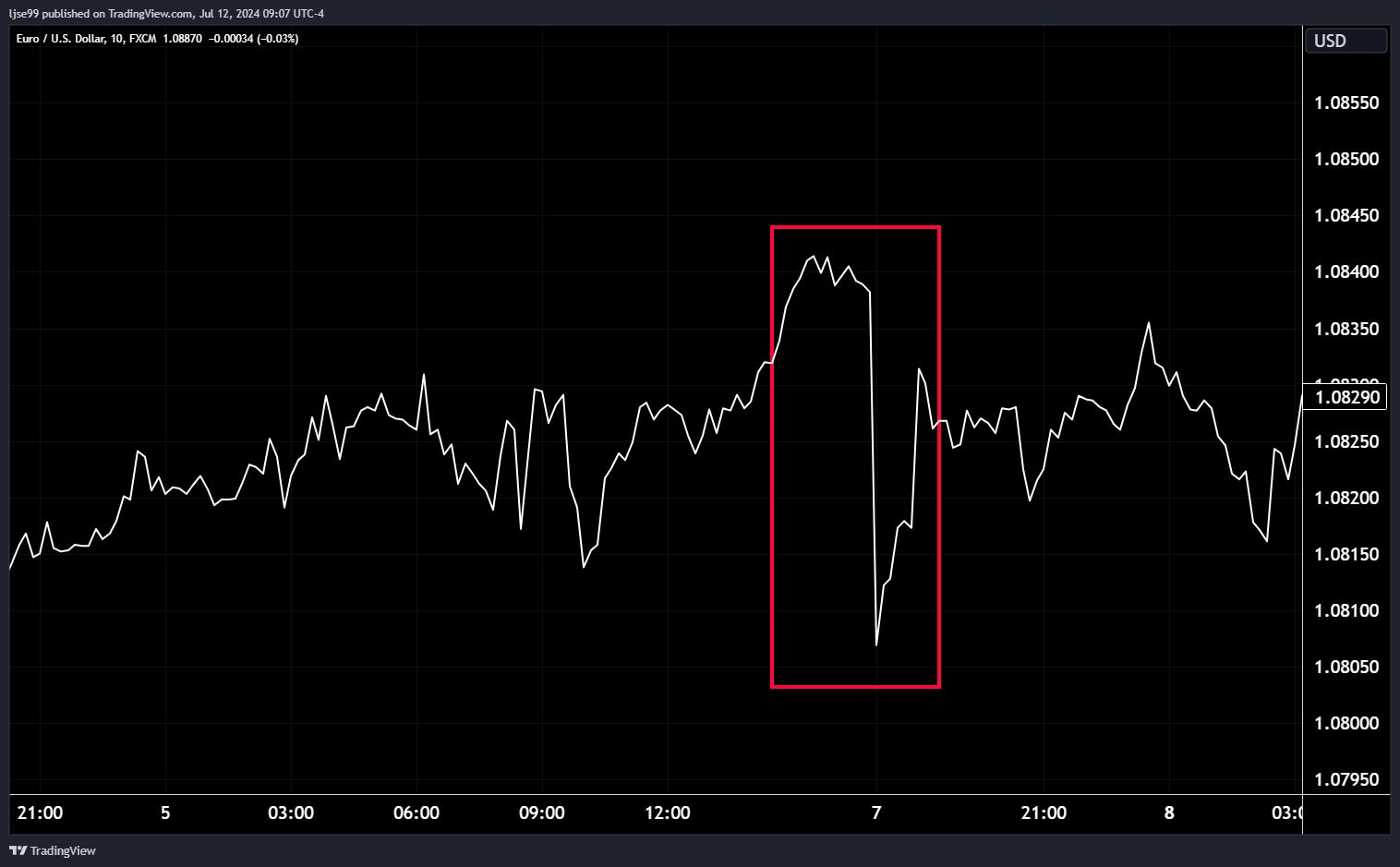 Figure 5 – Euro versus Dollar – Source: TradingView, 2024.
As the chart shows, there was a significant uptick in volatility in Euro currency markets. This volatility isn’t restricted to currency markets, with equity markets across Europe seeing increased volatility, particularly when compared with UK equity markets. The chart below from Bloomberg shows the volatility of UK and European equity markets, with a clear spike during the election.
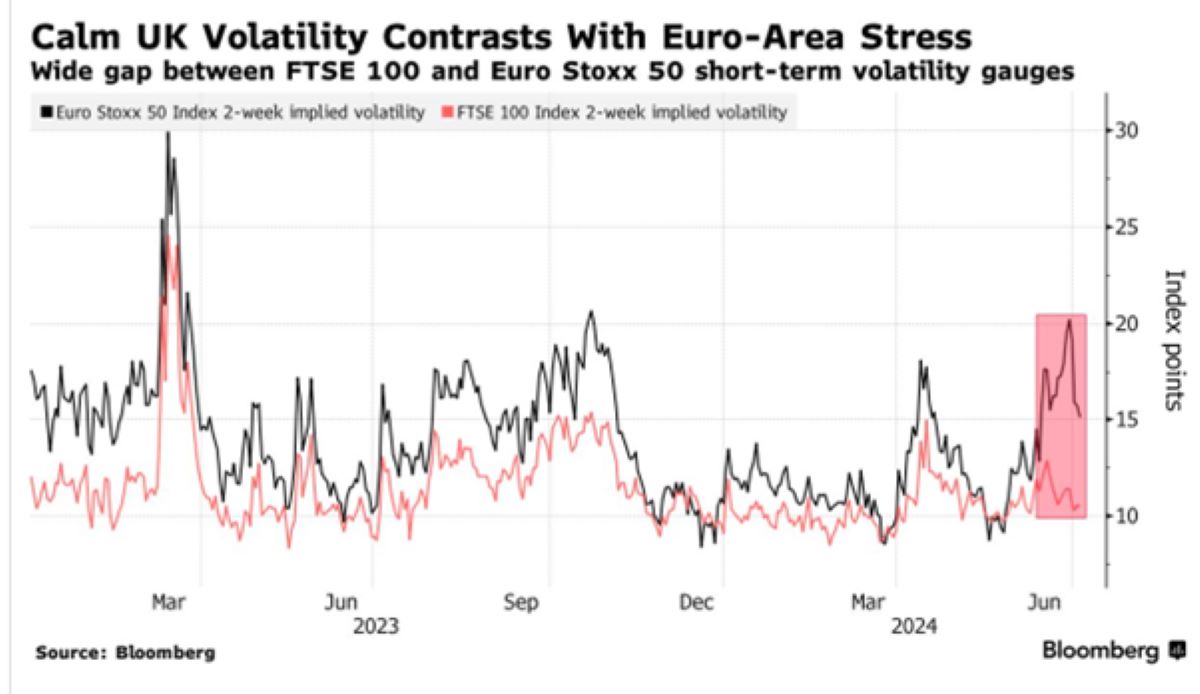 Figure 6 – UK and European equity volatility – Source: Bloomberg, 2024.
The chart above shows European equity volatility, but when breaking that down to look at the performance of French equities we see that much of this volatility has been caused by downwards moves in French markets. The chart below shows the returns of the French CAC 40 index in white and the German DAX 30 index in orange, with red dotted lines marking the calling of the election and the results of the election.
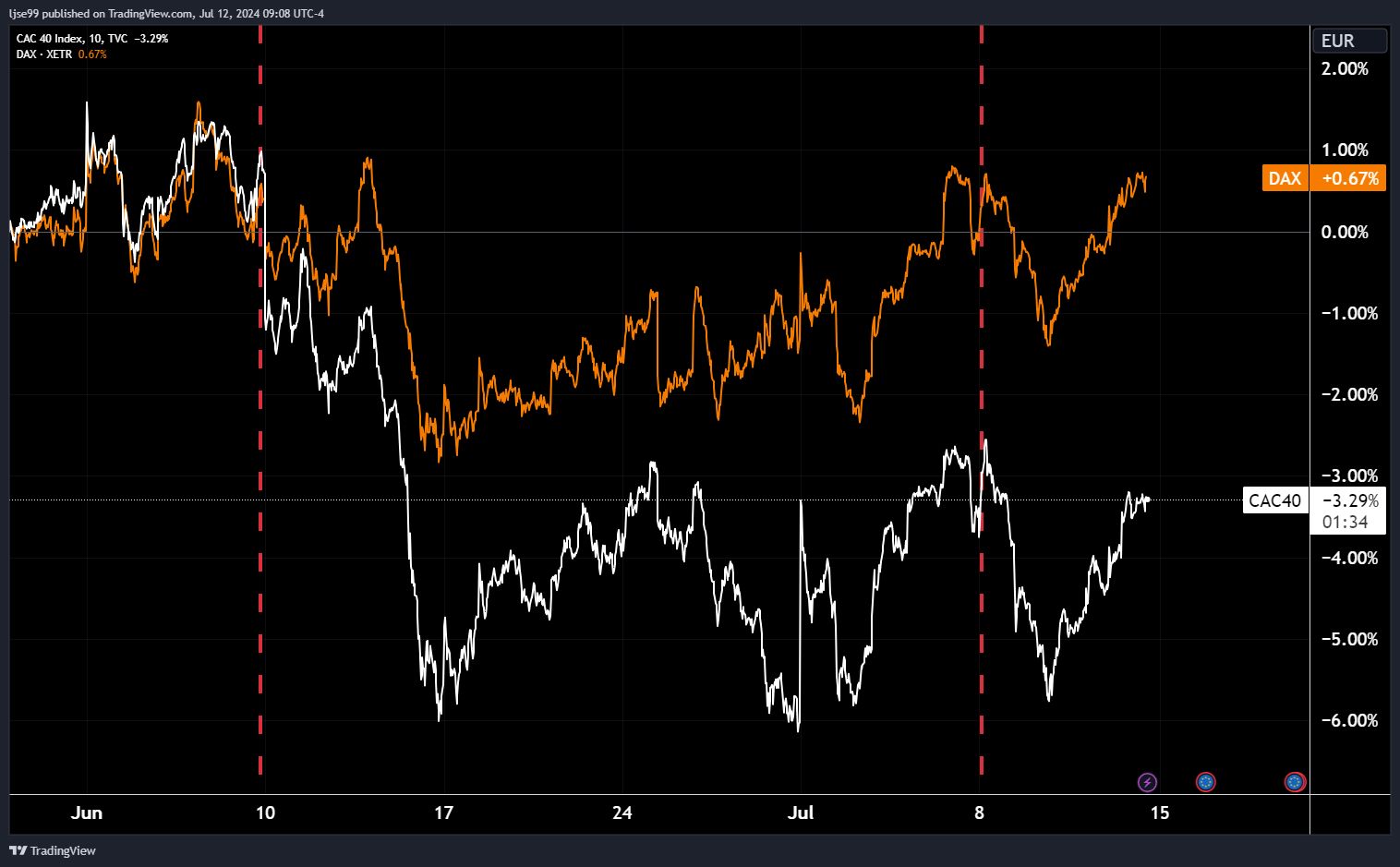 Figure 7 – French and German equity returns – Source: TradingView, 2024.
While German markets have moved broadly inline with French markets, downward movements have been less pronounced in Germany and recoveries weaker in France, with French equities exhibiting overall higher levels of volatility.
Finally, in fixed income markets the risks posed by the incoming French government are already being priced in, with bond investors demanding a premium to own French debt versus safer German debt.
What does this all mean going forward?
Looking purely from a market perspective these results are unambiguously good for UK markets. Valuations in UK markets have been particularly low since the 2016 Brexit vote and the subsequent political uncertainty, while France has attracted much inbound capital that would likely have landed on our shores. For so long as France remains politically unstable this is likely to reverse – we have already seen large Japanese and Taiwanese bond investors, primarily insurers, pull away from new French bond issuances and start to trim their holdings.
Outside of the France vs UK capital attraction comparison there is also the question of the FTSE 250, which having already got off to a good start looks primed to continue its strong performance – caveated with the fact that external factors, like a global recession, could easily blow things off course. Should the Labour government successfully implement their desired planning reforms and even get close to their target of the highest GDP growth in the G7, smaller UK companies can be expected to see material improvements in their business fundamentals, and with international investors finally giving the UK serious consideration, should also see the stock price gains to match. We remain cautiously optimistic for future UK market prospects.
If you have any questions about your portfolio please don’t hesitate to contact your adviser.
Arrange your free initial consultation
This market update is for general information only, does not constitute individual advice and should not be used to inform financial decisions.
Past performance is not a guide to future returns. Investment returns are not guaranteed, and you may get back less than you originally invested.

UK Tax Planning for high income earners
After years of frozen thresholds, reduced personal allowances and fiscal drag, tax planning for high earners has become increasingly important. The Autumn Budget 2025 and Spring Statement 2026 added further pressure, particularly for those with larger pension pots, higher value homes, investment income or estates already close to inheritance tax allowances.
A ‘high earner’ in terms of tax used to be reserved only for someone earning a very large salary, but now someone earning over £50,270 can fall into higher rate tax bands, while those earning more than £100,000 can lose their personal allowance entirely. The £12,570 tax-free Personal Allowance reduces (tapers) by £1 for every £2 you earn over £100,000. By the time your adjusted net income reaches £125,140, your allowance drops to zero.
For people with significant assets, the challenge is wider than income tax alone. Pensions, property, investments and inheritance tax all need to be considered together.
Arrange your free initial consultation
Tax can have a big impact on your ability to preserve and grow your savings and investments in retirement. As such, one of the main focuses when advising clients, is creating a plan that helps them achieve their objectives in the most tax-efficient manner. There are several ways to reduce the tax you pay on your annual income, especially if you’re in the higher or additional rate tax bracket.
What are the main taxes?
Income tax
Income tax is a tax imposed directly on your personal income. In simple terms, it is paid at rates between 0% and 45% dependent on which of the income tax brackets you fall into.
Once your earnings exceed your personal allowance, you are required to pay tax on the following sources of income:
- Income from employment
- Income from pension
- *Interest on savings
- Property rental income
- Employment benefits
- Income from a trust
*Interest would only be taxable above the personal allowance, the starting rate and personal savings allowance.
As of the 2026/27 tax year:
- The personal allowance remains at £12,570
- Basic rate tax (20%) applies to income from £12,571 to £50,270
- Higher rate tax (40%) applies from £50,271 to £125,140
- Additional rate tax (45%) applies from £125,141+
These thresholds are now frozen until 5 April 2031, further extending the impact of fiscal drag.
Dividend Tax
The dividend allowance remains £500, but dividends above this are taxed at 10.75% for basic rate taxpayers, 35.75% for higher rate taxpayers and 39.35% for additional rate taxpayers. From April 2027, tax on savings interest and property income is also due to rise by two percentage points.
If you are a Scottish taxpayer, income tax bands differ from the rest of the UK, so regional rules should be factored into your planning.
Capital Gains Tax
Capital Gains Tax (CGT) is paid on the profit made when you dispose of certain assets, such as shares, second homes, or other investments held outside of a tax-efficient wrapper.
For 2026/27, the CGT annual exemption remains £3,000, much lower than £12,300 in 2022/23. Gains above the allowance are generally taxed at 18% for basic rate taxpayers and 24% for higher and additional rate taxpayers, depending on how the gain falls across your tax bands.
Inheritance Tax
Inheritance Tax (IHT) is a tax on the value of an estate upon death or on certain gifts made during your lifetime.
- The nil-rate band remains at £325,000
- *The residence nil-rate band offers an additional £175,000 if passing a home to direct descendants
- The standard rate of IHT is 40%, or 36% if at least 10% of the net estate is left to charity
*To qualify for the Residence Nil Rate Band (RNRB), an estate must pass a residential property (or equivalent assets if downsized) to direct descendants. The deceased must have lived in the home at some point, and the net value of their total estate must be under £2 million.
From 6 April 2027, most unused pension funds and pension death benefits will be brought into a person’s estate for IHT purposes. This is one of the biggest upcoming changes for high earners, as pensions have often been used as an efficient way to pass wealth to the next generation.
Options to consider may include reviewing beneficiary nominations, drawing pension income differently, lifetime gifting, life insurance cover, charitable giving, trust planning where suitable, and using other assets before pensions. The right approach will depend on income needs, tax position, health, age, family circumstances and estate value.
High value property is also becoming a bigger issue. The proposed mansion tax, formally expected to be a High Value Council Tax Surcharge, is due to apply from April 2028 to homes in England valued above £2 million. For high earners with substantial property wealth, this could add an annual cost and may influence gifting decisions, estate planning and whether it remains practical to retain a family home.
How to reduce taxable income as a high earner
Reducing your taxable income can be one of the most effective ways to lower your overall tax bill. For high earners, this might mean utilising pension contributions, salary sacrifice, or charitable giving to stay within lower tax bands or reclaim lost allowances.
Reducing adjusted net income below £100,000 can help restore some or all of the personal allowance. Keeping income below £80,000 may reduce or remove the High Income Child Benefit Charge, while keeping income below £50,270 may help avoid higher rate tax.
Why is tax planning important?
Tax planning involves minimising tax liabilities by utilising allowances, exemptions, and tax reducers to lower the tax you pay, so it should be an essential part of an individual’s financial plan.
For high earners, planning is particularly important because several thresholds interact. These include the personal allowance taper above £100,000, the High Income Child Benefit Charge above £60,000, the tapered pension annual allowance for the highest earners, the £2 million IHT residence nil rate band taper and the future inclusion of pensions in estates from April 2027.
What is higher rate tax?
For 2026/27, higher rate tax begins with earnings between £50,271 and £125,140, which are taxed at 40%. Those earning above £125,140 are taxed at 45%. Because thresholds are frozen until 2031, more people are likely to pay 40% or 45% tax even if their real spending power has not improved.
Those earning less than £50,270 and more than £12,571 will pay the basic rate of tax at 20%. Most people do not pay income tax on the first £12,570 they earn because this falls within the personal allowance. Income above this is then taxed in bands.
High earners cutting pay: should you consider it?
Some high earners are now deliberately cutting their pay or exchanging salary for pension contributions or other benefits as a strategic way to reduce tax liability. This is often done through salary sacrifice or personal pension contributions, which can lower your taxable income, increase pension savings, and in some cases reclaim lost allowances such as the personal allowance or avoid additional tax charges like the High-Income Child Benefit Charge.
Salary sacrifice is especially valuable for high earners because it can provide both income tax and National Insurance savings. It may also allow an employer to pass on some or all of its own National Insurance saving into the pension. For those affected by the personal allowance taper, it can be particularly powerful because reducing adjusted net income can improve the effective rate of relief.
However, this benefit is changing. From April 2029, the National Insurance exemption for employee pension contributions made through salary sacrifice will be capped at £2,000 a year. Contributions above that level can still be made, but the National Insurance advantage will be reduced. This is likely to affect high earners most because they are more likely to sacrifice larger sums into pensions.
Ways to reduce your income tax bill
There are a few ways in which you can reduce your income tax bill. Broadly, they are as follows:
Contribute to your pension
Pension contributions remain one of the most effective tax planning tools for high earners. Contributions usually receive basic rate relief automatically, with higher and additional rate relief claimed through self assessment where appropriate.
The pension annual allowance remains £60,000 for 2026/27, although it can be tapered for the highest earners. ‘Carry forward’ may allow unused annual allowance from the previous three tax years to be used, provided the rules are met and the individual has enough relevant UK earnings.
For those earning between £100,000 and £125,140, pension contributions can be especially valuable. This is because the personal allowance is reduced by £1 for every £2 of income above £100,000, creating an effective marginal tax rate of up to 60%. A pension contribution can reduce adjusted net income and potentially restore some or all of that allowance.
Contribute to your pension via salary sacrifice
You can ask your employer to enter into a salary sacrifice contribution arrangement to your pension, which will reduce the amount of money subjected to the highest rate of income tax (or various rates depending on the tax bands the income falls into after the sacrifice), along with also providing valuable National Insurance savings. This can become quite complicated, and more details can be found on the government website.
A notable additional benefit of salary sacrifice arrangements is that depending on your employer, they may pay the National Insurance Contributions savings they make from the forgone salary into your pension.
Do take care though as the government is planning to make changes to how salary sacrifice for pension contributions work from April 2029 by capping the National Insurance (NI) exemption to £2,000 per year.
Make full use of your ISA annual allowance
ISAs remain a valuable way to shelter income and growth from tax. The overall ISA allowance remains £20,000 for 2026/27. From April 2027, the Cash ISA limit for those under 65 is due to fall to £12,000, although the overall ISA allowance is expected to remain £20,000.
Up to 60% tax relief available when you invest in a pension
Investing in your pension pot is an attractive option to increase your savings in a tax efficient way. We actively encourage clients, when suitable, to contribute regular amounts to their pension to not only build up their pension pot but also to benefit from tax efficiencies.
For those earning between £100,000 and £125,140 you could be in the 60% tax trap. But this also presents an opportunity when it comes to saving for retirement. If you have taxable income in this range, you can effectively receive income tax relief of 60% on your pension contributions as this is the marginal rate of tax paid on earnings within this band. This is due to the impact of your personal tax allowance of £12,570 being reduced by £1 for every £2 you earn over £100,000 meaning the allowance is reduced to zero when your income reaches £125,140. A pension contribution within this band of earnings effectively reclaims part, or all, of your personal allowance thus increasing the rate of tax relief to 60%.
How to avoid the High Income Child Benefit Charge
For 2026/27, the High Income Child Benefit Charge applies where the higher earning partner has adjusted net income above £60,000. The charge removes 1% of Child Benefit for every £200 of income above that level, with the full amount effectively lost once income reaches £80,000. Pension contributions and Gift Aid donations can reduce adjusted net income, which may reduce or remove the charge.
The benefits of charitable giving
Giving to charity can reduce income tax and, in some cases, inheritance tax. Through Gift Aid, a charity can claim an extra 25p for every £1 donated by a UK taxpayer. Higher and additional rate taxpayers can then claim further relief through self assessment.
Charitable giving can also reduce IHT if at least 10% of the net estate is left to charity, as this can reduce the IHT rate from 40% to 36%.
Tax relief schemes and other allowances
Venture Capital Trusts (VCT), Enterprise Investment Scheme (EIS) and Seed Enterprise Investment Scheme (SEIS) investments can offer valuable income tax relief, although they carry higher risk and are not suitable for everyone. For 2026/27, EIS relief remains 30% and SEIS relief remains 50%, while VCT income tax relief has reduced from 30% to 20% from 6 April 2026.
These investments can appeal to high earners who have already used pensions and ISAs, but they should only be considered as part of a diversified plan and with appropriate advice.
Don’t invest unless you are prepared to lose all the money you invest. This is a high risk investment and you are unlikely to be protected if something goes wrong.
But, as higher risk investments they are not suitable for all investors. There is a chance that all of your capital could be at risk and you should not invest into these types of plans without seeking expert advice from a reputable firm of independent advisers such as The Private Office.
|
Don’t invest unless you’re prepared to lose all the money you invest. This is a high-risk investment and you are unlikely to be protected if something goes wrong. |
|---|
How we can help
If you would like to find out more about how The Private Office can help with personalised tax efficient financial planning, please enquire for a free initial consultation with one of our Independent Financial Advisers.
Arrange your free initial consultation
The information contained within this article is based on our understanding of legislation, whether proposed or in force, and market practice at the time of writing. Levels, bases and reliefs from taxation may be subject to change.
The content in this article is for information only and does not constitute individual financial advice.
The value of your investments can go down as well as up, so you could get back less than you invested.
A pension is a long-term investment not normally accessible until age 55 (57 from April 2028 unless the plan has a protected pension age). The value of your investments (and any income from them) can go down as well as up which would have an impact on the level of pension benefits available.
Your eventual income may depend on the size of the fund at retirement, future interest rates and tax legislation.
The Financial Conduct Authority (FCA) does not regulate estate planning or tax advice.
VCTs are high risk investments and there may be no market for the shares should you wish to dispose of them. You may lose your capital.

Nine ‘finfluencers’ charged in FCA crackdown
The financial industry regulator, the Financial Conduct Authority (FCA), has charged nine ‘finfluencers’ – individuals that give unlicensed financial advice on social media – in a crackdown on financial misinformation and exploitation, which can be rampant on social media platforms.
One of the nine, Emmanuel Nwanze, was charged with running an unauthorised investment scheme and issuing unauthorised financial promotions. The FCA alleges that, between 19 May 2018 and 13 April 2021, Nwanze used an Instagram account to provide advice on buying and selling Contracts For Difference (CFDs) when they were not authorised to do so. CFDs are well known for being high-risk investment products that are used to bet on the price of an asset.
The FCA is intent on making an example out of the nine to discourage further unregulated advice of this nature.
Six of the defendants appeared before Westminster Magistrates Court on 13 June 2024. A further three with appear before the court on the 3 July.
What is a ‘finfluencer’?
Finfluencer is a relatively new term, used to describe a content creator who operates on social media to promote financial products and services to their audience. What separates a finfluencer’s advice from regulated financial advice is the finfluencer is often unqualified, unauthorised and unregulated. This means that it is common for them to promote risky investments, with no understanding of the consequences, often to the detriment of their audience and pure financial gain to them.
Finfluencer derives from the term ‘influencer’ which, in marketing and social media terms, refers to a person with the ability to influence viewer’s opinions on social media or video sharing platforms like YouTube.
The problem with finfluencers
If an finfluencer is knowledgeable about the product or service they promote and their content is considered 'responsible' by the FCA, finfluencers can actually be beneficial. They help buyers evaluate their choices and understand the variety of products available to them in a simple and easy to digest way.
The problem is that there are many examples like the nine that have been charged by the FCA, where this is not the case. Many finfluencers promote illegitimate 'get rich quick' schemes or act irresponsibly in their communications, with endorsement of questionable crypto investments and ‘memestocks’ being a common trend. In such cases, less knowledgeable audience members get exploited and even scammed.
Aside from the obvious detriment to the victims of this kind of unlicensed advice, the wider reaching implications is that this misinformation leads to a general distrust of the financial services industry, further discouraging financial literary and ultimately hurting the consumer.
If you are concerned about possible misinformation and are seeking real, impartial and fully qualified financial advice, book a free non-committal initial consultation with one of our qualified advisers who will be happy to see if we can help. Alternatively, you can give us a call on 0333 323 9065 to get in touch with a member of our team to find out more.
Arrange your free initial consultation
This article is intended for general information only, it does not constitute individual advice and should not be used to inform financial decisions.
Investment returns are not guaranteed, and you may get back less than you originally invested.

Ups, Downs and Elections – it’s a summertime roller coaster for investors
This month’s TPO Investment Market Update looks at how markets have developed since last month’s update, reiterating the benefits of portfolio diversification. The drivers of the top 3 performing major equity indices are looked at in more detail and we discuss the recent and upcoming elections globally and the impact of these on markets.
Arrange your free initial consultation
In last month’s update we discussed the benefit of holding a regionally diversified portfolio, given the reversal of return patterns between Q1 and April i.e. UK and Chinese equities outperformed, having lagged behind in Q1. We are now two thirds of the way into Q2 so for this month’s edition let’s see how markets have developed. We will also touch on the political environment, focussing on elections happening across the globe.
Market returns and the benefit of diversification
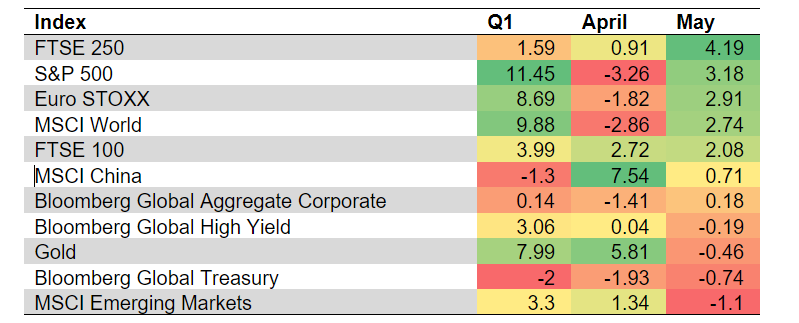 Figure 1 – Major equity & fixed income index returns – Source: FE Analytics, 2024.
May again proved the benefit of not concentrating your portfolio in just one or two assets. The S&P 500, which tracks the US stock market, was the second-best performer, having been amongst the worst in April. The FTSE 250, which tracks medium sized UK companies, was the best performer in May, having been towards the bottom in April and Q1. On the other end, gold, which had been the second-best performer in April was towards the bottom in May. Unless you have a crystal ball, it therefore pays to split your eggs amongst many baskets.
US Markets
Having reiterated the benefit of diversification, lets dive into the most notable drivers of returns in May, starting with the world’s largest equity market, the United States. Returns in the US have become increasingly dominated by only a handful of companies, to a degree that is unprecedented in recent memory. The chart below shows the top 10 companies’ share of total S&P 500 market capitalization, and the table shows the specific companies.
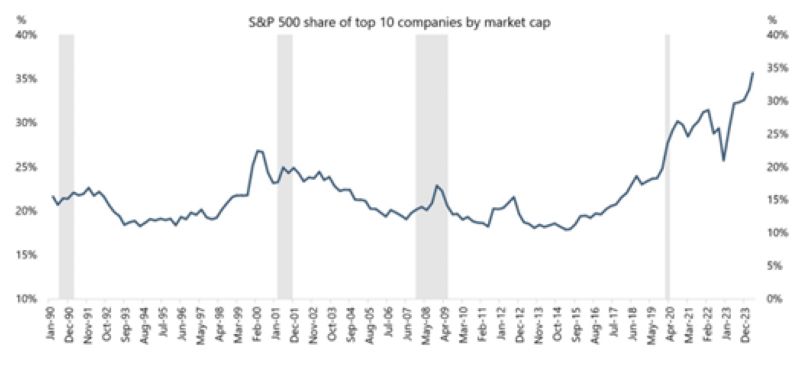
Figure 2 – Top 10 companies share of S&P 500 market capitalization – Source: Yahoo Finance, 2024.
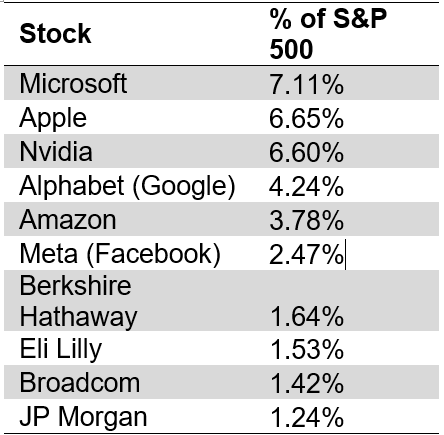
Figure 3 – Top 10 S&P 500 companies by market capitalization – Source: Slickcharts, 2024.
It is striking that the top 6, along with Broadcom, are all semi-monopoly technology companies. The dominant market positions they have achieved allow them to rake in large and growing profits and build up significant cash buffers. Investors have therefore piled into these stocks due to their superior profit growth, along with the safety afforded by their large cash piles. US investor sentiment is such that investors are willing to take risk and buy up on equities, but are still somewhat worried about a slowdown in economic growth, and so are averse to taking the risks associated with owning stocks more exposed to the business cycle and with smaller cash buffers.
European Markets
European equities have had a similarly good month. This came on the back of two primary causes, the first being a better-than-expected earnings season (in which 288 of 600 companies have so far reported their Q1 earnings), and the second being the expectation during May that the ECB would cut interest rates in June, which they now have. Looking at the first of those causes, the chart below shows by how much reported earnings beat market expectations by sector.
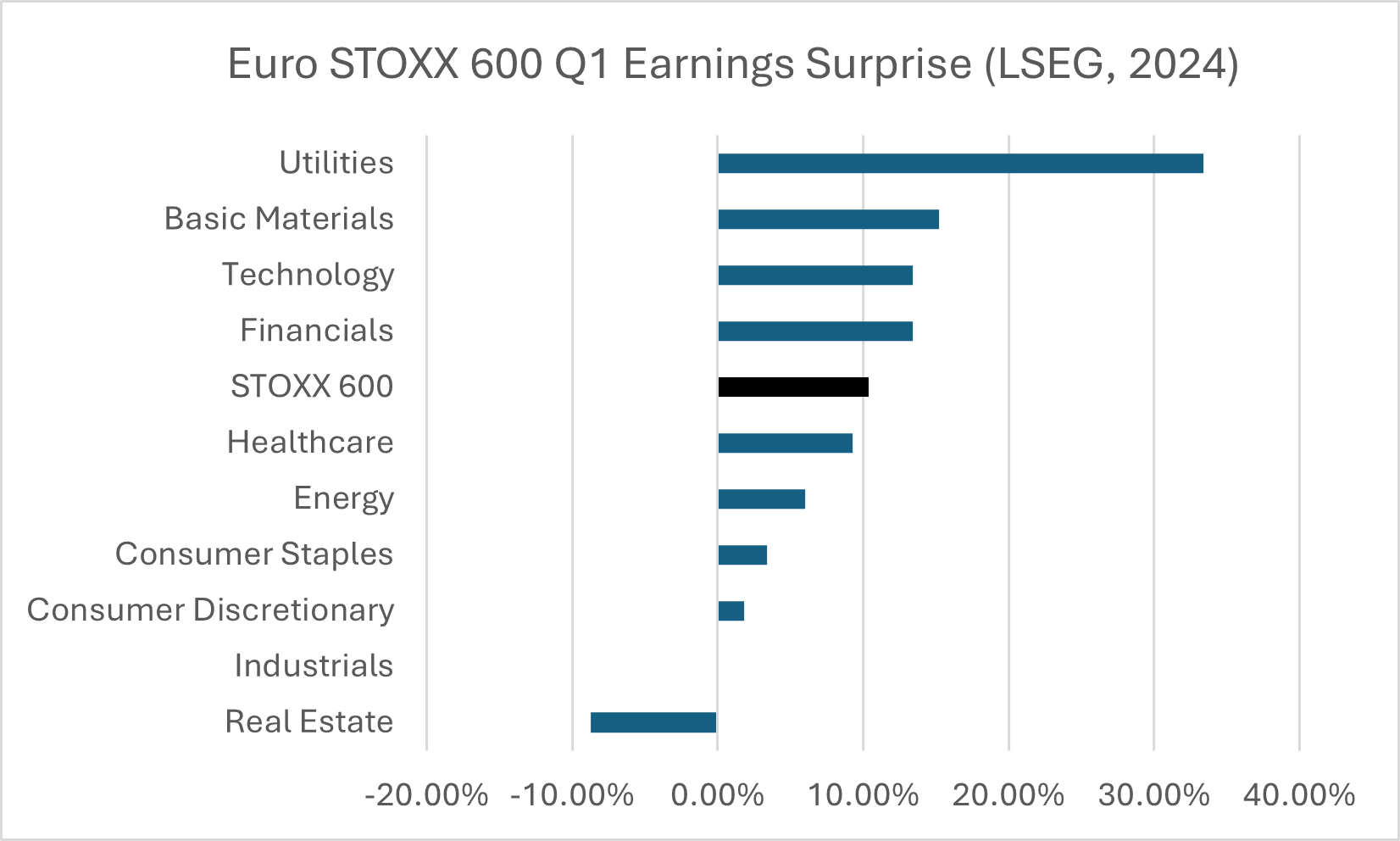 Figure 4 – STOXX 600 Q1 sectoral earnings surprise – Source: LSEG, 2024.
Across the whole market, European companies have beaten expectations by 10%, with only industrials and real estate underperforming expectations.
The second cause for European equity strength was the expectation of an ECB rate cut in June. Inflation has been falling in Europe and has got close to the 2% target, allowing the ECB to make an initial rate cut. This is in the context of a German economy still struggling with the effects of high energy prices, due to the Ukraine war, and increased export competition from China.
UK Markets
The final market that’s worth covering before we touch on elections is the FTSE 250, an index measuring the performance of mid-sized UK companies. The chart below shows the valuation of the FTSE 250 (dark blue line) versus mid-sized companies in other developed markets. The valuation metric used is Price-to-Earnings (P/E), which describes how many pounds you pay in stock price for a pound of company profits.
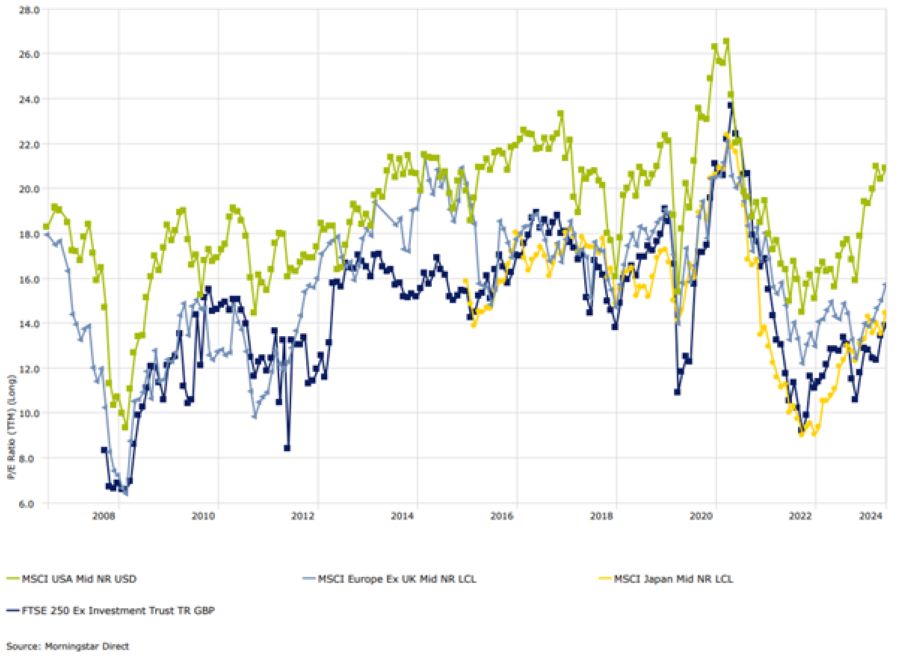
Figure 5 – P/E ratio of mid-cap indices in major developed markets – Source: Morningstar, 2024.
For mid-sized US companies, you are paying £20 for every £1 of company profits, whereas in the UK you only pay £14 for every £1 of company profits. While the US has long traded at a premium, this gap is wider than the long-term average and represents good value to international investors looking for a bargain. Where we have seen the most interest has been from large companies and private equity investors looking to purchase whole companies – recent examples include the £5bn private equity bid for Hargreaves Lansdown and American Industrial Partners £2.5bn bid for Serco. As this inbound merger and acquisition activity has increased, investors have bid up shares they think could be a future takeover target.
Elections
It has been a busy month for elections, with European, Mexican and Indian elections all taking place already, UK and French elections being called, and US election campaigning getting started.
Indian and European elections both caused volatility in their respective markets. Indian equities fell around 8% and then quickly regained that upon Modi’s win. In Europe, the surprise victory of the Le Pen’s National Rally in France during the European Parliamentary elections caused jitters in bond and currency markets. UK and European elections are yet to cause significant volatility but it is expected closer to voting.
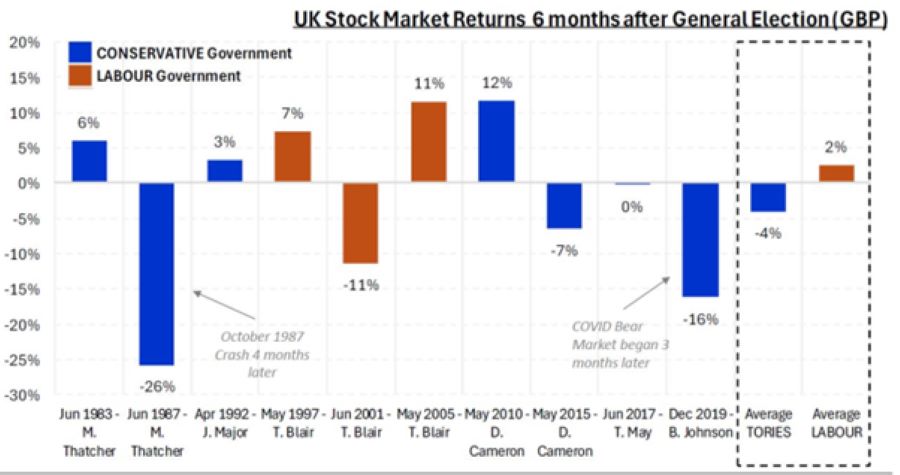
Figure 6 – UK stock market returns 6m after elections – Source: FE Analytics, 2024.
Average returns following a Labour victory, which is expected this election, have been better than under Conservative victories, although this number is distorted by the 1987 and ‘covid’ market crashes. From speaking to fund managers and allocators in the City, most are broadly welcoming of the stability expected under Starmer and Reeves, so the election should be supportive of equity returns.
Conclusion
In conclusion, equity markets continue to move upwards and make all-time highs, despite the bumps in the road felt during April. While performance has varied between regional markets from month to month, reinforcing the value of a diversified portfolio, the general trend is upwards. Political instability, primarily caused by elections, has, and will increase the volatility of markets, however the historical data, at least in the UK, points to the election being supportive of equity returns.
If you have any questions about your portfolio please don’t hesitate to contact your adviser.
Arrange your free initial consultation
This market update is for general information only, does not constitute individual advice and should not be used to inform financial decisions.
Past performance is not a guide to future returns. Investment returns are not guaranteed, and you may get back less than you originally invested.

The new rules around sustainable investing
Environmental, Social, and Governance (ESG) investing refers to an investor's desire to invest not only for financial gain but also to have a positive impact on the environment, ensuring that a company has a positive impact on society while adhering to strong governance standards.
The term ‘ESG investing’ has also been used interchangeably to describe ethical investing which is to invest in line with one’s own belief system, and impact investing which is to invest for both a financial goal and a specific environmental or social outcome.
The history of ESG investing
You might think that ESG investing is a relatively new concept, but we can go back to the early 1950s with Howard Bowen's book "Social Responsibilities of the Businessman," in which he articulated that businesses have a moral obligation to serve not only their customers, but also the society in which they operate (and thrive). The UN's "Who Cares Wins" report in 2004 was another watershed moment in which the term 'ESG' was formally introduced into our common language. It served as the foundation for the launch of the UN Principles for Responsible Investment (PRI) in 2006, which encouraged the incorporation and adoption of ESG values into an investor's decision-making processes.
Demand for ESG products still exists
Fast forward to the present day, and while there have been additional (welcome) developments in the regulation and formalisation of ESG investing, there has also been a notable alignment of economic and social goals.
Some notable examples include the strong emphasis from governments to adopt clean energy policies and labour policies across the western world, coming under further scrutiny with the ‘fair pay for fair work’ campaign.
This demand for ESG products is only likely to accelerate with further need for companies to adopt sustainable business practises.
Greenwashing & the number of ESG funds
Due to this rising consumer demand, the market has seen an increase in the number of financial products and services that claim sustainability features. However, this has increased the risk of greenwashing, in which companies' sustainability claims are exaggerated, misleading, or unsubstantiated.
Between 2021 and 2023, the FCA received over 1,700 applications to launch a new ESG or sustainability-focused fund (Source: Morningstar). This prompted the FCA to state that:
“We have seen numerous applications for authorisation of investment funds with an ESG or sustainability focus. A number of these have been poorly drafted and have fallen below our expectations. They often contain claims that do not bear scrutiny.” (July 2021).
What are Sustainability Disclosure Requirements?
In response, the FCA has introduced the Sustainability Disclosure Requirements, also known as 'SDR', with the goal of protecting consumers and ensuring a fair marketplace, published 28/11/2023.
The SDR are multifaceted, but the overarching goal is to assist consumers in making informed decisions based on their sustainability preferences, while also promoting fairness among firms that provide genuinely sustainable products and services.
The anti-greenwashing rule
The SDR introduces a new rule that requires all regulated firms, ensure that any sustainability-related marketing claims are clear, fair, and not misleading, as well as consistent with the product's sustainability profile. There are also limits on the use of sustainable terms in product names and marketing.
What is happening to the term ‘ESG Investing’?
To date, a fund could be marketed as 'ESG', 'Sustainable' or a range of other green descriptives with little oversight, however, the SDR has implemented a new fund labelling system with prescriptive guidelines on how funds can be marketed.
From 31st July 2024, fund managers can begin to use one of four labels which, whilst not meant to be hierarchical (an investor can choose a fund which aligns with their preference), will allow investors to identify suitable products and make comparison between funds far easier.
The four labels include:
| Label | Sustainable objective |
|---|---|
| Sustainability Focus | To invest in assets that are environmentally and/or socially sustainable determined by a robust evidence-based standard of sustainability |
| Sustainability Improvers | To invest in assets that have the potential to improve their environmental and/or social sustainability over time, determined by their potential to meet a robust, evidence-based standard of sustainability over time (this is required to be an absolute measure) |
| Sustainability Impact | To achieve a predefined, positive, measurable impact in relation to an environmental and/or social impact |
| Sustainability Mixed Goals | To invest in two or more of the above sustainability objectives |
To use a label a fund must have at least 70% of its assets in alignment with one of the above sustainability objectives. It remains to be seen how many funds will apply for a label but estimates from Morningstar are that 300 existing funds will seek a label.
It should be noted that the SDR applies only to UK domiciled funds this is unlike the SFDR (the European Commission’s approach to regulating ESG funds) which applies to funds globally if they are marketed in Europe.
These labels can be accompanied by the following images:
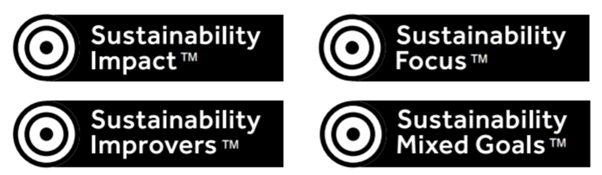
Source: FCA's Policy statement PS23/16
If you would like more information, why not arrange an initial free consultation with a financial adviser today?
Arrange your free initial consultation
This article is intended for general information only, it does not constitute individual advice and should not be used to inform financial decisions.
Investment returns are not guaranteed, and you may get back less than you originally invested.
Past performance is not a guide to future returns.
The Financial Conduct Authority (FCA) does not regulate cash flow planning or tax advice.

Diversify or die - the case for balanced investor portfolios
In our Investment Markets update this month, we’re going to cover the following 2 themes:
-
How April 2024 contrasted to Q1, leading to the benefits of diversification.
-
The impact of the change in monetary policy expectations in April and how this drove returns.
Arrange your free initial consultation
Market Volatility and Investor Sentiment
Markets are fickle and are prone to reversing their trends at the drop of a hat. The fundamental forces that underpin them are usually slow moving, but investors animal spirits aren’t easily tamed. They can bolt like a wild beast in response to small disturbances, in the form of economic data releases that don’t conform to expectations. This was the case in April, when markets took slowing US economic growth and sticky inflation data poorly, causing a stampede to exit many of the main regional equity and fixed income markets. That said, there were some regions that maintained their sense of calm and even excelled – reinforcing the value of holding a portfolio diversified across geographies.
Q1 Market Performance
To frame this story we’d like to show you how markets behaved from January to March. The table below provides a brief summary.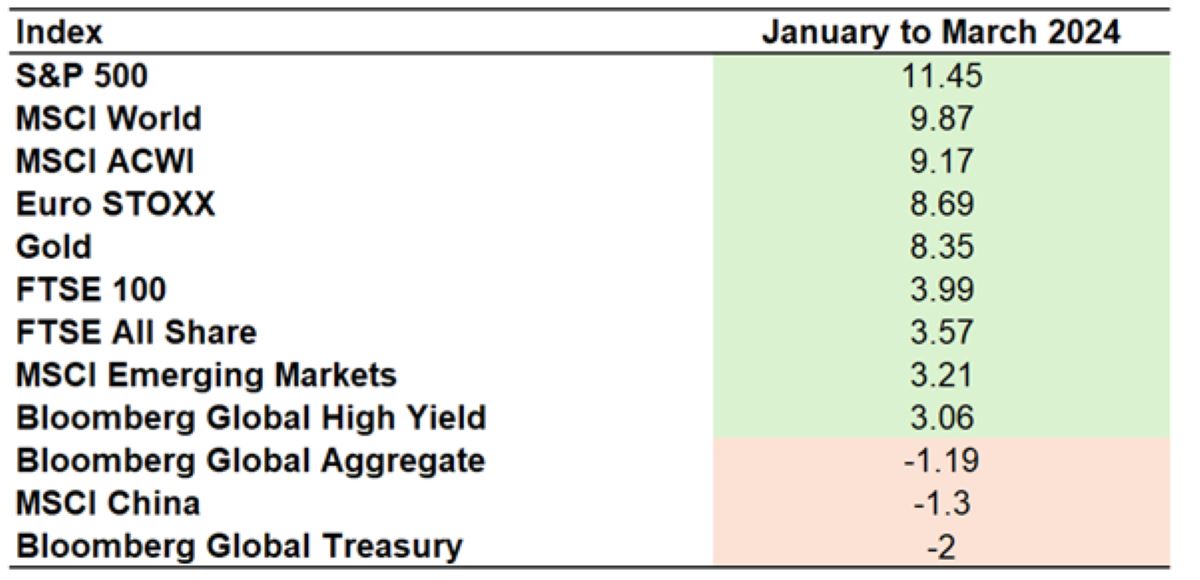 Figure 1 – Table of returns to key global asset classes – Source: FE Analytics, 2024.
US equities, in the form of the S&P 500 index, led the pack and drove global equity returns, represented by the MSCI World and ACWI indices. UK equities, in the form of the FTSE 100 and FTSE All Share indices, posted respectable performance, however lagged their European and US peers. Chinese equities were in the doldrums, pulled down by negative investor sentiment engendered by a deflating property bubble and the overhang of geopolitical tensions. In a few words: the US excelled, the UK did OK, and China saw serious underperformance.
April's Market Reaction
So what happened in April? US inflation and growth data disappointed investors relative to their expectations. Firstly, economic growth slowed, taking some initial wind out of the sails of US equities, but didn’t slow enough to force the Federal Reserve into signalling interest rate cuts. Secondly, US inflation remained more sticky than investors had hoped, with that last mile down to the 2% target being frustratingly elusive. The inability for inflation to make that final leap below 2% caused much consternation among investors, who removed between 1 and 2 expected interest rate cuts from their pricing of bond yields, causing bond yields to rise and subsequently equity prices to fall. US markets, in the main, drive global markets so this trend spread across most developed markets.
Interest Rate Expectations
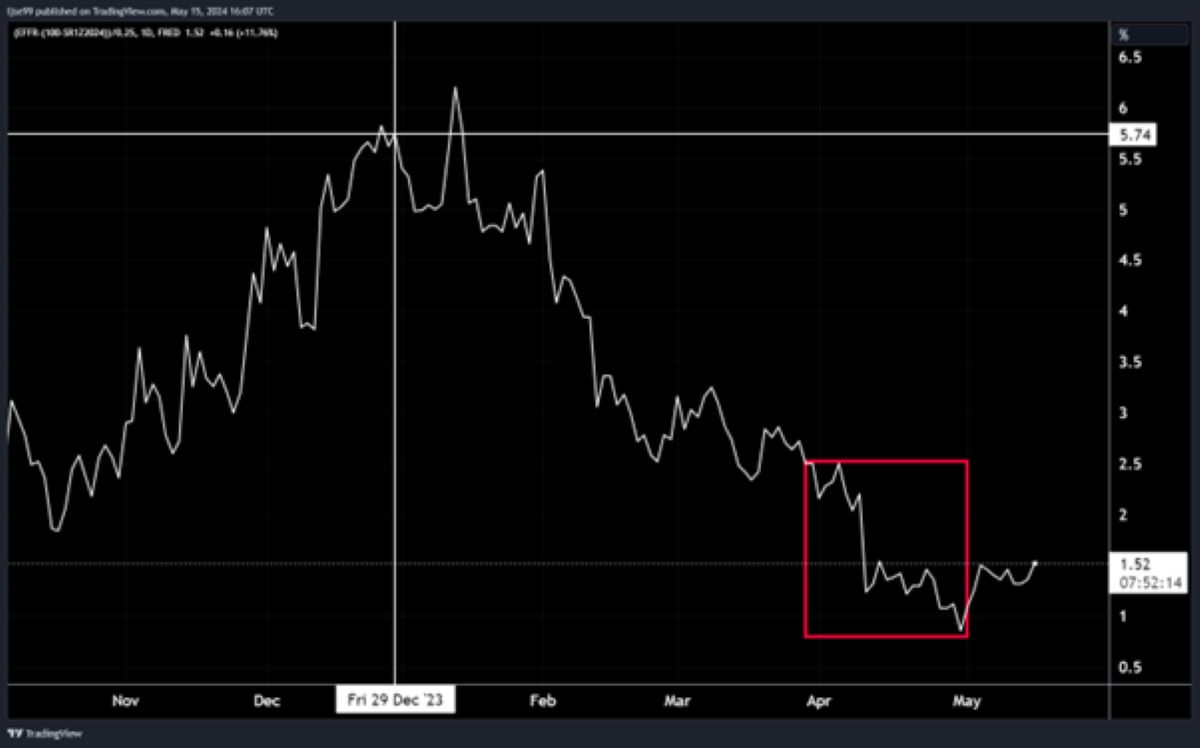 Figure 2 – Number of Federal Reserve interest rate cuts by the end of 2024 expected by markets – Source: TradingView, 2024.
The chart above illustrates the rollercoaster of interest rate expectations through the year. Markets expected nearly 6 interest rate cuts in 2024 at the start of 2024. By the beginning of April this was down to 2.5 cuts and by the end of April, following US GDP and inflation data, this was down further to only 1 interest rate cut. That final move has been boxed in red. This is a return of the so called ‘higher for longer’ interest rate narrative.
Resilience of Diversified Portfolios
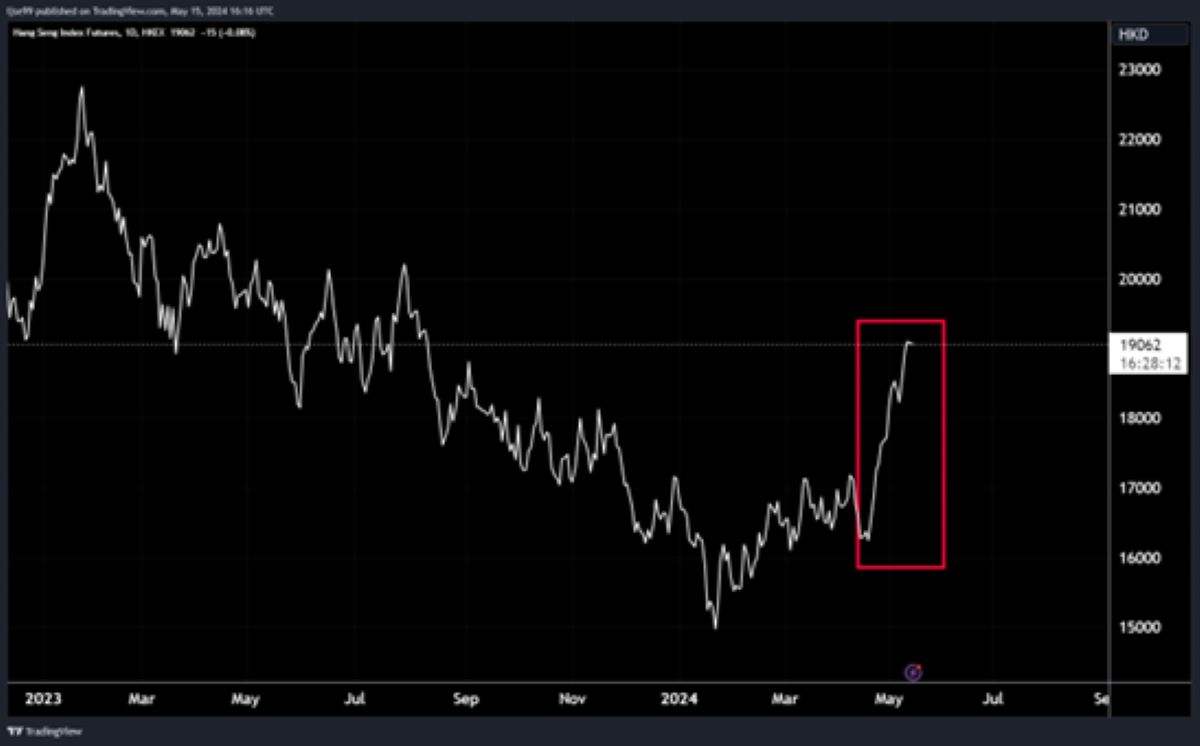 Figure 3 – Hang Seng equity index returns 2023 to date, with recent upwards thrust boxed in red – Source: TradingView, 2024.
However, all was not lost, especially for investors with a diversified portfolio. Chinese equities finally made their comeback, following a year of brutal drawdowns – Chinese authorities had engineered a small reversal in price slides through numerous measures (some as extreme as banning onshore fund managers from selling) and this initial price action drew in western investors who had sat on the side lines for the last year. As western investors returned, prices surged upwards , shown in the Figure 3
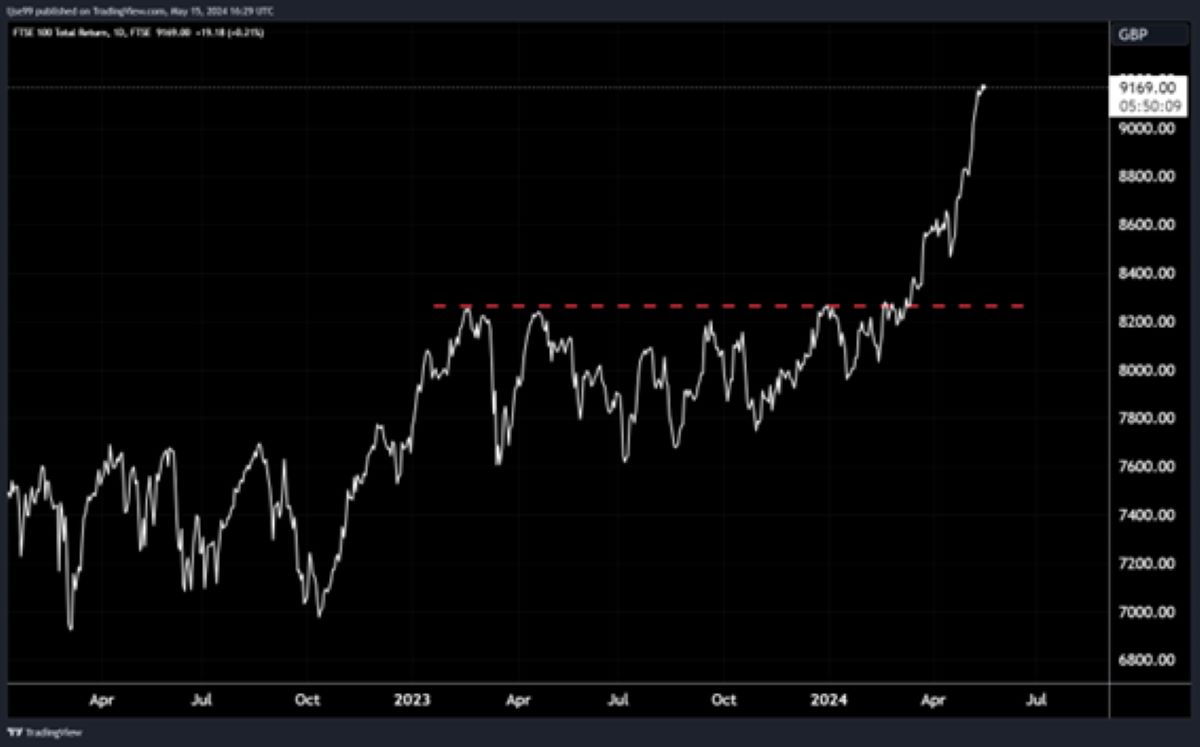 Figure 4 – FTSE 100 Total Returns – Source: TradingView, 2024.
Potentially more relevant to readers in the UK was the performance of UK markets, which broke out from the cage they had been trapped in for 2023 and the start of 2024. The UK has a very different sector composition to US markets: where the US is heavy on high growth technology stocks, the UK has more of the older world industries which have underperformed over the long run but are well suited to periods of rising interest rates and elevated commodity prices (which remain high due to geopolitical tensions).
| Pre-tax profit | |
|---|---|
| Financials | 27% |
| Oil & Gas | 20% |
| Consumer Staples | 13% |
| Mining | 11% |
| Consumer Discretionary | 8% |
| Health Care | 8% |
| Industrial goods & services | 7% |
| Utilities | 3% |
| Telecoms | 2% |
| Real estate | 1% |
| Technology | 0% |
Figure 5 – Sectoral pre-tax profit share of the FTSE 100 – Source: Investor Chronicle, 2024.
The table in Figure 5 shows the sectoral share of FTSE 100 profits. Notable is the high share of financials (mainly banks) and energy and mining companies. Banks benefit from interest rates remaining higher for longer because it extends the period in which they can offer loans at high interest rates, increasing their margins and benefitting their profitability. Energy and mining companies benefitted from elevated commodity prices, which have seen an uplift as geopolitical tensions raise questions over security of supply.
Conclusion
In conclusion, markets at the highest level performed well from January to March, but took a tumble in April as slowing US economic growth and sticky US inflation caused investors to worry about the future path of interest rates – but this pain was not evenly spread, with some of the initial laggards becoming the best performers. This recent experience reinforces the need for a portfolio that is diversified across geographies, economic sectors and asset classes.
If you have any questions about your portfolio please don’t hesitate to contact your adviser.
Arrange your free initial consultation
This market update is for general information only, does not constitute individual advice and should not be used to inform financial decisions.
Past performance is not a guide to future returns. Investment returns are not guaranteed, and you may get back less than you originally invested.

The investment crystal ball - What do we know so far?
With the first quarter of the year already wrapped up (it feels like Christmas was yesterday!) we thought it would be worth recapping the high-level macroeconomic picture and summarising the notable movements in markets through the quarter. We start with economic growth below.
Arrange your free initial consultation
Macroeconomics - Economic Growth & Inflation
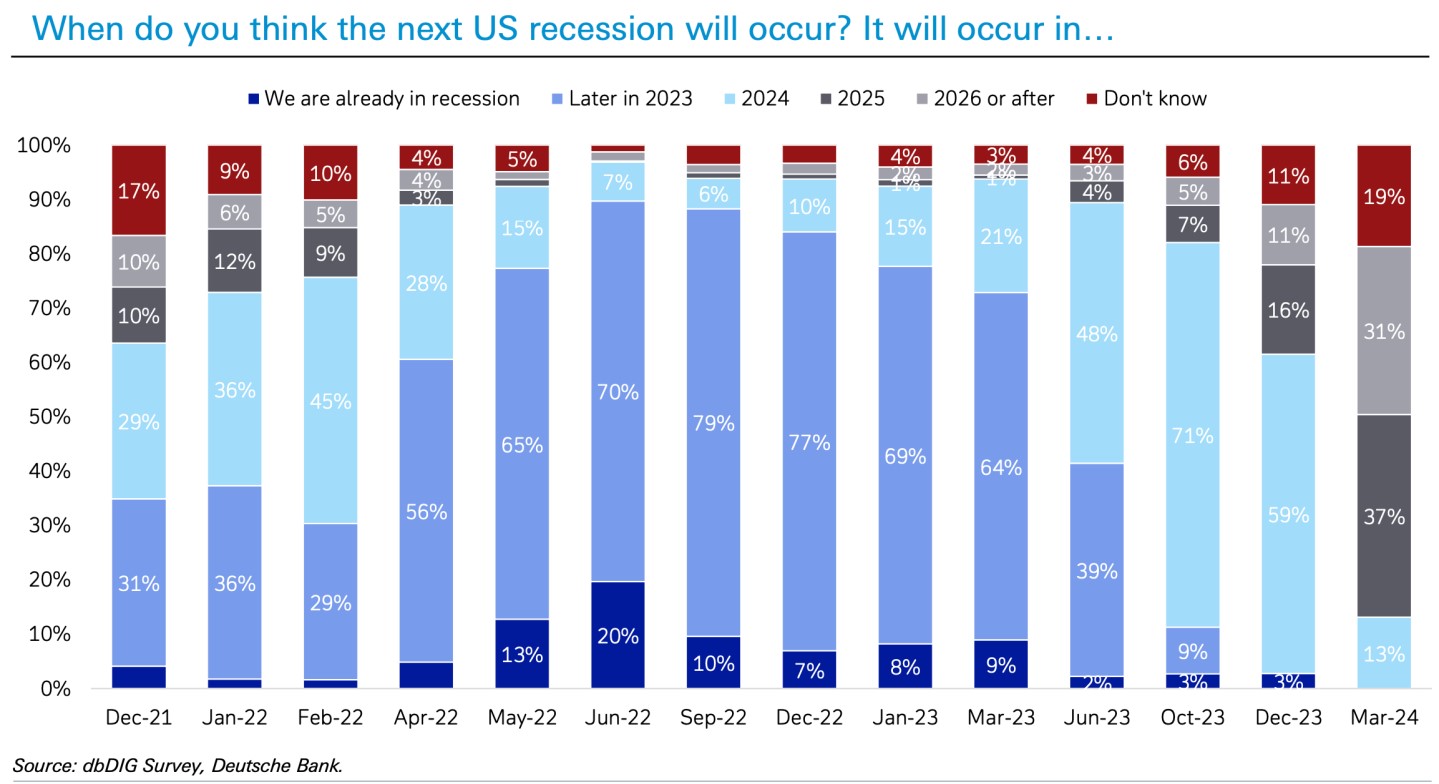
Figure 1 – When do economists think the next US recession will occur?, Source: DeutcheBank, 2024.
Before we dig into the current macroeconomic landscape it’s worth setting the scene by revisiting how macroeconomists expected the economy to perform both in 2023 and 2024’s first quarter. The chart above shows the percentages of economists that expect a US recession in given time periods, surveyed every quarter. Throughout 2023 the date of recession was pushed back ever further, from ‘later in the year’ out to ‘2024’. Now that we have arrived in 2024 expectations have moved out into 2025 and beyond. But why is this?
The most consequential data release was the Q4 2023 GDP data for the US, which surprised economists and investors, growing at an annualized rate of 3.4% . This has been reinforced by labour market data showing that hiring and wage growth remains strong, with the expectation that this will continue to support household consumption through 2024. The OECD now estimate the US economy to grow 1.5% in 2024, a far sight from the recession expected last year.
Economic growth outside of the US has been more sluggish, particularly in developed markets. Higher debt burdens in Europe have held governments back from the level of government investment seen in the US, while developed Asian economies are yet to see the full benefits of Chinese stimulus efforts. The OECD’s forecasts of economic growth in 2024 and 2025 for G20 economies can be seen below:
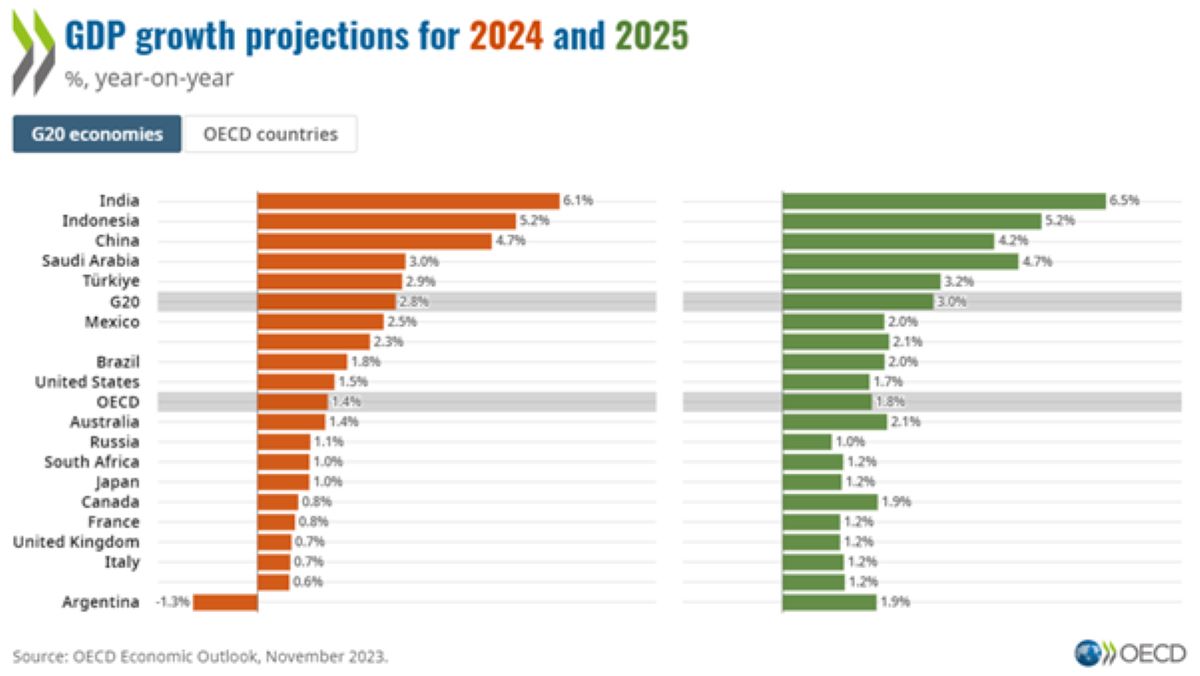
Figure 2 – GDP Growth projections for G20 and OECD countries, Source: OECD, 2024.
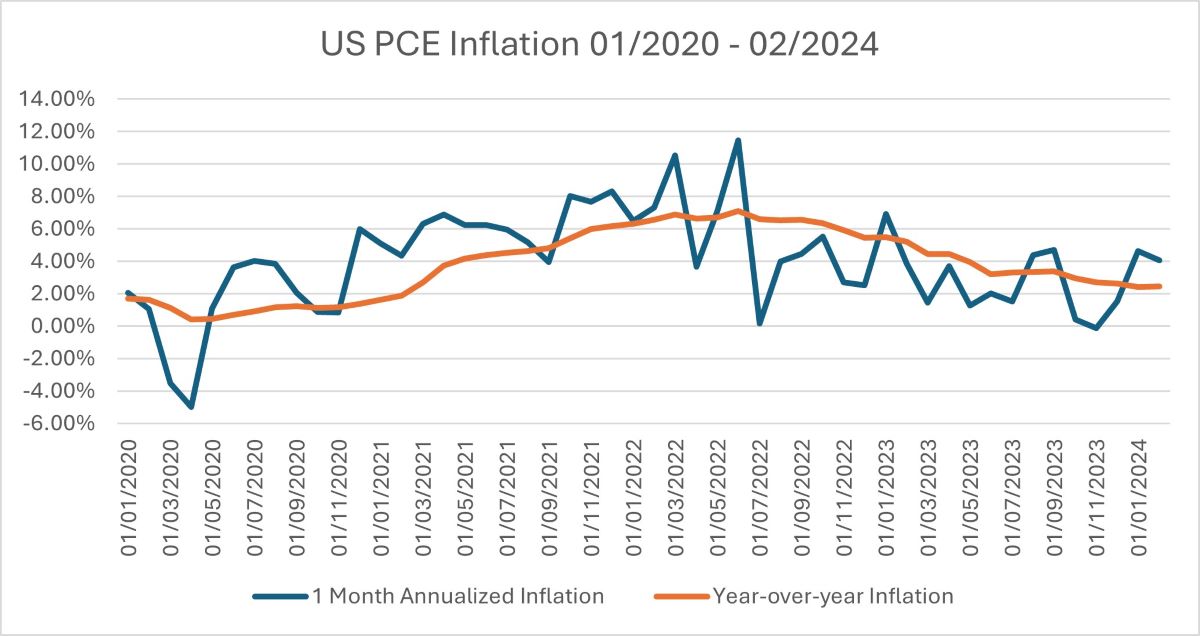
Figure 3 – US Inflation from 2020 – 2024, Source: Bureau of Economic Analysis, 2024.
The chart above shows the US inflation rate from 2020 through to the latest data release for February 2024. The orange line shows year-on-year inflation, while the blue line shows the inflation in a given month at an annualised rate, i.e. showing what the inflation rate would be for a whole year if it stayed at the pace of that month. Inflation data is fairly volatile from month to month, so the year-on-year figures are important in establishing trends, while the monthly data is useful in spotting where those trends may be changing course.
Two things stand out in the graph. Firstly, there has been a clear downward trend in inflation since July of last year. This has supported the Federal Reserve in guiding markets towards interest rate cuts in 2024. Secondly, inflation in the first two months of this year has accelerated above the year-on-year rate, running at an annualised rate of 4-4.5%. This second point has caused consternation among investors, who are becoming less certain that central banks will be able to cut interest rates in the first half of this year.
Markets – Fixed Income
That final point leads into the market performance of fixed income securities.
The price of a bond is inverse to the yield it pays, meaning rising bond yields cause falling bond prices (and thus capital values) and vice versa. As interest rate cut expectations are pushed further into the future and become less probable, the yield on bonds rises. This effect, of changes in interest rates and their expected future path on bond prices is called ‘duration risk’, and the effects of this risk are greater when a bond’s maturity is longer and the coupon (yield) it pays is smaller. Government bonds tend to have longer maturities, and owing to their security, tend to pay a smaller coupon (yield), making them highly susceptible to changes in interest rate expectations. At the other end of the spectrum, you find high yield corporate bonds, which tend to have a short maturity, and owing to their lower credit quality (i.e. higher credit risk) they pay a higher coupon. Thus, government bonds are more exposed to duration risk, high yield corporate bonds are more exposed to credit risk, and investment grade corporate bonds tend to sit in the middle on both risks.
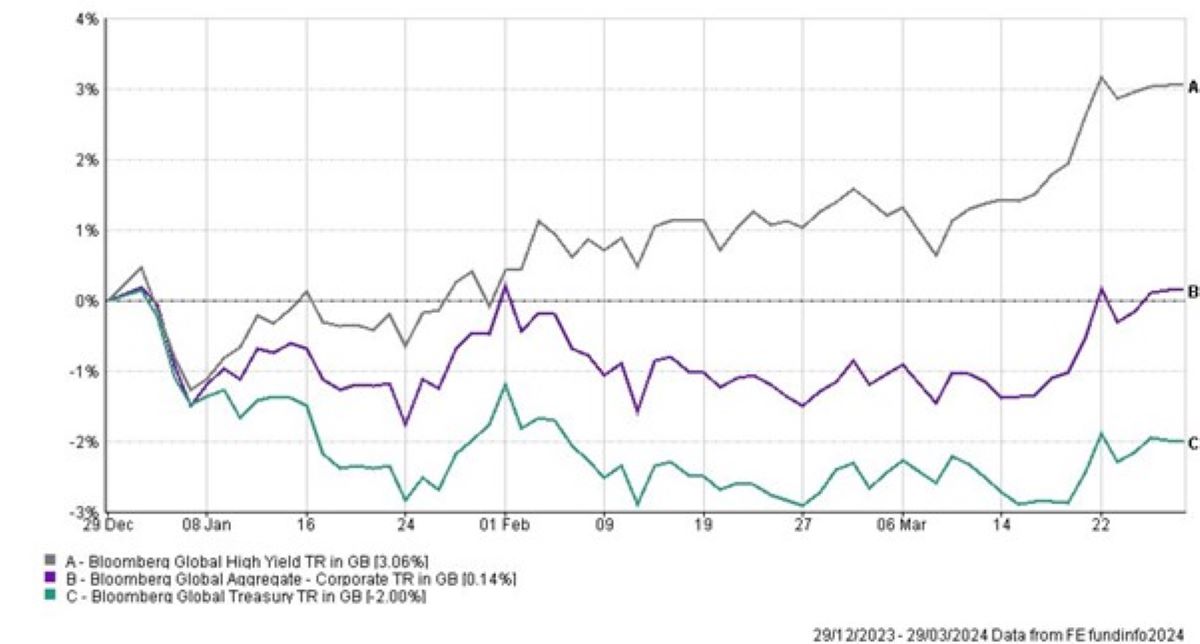
Figure 4 – High Yield, Investment Grade and Government Bond returns in Q1 2024, Source: FE Analytics, 2024.
The first quarter saw high yield corporate bonds (grey line) outperform both investment grade corporate bonds (purple line) and government bonds (turquoise line). Going back to the macroeconomics, we had strong economic growth and some signs of inflation ticking up, meaning economic growth can sustain corporate cashflows and stave off credit risks, while inflation worries cause interest rate expectations to rise and thus longer duration bonds to selloff. Investment grade corporate bonds and government bonds were those longer duration bonds that sold off.
Markets – Equities
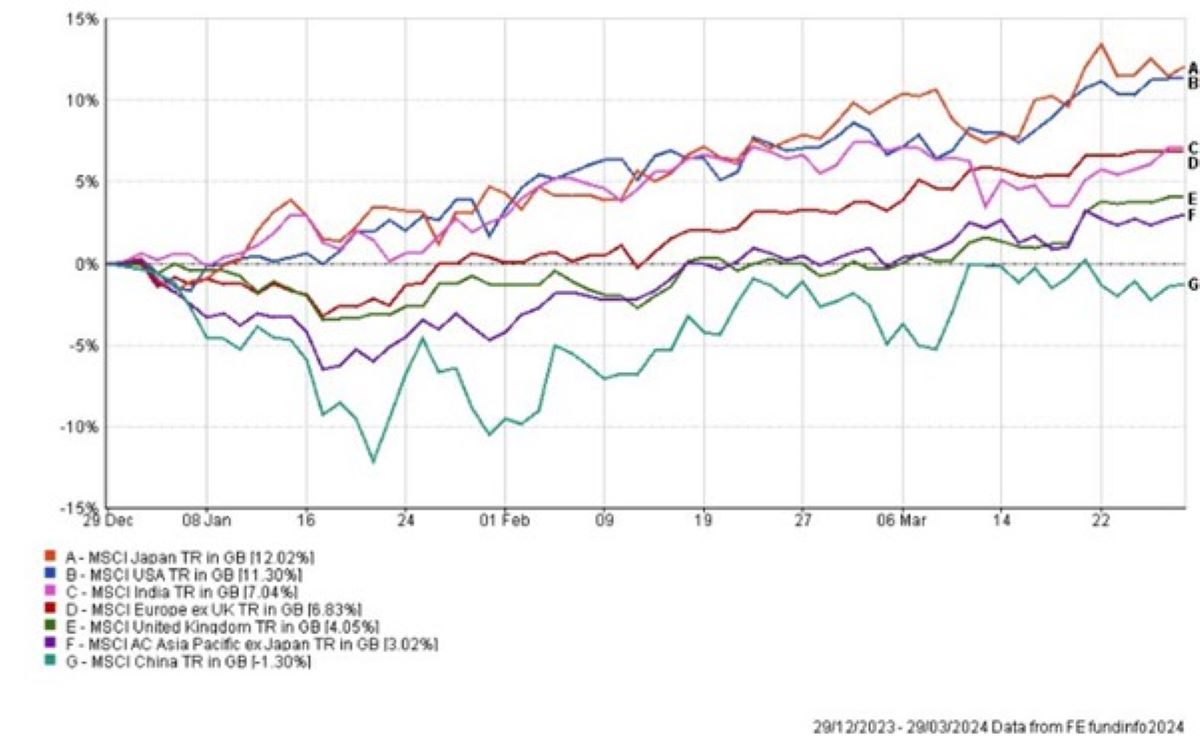
Figure 5 – Regional Equity Market Returns in Q1 2024, Source: FE Analytics, 2024.
Equity markets shrugged off the losses in government bonds and posted a strong quarter, with China being the only major region to see losses – a deflating property sector continues to weigh on corporate investment and household consumption. The strongest performance on a country basis was seen in Japan, propelled by a combination of robust corporate profit growth and favourable international investor sentiment. An interesting picture emerges when equity returns are broken down by sector, shown below.
Leading contributors
Time period: 01/01/2024 to 31/03/2024
| Rescaled weight | Return | Contribution | |
| Semiconductors | 7.28 | 34.53 | 2.32 |
| Software | 10.03 | 9.83 | 0.96 |
| Banks | 7.08 | 9.89 | 0.70 |
| Interactive media | 4.81 | 14.64 | 0.70 |
| Retail - Cyclical | 5.31 | 12.46 | 0.65 |
| Insurance | 3.97 | 13.50 | 0.52 |
| Oil & Gas | 4.33 | 10.59 | 0.46 |
| Drug manufacturers | 5.01 | 8.87 | 0.44 |
| Industrial products | 2.47 | 10.94 | 0.27 |
| Aerospace & defense | 1.56 | 15.64 | 0.24 |
| Credit services | 1,74 | 11.59 | 0.20 |
| Medical devices & Instruments | 2.03 | 9.52 | 0.19 |
| Media - Diversified | 0.99 | 19.57 | 0.18 |
| Retail - Diversified | 1.57 | 10.97 | 0.17 |
| Farm & Heavy construction machinery | 0.74 | 16.96 | 0.12 |
Figure 6 – Sector level contributions to global equity returns in Q1 2024, Source: Morningstar Direct, 2024.
The table above show industries, their weightings in global equity markets, the returns generated by those industries in Q1, and by multiplying their weight and returns shows their contribution to global equity market performance.
AI and semiconductors have driven market performance through 2023 and the first quarter, shown by semiconductors and software ranking top two in sector contribution. What has been interesting is the catchup of many of the ‘cyclical’ sectors that are sensitive to changes in economic conditions, these are the likes of banks, oil and gas producers, discretionary retailers, and industrial product manufacturers. These sectors had been fairly flat for the first two months of the year but staged a comeback in March following the release of data suggesting an upturn in the global manufacturing cycle and inflationary pressures.
Summary
Economic growth has been better than expected so far this year, particularly in the US.
Strong growth has underpinned rising inflation, which has held back government bond performance but supported returns in high yield corporate bonds.
Equity markets have been largely unphased by recent inflation data, with semiconductor and AI related stocks continuing to gain. However, towards the end of the quarter there has been a notable rotation into cyclical stocks that benefit from an economy that is heating up, both in terms of inflation and manufacturing growth.
As a client of either our discretionary or advisory portfolio service, your portfolios are positioned to capture remaining upside in the AI/semiconductor space, while retaining significant allocations to cyclical sectors through UK & European equities. Similarly, we remain vigilant to developments in bond (fixed interest) markets. Our asset class and sector/industry diversification aims to smooth out returns and ensure that our investors benefit from different investment opportunities throughout the economic cycle. If you have any questions about your portfolio please contact your adviser.
Arrange your free initial consultation
This market update is for general information only, does not constitute individual advice and should not be used to inform financial decisions.
Past performance is not a guide to future returns. Investment returns are not guaranteed, and you may get back less than you originally invested.
The question is when rather than if
This month we explore how investors might be rewarded for holding a diversified portfolio and whilst one cannot time the markets the outlook for asset prices remains positive this year.
Arrange your free initial consultation
Global Equity Performance
Last month was another strong month for equity markets with the S&P 500 reaching a record high as earnings for the “Magnificent 7” did not disappoint investors, a (long awaited) rebound in Chinese equities supported broader Asia, the Nikkei index in Japan reached a high not seen since December 1989 and European equities whilst underperforming relative to their US equity peers produced positive returns in the month (see Figure 1.).
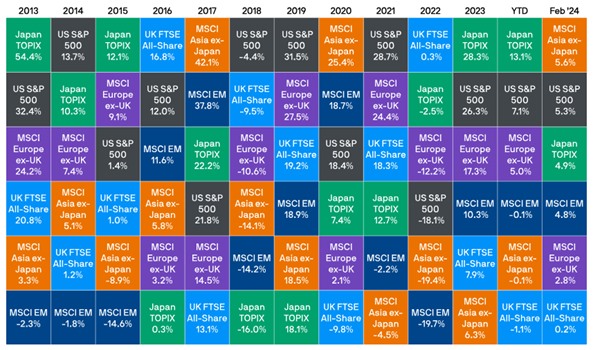
Figure 1. World Equity returns, Source: JP Morgan, 29th February 2024
In fixed income we saw positive returns from high yield (a form of riskier corporate debt and less sensitive to interest rate expectations given its low duration) which is no surprise considering the positive return in risk markets such as equities. US and European Government bonds were down in the month as stronger inflation data saw investors push back their expectations of a cut in interest rates, meanwhile continued strength in UK wage data saw the price of Gilts fall as investors also revised their expectations of when the Bank of England will cut interest rates (see Figure 2.).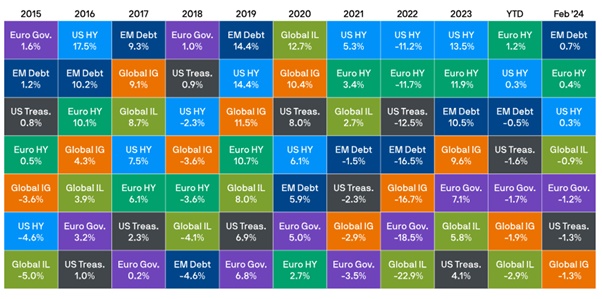
Figure 2. World Fixed Income returns, Source: JP Morgan, 29th February 2024
Diversification importance
Some of you reading this will have already noted that with equities going up in price and bonds falling in price, it means that the two asset classes exhibited negative correlation and offered investors the opportunity of diversification. That word (diversification) which has eluded investors in recent years as equities and bonds moved in tandem, going up together (most recently in October of last year) and falling together with the most notable example being in January 2022 when Central Banks reopened the quantitative tightening policy playbook and began to hike interest rates from historic lows.
As we move through this year the feature of ‘diversification’ and the idea that having exposure to multiple asset classes and regions is an optimal approach to one’s investment journey is something I expect to continue and will look to substantiate in this update. I’m cognisant though and to plagiarise the widely used quote that “history does not repeat but it rhymes”, it’s not as simple as to suggest simply repeating what was successful last time.
Interest rate expectations
Interest rates are expected to be cut this year as inflation data in the developed world has fallen materially from the highs of 2022. UK inflation in October 2022 was 11.1% and recently came in 4% year on year (which was even below analyst forecasts) and whilst the US - which has been the poster child for the soft-landing narrative - saw its most recent inflation print increase, this was to 3.2% which is a long way from the 9.1% inflation rate that was recorded in June 2022.
This sets the stage for a cut in interest rates which the market is anticipating will occur in Q2 of this year and with it the potential for bonds to reassume their rightful place as a diversifier in portfolios along with offering investors a positive return.
A fall in interest rates will also have implications for other asset classes. Money market funds which have attracted significant flows in recent times and have seen the Assets Under Management (AUM) in US money market funds reach c. $6.5tn (see figure 3.) will see their relative return fall as the interest on the funds is directly linked to the interest rate set by Central Banks. 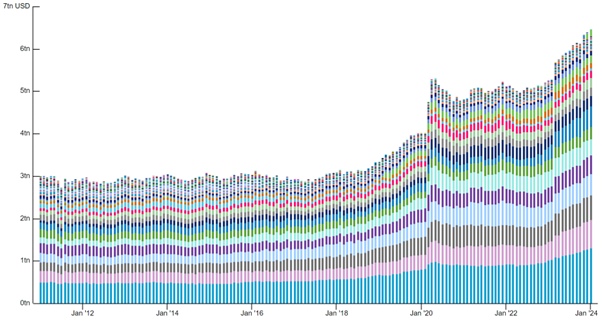
Figure 3. Total assets in US Money Market funds, Source: OFR Analysis, 31st January 2024
The question then posed is will the prospect of reinvestment risk (reinvesting one’s income at a lower rate than previously invested) see increased inflows in equity markets as investors look to achieve a higher return.
Research by Schroders showed that since 1928 there have been 22 interest rate cutting cycles in the US and that on average, equities have outperformed cash by 9% in the 12 months after the first cut in interest rates. Bonds have also typically outperformed cash with an average outperformance of 3%.
Regional opportunities
Referring to my earlier point about not repeating exactly what worked previously. Much has been made about the recent performance of the ‘Magnificent 7’ (see figure 4.) and the rich valuation of US equities compared to the broader US equity market. Whilst there are reasons to support the continued outperformance of these companies (high free cash flows, low levels of debt and durable business models) this is not the same as saying that all the other 493 listed companies in the S&P 500 or more broadly non-US equites will underperform.
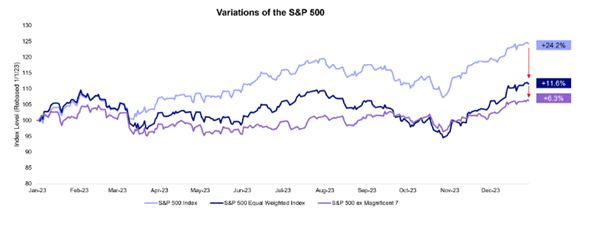
Figure 4. Performance of the ‘Magnificent 7’, S&P 500 index, S&P 500 equally weighted index last year, Source: OFR Analysis, 31st January 2024
US exceptionalism – the idea that the US economy has better relative growth, more dynamic financial markets and a strong currency – has long been touted as a reason for the continued outperformance of the US equity market and whilst this is certainly one reason, there are a number of reasons to think we may see this exceptionalism wane at least in the short term.
This is in part due to the fact that the market is pricing in a soft landing in the US and that the Federal Reserve has been able to implement the ‘perfect policy’ (I remain sceptical) but also that investors remain pessimistic on the outlook for other regions.
Leading economic indicators in Europe are beginning to trend up, global factory activity is increasing, and investors are beginning to reassess their view on equities outside of the US specifically given the divergence of European equities compared to US equities. Another potential opportunity lies in Japan where corporate governance reforms and interventions from the regulator will likely see continued support for Japanese equity markets and there looks to be continued price upside considering that the market trades on a cheaper valuation to its global peers (see Figure 5.). 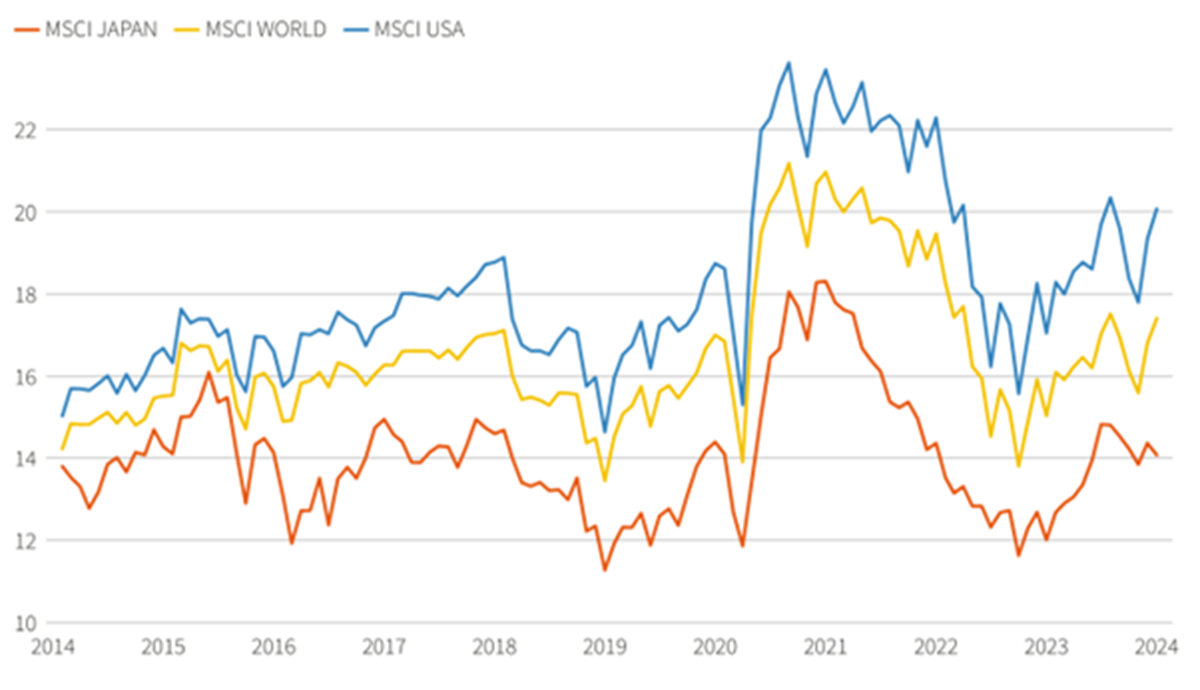
Figure 5. Forward Earnings of equity markets, Source: LSEG & Reuters, 23rd February 2024
Conclusion
Putting all of this together suggests that investors will be rewarded for holding a diversified portfolio and whilst one cannot time the markets the outlook for asset prices remains positive this year.
If you would like to speak to your adviser about this, or have any other questions please don’t hesitate to get in touch.
Arrange your free initial consultation
This market update is for general information only, does not constitute individual advice and should not be used to inform financial decisions.
Past performance is not a guide to future returns. Investment returns are not guaranteed, and you may get back less than you originally invested.

Spring Budget 2024
The Spring Budget 2024 confirmed some rumours, such as the introduction of a British ISA, and at the same time, contained a few surprises too.
The main points are summarised below along with a reminder of some of the other changes coming into effect in April 2024.
Some measures are potentially subject to change until enacted into legislation.
If you have any questions or would like to speak to one of our expert financial advisers about the changes announced, contact us to arrange a free initial consultation.
Arrange your free initial consultation
Pensions
Abolition of Lifetime Allowance (LTA) from 6 April 2024
A further Pension Schemes Newsletter / Lifetime Allowance Guidance Newsletter is expected this week but no further detail was issued as part of the Budget itself. Further information will be issued once it’s available.
State pension
Triple lock means new state pension and basic state pension will increase by 8.5% in April 2024. Full new state pension figure will be £221.20 per week.
Investments
Individual Savings Accounts (ISA)
The annual subscription limits all remain at their current levels in 2024/25, i.e.
- £20,000 ISA
- £4,000 Lifetime ISA
- £9,000 Junior ISA (and Child Trust Fund)
A new British ISA is to be introduced from a date to be confirmed. This will give investors an additional £5,000 ISA allowance each tax year, so on top of the current £20,000. There is a consultation paper in place to obtain feedback from ISA managers, but the idea is for allowable investments to include UK equites and potentially UK corporate bonds, gilts, collectives.
As previously announced at the Autumn Statement, the government is to make changes to ISAs to simplify the scheme and widen the scope of investments that can be included in ISAs. To simplify the scheme the government will:
- Allow multiple subscriptions in each year to ISAs of the same type, from 6 April 2024
- Remove the requirement to make a fresh ISA application where an existing ISA account has received no subscription in the previous tax year, from 6 April 2024
- Allow partial transfers of current year ISA subscriptions between providers, from 6 April 2024
- Harmonise the account opening age for any adult ISAs to 18, from 6 April 2024
- Digitise the ISA reporting system to enable the development of digital tools to support investors
Reserved Investor Fund
The Reserved Investor Fund is a new type of investment fund designed to complement and enhance the UK’s existing funds rule. This meets the industry demand for a UK-based unauthorised contractual scheme, with lower costs and more flexibility than the existing authorised contractual scheme. The introduction date is still to be confirmed.
Taxation
Income tax
All income tax rates and bands remain at their current levels in 2024/25. See our latest tax tables 2024/25.
National insurance (NI)
National Insurance is paid by people between age 16 and State Pension age who are either an employee earning more than £242 per week from one job or self-employed and making a profit of more than £12,570 a year.
Following on from the NI cuts made in the Autumn Statement when the 12% rate of employee NI reduced to 10% from January 2024, the government is cutting the main rate of employee NI by 2p from 10% to 8% from 6 April 2024.
They are also cutting a further 2p from the main rate of self-employed National Insurance on top of the 1p cut announced at Autumn Statement and the abolition of Class 2.
This means that from 6 April 2024 the main rate of Class 4 NICs for the self-employed will now be reduced from 9% to 6%.
Child Benefit charge
The adjusted net income threshold for the High Income Child Benefit Charge (HICBC) will increase from £50,000 to £60,000, from 6 April 2024.
For individuals with income above £80,000, the amount of the tax charge will equal the amount of the Child Benefit payment. For those with income between £60,000 and £80,000, the rate at which HICBC is charged is halved, and will equal one per cent for every £200 of income that exceeds £60,000.
New claims to Child Benefit are automatically backdated by three months, or to the child’s date of birth (whichever is later). For Child Benefit claims made after 6 April 2024, backdated payments will be treated for HICBC purposes as if the entitlement fell in the 2024/25 tax year if the backdating would otherwise create a HICBC liability in the 2023/24 tax year.
In his Budget speech, the Chancellor announced that the plan is to move assessment for the HICBC to a system based on household income from April 2026. This is to remove the current unfairness meaning that a couple who each have income below the threshold, so could in 2023/24 have £49,000 pa each (£98,000 pa in total), wouldn’t be subject to the HICBC whereas another household with one person with income of £51,000 for example would.
Dividend allowance
As we are already aware, the dividend allowance reduces from £1,000 to £500 on 6 April 2024. Dividend tax rates remain the same at 8.75% in basic rate band, 33.75% in higher rate band and 39.35% in additional rate band (and 39.35% for discretionary trusts).
Arrange your free initial consultation
Capital gains tax (CGT)
Annual exemption reduces from £6,000 to £3,000 on 6 April 2024 (a maximum of £1,500 for discretionary/interest in possession trusts – shared between all settlor’s trusts subject to a minimum of £600 per trust).
CGT rates remain as they currently are apart from the higher CGT rate for residential property gains (the lower rate remains at 18%):
- 10% for any taxable gain that doesn’t fall above the basic rate band when added to income and 20% on any gain (or part of gain) that falls above the basic rate band when added to income
- For residential property gains these rates increase to 18% and 24% (formerly 28%) respectively
- Discretionary/interest in possession trustees and personal representatives pay at the higher rates (20%/24% (formerly 28%))
Simplifications for trusts and estates
From April 2024 trustees and personal representatives of estates will no longer have to report small amounts of income tax to HMRC and taxation of estate beneficiaries will be simplified, as shown below:
- Trusts and estates with income up to £500 will not pay tax on that income as it arises
- The £1,000 standard rate band (effectively basic rate band) for discretionary trusts will no longer apply
- Beneficiaries of UK estates will not pay tax on income distributed to them that is within the £500 limit for the personal representatives
Stamp duty land tax (SDLT)
SDLT Multiple Dwellings Relief is being abolished from 1 June 2024. This applies to purchasers of residential property in England and Northern Ireland who acquire more than one dwelling in a single transaction or linked transactions.
Changes to the taxation of non-doms
The concept of domicile is outdated and incentivises individuals to keep income and gains offshore. The government is therefore modernising the tax system by ending the current rules for non-UK domiciled individuals, or non-doms, from April 2025. A new residence-based regime will take effect from April 2025.
From April 2025, new arrivals, who have a period of 10 years’ consecutive non-residence, will have full tax relief for a 4-year period of subsequent UK tax residence on foreign income and gains (FIG) arising during this 4-year period, during which time this money can be brought to the UK without an additional tax charge.
Existing tax residents, who have been tax resident for fewer than 4 tax years and are eligible for the scheme, will also benefit from the relief until the end of their 4th year of tax residence.
Liability to inheritance tax (IHT) also depends on domicile status and location of assets. Under the current regime, no inheritance tax is due on non-UK assets of non-doms until they have been UK resident for 15 out of the past 20 tax years. The government will consult on the best way to move IHT to a residence-based regime. To provide certainty to affected taxpayers, the treatment of non-UK assets settled into a trust by a non-UK domiciled settlor prior to April 2025 will not change, so these will not be within the scope of the UK IHT regime. Decisions have not yet been taken on the detailed operation of the new system, and the government intends to consult on this in due course.
Furnished holiday lets (FHL)
The FHL tax regime, which relates to short-term rental properties, is to be abolished from April 2025.
Currently, if an individual lets properties that qualify as FHLs:
- The profits count as earnings for pension purposes
- They can claim Capital Gains Tax reliefs for traders (Business Asset Rollover Relief, relief for gifts of business assets and relief for loans to traders)
- They’re entitled to plant and machinery capital allowances for items such as furniture, equipment and fixtures
Raising standards in the tax advice market
A consultation has been issued to discuss the government’s intention to raise standards in the tax advice market through a strengthened regulatory framework. It sets out three possible approaches to strengthening the framework: mandatory membership of a recognised professional body, joint HM Revenue and Customs (HMRC) – industry enforcement, and regulation by a separate statutory government body. The consultation also explores approaches to strengthen the controls on access to HMRC’s services for tax practitioners.
This has relevance to anyone who may receive or provide tax advice or offers services to third parties to assist compliance
with HMRC requirements. For example, accountants, tax advisers, legal professionals, payroll professionals, bookkeepers, insolvency practitioners, financial advisers, customs intermediaries, charities and other voluntary organisations that help people with their tax affairs, software providers, employment agencies, umbrella companies and other intermediaries who arrange for the provision of workers to those who pay for their services, people who engage workers off-payroll, promoters, enablers and facilitators of tax avoidance schemes, professional and regulatory bodies, and clients, or potential clients, of all those listed above.
The consultation runs until 29 May 2024.
VAT
The VAT threshold is increasing from £85,000 to £90,000 from 1 April 2024, the first increase in seven years. See our tax tables 2024/25 for more details. See our tax tables 2024/25 for more details.
If you’d like to discuss any of the changes announced in the Budget or would simply like to explore ways that you can minimise the amount of tax you pay on your wealth, why not get in touch and speak to one of our expert team of advisers. We’re offering anyone with £100,000 in savings, investments or pensions a free financial review worth £500.
Arrange your free initial consultation
This article is intended for general information only, it does not constitute individual advice and should not be used to inform financial decisions.
The Financial Conduct Authority (FCA) does not regulate tax advice.